Around the World with Beyondia 🧵 Mediterranean Region 🪡 Episode 13
Naxos isn’t the island tourists pick first. That’s exactly why it still feels like this.
Naxos invented the habit of carving teh stone
The Parthenon is made of Pentelic marble from a mountain outside Athens. That is the school answer, and it is not wrong. The more interesting answer is that Athens did not know how to carve marble until a small island in the middle of the Aegean taught it. In the third millennium BC — more than two thousand years before Pericles built anything — the sculptors of Naxos were already producing the minimalist white figurines now known to every major museum in the world as Cycladic art. Small female forms, arms folded across the chest, faces reduced to a single ridge of nose, proportions abstract enough that when Picasso, Modigliani, and Brancusi encountered them in the early twentieth century they rearranged their own work around the encounter. Those figurines were carved on Naxos, from Naxian marble, using techniques Naxian stonemasons developed five thousand years ago. By the time Athens began thinking about the Parthenon in the fifth century BC, Naxian marble was already the Aegean standard. The lions on Delos are Naxian marble. The kouroi statues scattered across the Greek world are Naxian marble. Naxos did not just supply the stone. Naxos invented the habit of carving it.
This is the oldest island in the Cyclades in almost every meaningful sense. It is the largest by area, at around 430 square kilometres. Its highest point, Mount Zas, rises to 1,004 metres — the tallest peak in the Cyclades, and named, inevitably, for Zeus, who was said in local mythology to have been raised in a cave on its slopes before descending to Olympus to take his throne. The island has been fertile enough, for long enough, to matter for something more than beauty. Naxos grows its own food. Naxos makes its own cheese — graviera and arseniko, both of which are Protected Designation of Origin products you cannot legally call by their names unless they were made here. Naxos distils kitron, a bright-yellow liqueur made from citron leaves, a fruit grown almost nowhere else on the European continent. In a sea where most islands are aesthetic and almost none are self-sufficient, Naxos is the grown-up in the room.
The sunset ruin everyone photographs is called the Portara. It sits on the small islet of Palatia, connected to Naxos Town by a short stone causeway the island built during the Venetian centuries. The Portara is a doorway. Just a doorway. Six metres tall, four massive blocks of Naxian marble fitted together without mortar, facing the open sea. It is all that remains of a temple to Apollo begun around 530 BC by the local tyrant Lygdamis, who was overthrown in 524 BC before the temple could be finished. The construction stopped where it was. Over the course of the next twenty-five hundred years, the rest of the temple’s marble was quietly carried away by Naxians and Venetians and Ottomans who had walls to build and churches to repair. The doorway was too large, too heavy, and too precisely cut to be disassembled by hand. So it stayed. Every other Greek ruin you can think of is a temple that has slowly lost pieces of itself. The Portara is a temple that was never there in the first place, standing permanently open onto the sea it was supposed to face. A threshold without a room. The most enduring architectural feature of ancient Naxos is something the ancient Naxians did not finish.
Inland, on a rise above the town, the medieval Kastro still stands — a Venetian fortified quarter built by Marco Sanudo in 1207, when Naxos became the capital of the Duchy of the Archipelago. For three hundred years, a small family of Italian dukes ran most of the Cyclades from inside this citadel, speaking Italian in their courtyards while the island below them spoke Greek. When the Ottomans took over in 1564, the dukes simply stayed, converted where necessary, and kept running the place in a slightly different language. Within the Kastro walls today, fifteen families still live in houses that have been handed down, mother to daughter, since before Columbus sailed. The family crests are still carved above the doorways. An old woman sells homemade marmalade from a stone bench near one of them, under a Venetian coat of arms her great-great-grandmother pointed at and called my grandfather’s.
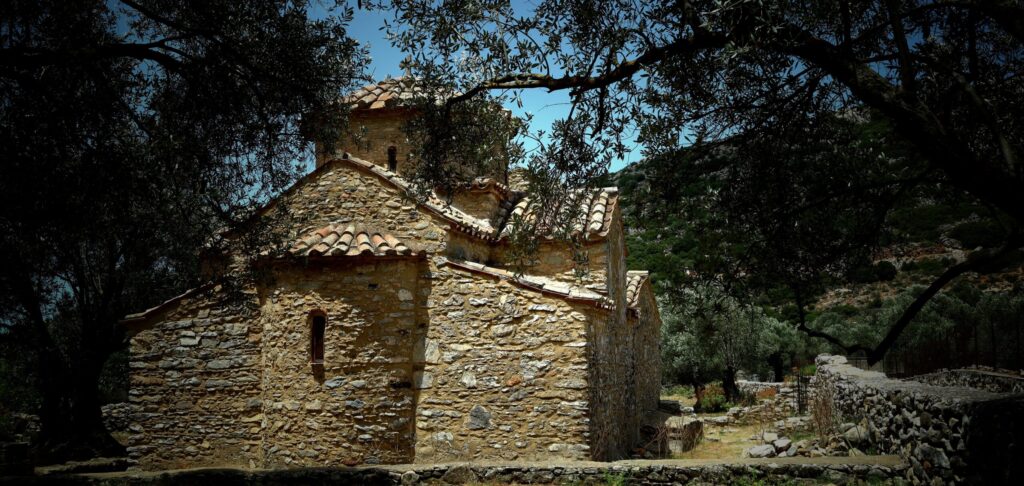
Most islands of the Cyclades run downhill toward a harbour and a few tavernas. Naxos runs uphill — through farmland, through medieval villages whose names are older than their churches, past olive groves, through the marble-quarry villages of Apeiranthos and Filoti, toward Mount Zas and the cave where Zeus, supposedly, grew up. Halki, the old inland capital, still has a general store and a kitron distillery that have both been in the same family for the same number of generations. The island’s interior is not a tourist detail. It is the island. The coast is where the visitors stay. The interior is where the island lives.
Some islands live on their looks. Naxos lives on its work. For five thousand years, Naxians have carved marble, grown food, distilled liqueur, raised children, and watched newer, louder, prettier islands take all the photographs. The island has not minded. The people who come to Naxos tend to come back. The people who come to take a selfie in front of the Portara and leave have, in some small but real way, confirmed the Portara’s original function — a threshold you stand inside for a moment, and then walk through, and keep going.
Nine regions. One hundred and twenty destinations. Three hundred and forty-eight weeks remaining.
Some islands ask to be photographed. The best ones ask to be lived in.

Beyondia
Trusted Travel CompanionReal digital nomad. I travel. I learn. I grow.
What about you? Where are you going?