🌐 Around the World with Beyondia 🧵 Mediterranean Region 🪡 Episode 31: Corsica
Napoleon Bonaparte was born on a French island whose first language was Italian, fourteen months after the island had been French at all.
Corsica — Sold to the Kingdom of France
On the 15th of August 1769, in the small port town of Ajaccio on the western coast of a mountainous Mediterranean island, a child was born to a minor noble family of Corsican origin. The father was Carlo Buonaparte, a lawyer and former secretary to Pasquale Paoli, the leader of the recently-extinguished Corsican Republic. The mother was Letizia Ramolino, eighteen years old, of Genoese descent on her mother’s side. The family spoke Corsican-Italian at home, attended mass in Latin, signed legal documents in Italian, and held property by Genoese-Italian customary law. The child was baptised Napoleone Buonaparte. He spoke not a word of French. The island on which he was born had been French for fourteen months and three weeks. In May 1768, the Republic of Genoa — which had ruled Corsica for over four centuries but had effectively lost control of it to a Corsican independence movement under Paoli — sold the island to the Kingdom of France under the Treaty of Versailles for an unpaid debt. French troops landed shortly afterwards. They defeated Paoli’s republican forces at the Battle of Ponte Novu in May 1769. Paoli fled into exile in London. Corsica, which had been independent for fourteen years, was incorporated into France. Three months later, in a town that had been French for the entire period since the surrender, Napoleon was born.
The man who would, within thirty years, become Emperor of the French — who would rewrite the legal system of half a continent, who would establish the metric system as the modern international standard, who would design the modern French administrative state that the Fifth Republic still runs on, who would crown himself in Notre-Dame in front of a Pope, and who would reshape the political geography of Europe so thoroughly that the Congress of Vienna spent nine months trying to undo his work — was, by birth, language, cultural formation, and political accident, an Italian-speaking subject of Genoa who had become French only because his island had been sold while his mother was pregnant. He was sent to mainland France at the age of nine to attend the military academy at Brienne-le-Château, where he learned French as a foreign language and was reportedly mocked by classmates for his accent. He continued to write in Italian in his personal correspondence into his early twenties. He italicised his name as Napoleone Buonaparte in his earliest published essays. The francisation of his name to Napoléon Bonaparte came only in 1796, when he was twenty-six and already a successful French general. The single most consequential figure in modern French history was, in his first ten years of life, not French. Most casually-informed readers do not carry this fact. It changes a great deal of what follows.
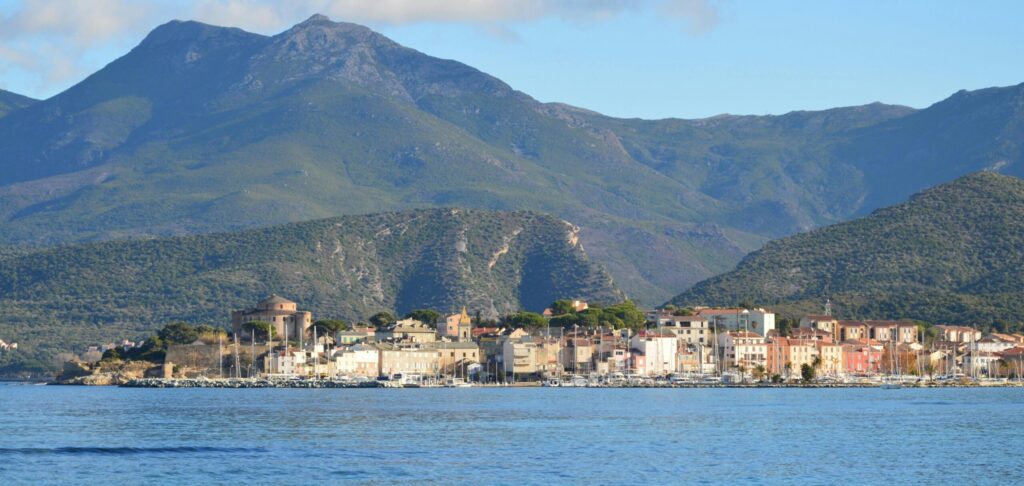
This is not a small detail. It is the foundational fact about Corsica and the article’s deepest argument. The island is geographically much closer to Italy than to France — ninety kilometres of open sea separates the southern Corsican coast from northern Sardinia, and one hundred and seventy kilometres separates the eastern Corsican coast from Tuscany. The French mainland is two hundred kilometres west, across the much rougher waters of the Ligurian Sea. The native language of Corsica — u Corsu — is a Tuscan-derived Romance language, mutually intelligible with the dialects of northern Sardinia and southern Tuscany, and significantly more distant from standard French than from standard Italian. Corsican was the household language of the island until well into the twentieth century, and remains widely spoken, especially in the interior villages. Corsican family names — Buonaparte, Colonna, Pozzo di Borgo, Ornano, Casanova, Sebastiani — are largely Italian in form. The cuisine is Mediterranean rather than French: chestnut-flour bread, ewe’s-milk cheeses (brocciu, tomme corse), cured meats like figatellu and coppa, wild boar stew, mountain honey, red wines from native grape varieties (Sciaccarellu, Niellucciu) found nowhere else in the world. The architecture of the inland villages — stone houses with terracotta roofs, hilltop chapels, watchtowers along the coast — is Mediterranean rather than French. The geography is granite peaks rising to over 2,700 metres (Monte Cinto, the highest, is 2,706 metres) covered halfway down with the dense aromatic scrubland called macchia. This is not a French island that happens to be in the Mediterranean. This is a Mediterranean island that has spent the last two and a half centuries arguing, with various degrees of intensity, with the country that bought it.
Before the French bought it, the island had its own republic. The Corsican Republic was declared in 1755 by Pasquale Paoli, a Corsican general who had spent his youth in exile in Naples studying philosophy, law, and military strategy. Paoli was thirty when he returned to lead the Corsican independence movement against four centuries of Genoese rule. Within five years he had effectively driven the Genoese out of the interior of the island and confined them to a handful of coastal garrisons. In 1755, his government promulgated the first written constitution of the modern era — a thirty-two-article document establishing a republic with a directly elected legislature (the Diet), separation of executive and judicial powers, universal adult male suffrage (including for the propertyless, an extraordinary provision for the eighteenth century), and a judicial system with rights to trial and appeal. The constitution explicitly invoked the principle that sovereignty resided in the people. The U.S. Constitution would not be drafted for another thirty-two years. The French Revolution would not begin for another thirty-four. The Corsican Republic was, for its fourteen-year lifespan, one of the most genuinely democratic states in the eighteenth-century world. Paoli also founded the University of Corsica at Corte in 1765 — closed by the French in 1769, reopened by the French Republic in 1981 — and established a free press, a national mint, and a national navy with a few light frigates.
In 1765, a young Scottish lawyer and travel writer named James Boswell visited Corsica on a deliberate diplomatic mission to meet Paoli. Boswell was twenty-five. He spent six weeks with the Corsican general, conducted long conversations with him in Italian, and returned to Britain to write An Account of Corsica, the Journal of a Tour to that Island, and Memoirs of Pascal Paoli, published in 1768. The book was an international sensation, translated within a year into French, German, Dutch, and Italian. It made Paoli a celebrity across the Enlightenment world. Voltaire and Rousseau both corresponded with him. The young American revolutionaries — John Adams in particular — cited Paoli’s Corsican constitution as a model for the kind of free republic they imagined establishing. The town of Paoli, Pennsylvania, was named for him in 1769. There are roughly thirty places in the United States today called Paoli — Pennsylvania, Indiana, Oklahoma, Colorado, several others — almost all named in the eighteenth century after a Corsican general who governed a Mediterranean island for fourteen years and then was forced into exile in London, where he died in 1807 and is buried in the Old Saint Pancras Cemetery alongside a stained-glass window paid for by the British Crown.
Then, in 1768, the Republic of Genoa — which had effectively lost the island but still nominally claimed it — sold Corsica to the Kingdom of France in exchange for the cancellation of accumulated debts. The price was approximately two million livres. The Genoese got out of an unwinnable colonial war. The French got an island with strategic harbours and a population that did not want them. Paoli was defeated at Ponte Novu in May 1769 and fled. The republic ended. Three months later, in Ajaccio, in a household that had supported Paoli to the last, Napoleon was born. His father Carlo had been a Paoli loyalist; he switched allegiance to the French only when the war was lost, and then quickly enough to retain his minor noble standing under the new regime. The Buonaparte family registered themselves as French. The son who would, twenty-six years later, lead French armies across Europe, was the direct product of this transition — born to a household that had been part of one of the earliest modern democracies, and which had become French by reluctant administrative necessity in the final months before his birth.
The island has had a complicated relationship with France ever since. The First French Republic granted Corsica administrative privileges in 1793. Paoli, back from exile, briefly led a separatist government from 1794 to 1796 with British naval protection — the Anglo-Corsican Kingdom, with George III as nominal sovereign, a Westminster-style parliament at Corte, and Paoli as effective head of state. The British withdrew when Napoleon’s Italian campaign threatened them. Paoli was exiled to London a second time. The island returned to France. Napoleon, by then ascendant, did not return home; he spent the rest of his life avoiding Corsica, which had spurned him during his brief flirtation with Corsican nationalism in the early 1790s. The island spent the nineteenth century under direct French administration, was occupied by Italian forces during the Second World War for fifteen months, was liberated in October 1943 — the first French department to be liberated — and has been part of metropolitan France ever since. The Corsican independence movement re-emerged in the late 1960s and remains active. The Front de Libération Nationale Corse conducted a low-intensity violent campaign for decades; a ceasefire in 2014 effectively ended the violence, but the political demand for autonomy or independence remains a significant feature of the island’s politics. In a referendum in 2003, Corsicans narrowly rejected even greater administrative autonomy, in a vote that revealed the deeply divided character of the island’s relationship to France. The current statutory regime gives Corsica a special administrative status with its own elected assembly and an extended set of regional powers, but it is not autonomous in the sense that Sardinia, Sicily, or South Tyrol are. The argument is ongoing.
The Corsican flag — adopted officially by the regional government in 1980, but used informally for far longer — is a single black Moor’s head on a white field, his blindfold raised above his forehead so that his eyes look outward across the page. The flag is closely related, in heraldic origin, to the Sardinian Bandiera dei Quattro Mori — both date from the medieval Crown of Aragon’s iconography of victory over Moorish enemies — but the meaning Corsicans have assigned it is entirely their own. The Moor was originally depicted blindfolded; Paoli, in 1755, raised the blindfold above the eyes as a symbolic statement of national consciousness. The flag’s message, in the Corsican reading, is that the island has finally opened its eyes. The interpretation is the same as the Sardinian: the conqueror sees nothing; the islander sees out. Two Mediterranean islands, separated by ninety kilometres of water, both ruled in turn by every Mediterranean empire that ever existed, both having ended up under the flags of the larger nation-states adjacent to them, both flying versions of the same heraldic image with the same political meaning. The neighbours recognise each other.
Napoleon, in exile on Saint Helena in the years before his death in 1821, was asked once how he could recognise Corsica from far out at sea. He answered, according to his memoirist Las Cases, that he could recognise it by smell — by the scent of the macchia, the dense fragrant scrubland of myrtle, juniper, rosemary, lentisk, and cistus that covers nearly half the island and releases its aromatic oils into the air, drifting kilometres out over the Mediterranean on hot summer afternoons. The macchia is, in many ways, the island’s most distinct possession. It is what every Corsican carries away with them and what every returning Corsican smells first, from the deck of the ferry approaching Bastia or Ajaccio, before any village or harbour is in sight. The vegetation, like the language, like the constitution, like the family names, is older than the political accident that made the island French. The republic that produced America’s revolutionaries was Corsican. The constitution that predates the U.S. one by thirty-two years was Corsican. The man who reshaped Europe in the early nineteenth century was Corsican. The flag has been raised, eyes open, for two hundred and seventy years.
Some islands are part of countries. This one was sold to one, and has been arguing with the receipt ever since.
Nine regions. One hundred and twenty destinations. Three hundred and thirty weeks remaining.
The journey reaches the French mainland. The next stop is the Promenade des Anglais — built by the English, named for the English, in a town that was Italian for most of its history.

Beyondia
Trusted Travel CompanionReal digital nomad. I travel. I learn. I grow.
What about you? Where are you going?