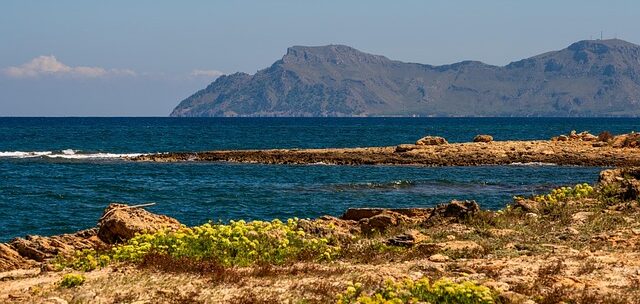
The ferry from Bastia crossed the Mediterranean night. I stood on the deck until the lights of Corsica became uncertain and then became nothing, and the sea was dark in every direction. Somewhere behind me, the island was still releasing the smell of its hills into the water — myrtle, rosemary, thyme, the dense wild perfume the French call maquis — and I understood for the first time that I had arrived at a place through a sense I could not carry.
I could describe a scent. I had done it many times. But carrying one — holding it inside language the way language holds a colour or a shape or a fact — was not possible. The maquis had arrived before the island was visible, entering through the body before the mind had anything to work with.
The first Mediterranean moment — Corsica
I had driven the western coast that afternoon. The Calanques de Piana were red — not the ochre of Roussillon that I would see later but a deeper mineral red, the colour of granite that has been oxidising for millions of years. The cliffs fell vertically into turquoise water. The road clung to them without guardrails.
I stopped at a pullover and got out and stood at the edge and the wind carried the maquis up from the scrub below and I breathed it and could not write it down.
Not could not in the way the caldera had defeated my language in Santorini — where the scale exceeded what words were designed to hold. This was different. This was a sense that did not convert. Sight converted to description fluently. Sound converted adequately. Touch, temperature, texture — I could approximate all of these. But scent arrived and remained itself. It did not become words. It remained rosemary and salt and warm stone and the particular sweetness of cistus in the afternoon sun, and no sentence I constructed would deliver it to someone who was not standing here breathing it.
I drove the rest of the coast to Bonifacio in silence, windows down, letting the air carry what my language could not.
Nice arrived the next morning in white light.
The ferry docked and the city was immediately there — the Promenade, the old town, the hill of the Château against a sky so clear it looked like it had been cleaned overnight. After Corsica’s red granite darkness, the white limestone of Nice was almost aggressive in its brightness. Different lights of Mediterranean.
I had not planned to drive the Grande Corniche. I had planned to stay in the old town, to walk the Cours Saleya market, to eat socca from a street stall and do the things the Explore guide suggested.
But someone at breakfast mentioned the road above Monaco, and I went.
The second Mediterranean moment — Nice, the Grande Corniche
The road climbed to five hundred metres above the sea. The view opened — Nice behind me, Cap Ferrat below, Monaco a dense white cluster on its promontory, the Mediterranean stretching south and east toward all the places I had already been.
I pulled over at a point where the road widened and the view was complete and I stood there for a long time.
Matisse had lived down there. In a room with a window that faced the light. He had sat in that room and painted what the light did to the objects it fell on — a tablecloth, a vase, the view through the glass. He had not painted the light itself. He had painted what the light changed.
I understood something standing above his city that I had not understood from inside any museum.
The painters who came here did not describe the light. They responded to it. A painting was not a record of what was seen. It was an answer — the painter’s nervous system reacting to what entered through the eyes and producing something that had not existed before the looking.
I had been describing for the entire journey. Carefully, accurately, thoroughly. I had described Rome and Dubrovnik and Athens and the pyramids and the tombs and the temples. Every description was faithful to what I had seen. And every description was a record — a transcription of the observed, delivered to someone who asked.
None of it had been a response. None of it had been something new that the seeing produced in me and that I put into the world because the seeing demanded it.
The painters had not come here to describe the Riviera. They had come here because the light made them make things.
I stood on the road and looked at the sea below and felt the distance between recording what I see and being changed by it.
Provence arrived slowly. The autoroute from Nice turned inland and the landscape softened — the vertical drama of the coast giving way to something horizontal, agricultural, old in a different way. Not the antiquity of temples. The oldness of fields that have been ploughed in the same pattern for centuries.
The third moment — Roussillon
The Ochre Trail was a walk through the earth’s colour. Red, orange, gold — the cliffs glowed in afternoon light as if they were producing their own warmth. The stone under my feet was the same pigment that coloured the village houses above. The earth and the architecture were the same material. Nothing here was imported. The buildings were made of what they stood on.
I walked the longer trail and stopped at a point where the ochre cliffs opened into a small amphitheatre of colour and the late sun hit the western face and something happened that I had been approaching since the ferry crossing.
The light and the stone were the same colour.
Not metaphorically. The golden afternoon light falling on the golden ochre cliffs produced a moment where the thing illuminating and the thing illuminated were indistinguishable. The stone glowed and the light glowed and the boundary between them was not a boundary at all. It was a conversation — the light saying this is what you look like and the stone saying this is what you feel like and neither of them requiring a third party to translate.
I stood in the middle of it and for the first time on this journey I did not feel like an observer.
I felt like part of what I was looking at. Not separate. Not outside. Not recording. Present in the way the light was present — arriving, touching, becoming the colour of what it touched.
I stayed until the sun dropped behind the ridge and the cliffs dimmed from gold to amber to a deep terracotta that held the last warmth of the day long after the light itself had gone.
Then I walked back through the village, past the ochre-coloured houses and the closed market stalls and a cat sitting on a warm step, and I did not describe any of it.
🔍 Related GoBeyondia Journeys in France
- 🇫🇷 France — Lavender, Long Lunches & a Country That Perfected the Art of Living
- Corsica to Provence 🇫🇷 Three Colours of France
- The Mediterranean Light They Came For

Beyondia
Trusted Travel CompanionReal digital nomad. I travel. I learn. I grow.
What about you? Where are you going?