🌐 Around the World with Beyondia 🧵 Mediterranean Region 🪡 Episode 37: Bordeaux
Every bottle of fine wine in the world has its price set, somewhere upstream, by a ranking written for an exhibition catalogue in 1855. The exhibition is forgotten. The ranking has not been altered in a hundred and seventy years.
The Bordeaux wine industry itself is roughly two thousand years old
In April 1855, the Chamber of Commerce of Bordeaux was asked, by the office of Emperor Napoleon III, to compile a list of the finest wines of the region for display at the Paris Universal Exposition. The Exposition was a three-month industrial-and-cultural showcase designed to demonstrate French commercial supremacy to the rest of Europe — five million visitors over six months, the largest such event held in France to that date, and a deliberate counterpart to the London Great Exhibition of 1851 that had so impressed and embarrassed the French establishment. Napoleon III wanted French wine displayed prominently. The Chamber of Commerce of Bordeaux delegated the actual ranking to the city’s courtiers en vins — the wine brokers, a small professional class that had been quietly tracking the prices and qualities of Bordeaux’s major estates for more than a century. The brokers ranked the wines of the Médoc, plus one estate from the Graves (Château Haut-Brion), into five descending tiers of red wine — Premier, Deuxième, Troisième, Quatrième, and Cinquième Crus — and the wines of Sauternes and Barsac into a separate hierarchy for sweet whites. They submitted the list to the Chamber on the 18th of April 1855. The list contained sixty estates. It was published in the official Exposition catalogue. The Exposition closed in November. The catalogue was archived.
The list became permanent. It has been altered, with one significant exception, almost nothing in the hundred and seventy years since. Château Mouton-Rothschild was promoted from Deuxième Cru to Premier Cru in 1973, after a fifty-year campaign of patient lobbying by Baron Philippe de Rothschild — the only such promotion in the entire history of the Classification. Two estates have been split or absorbed administratively. Otherwise, the 1855 Classification of Bordeaux still stands exactly as the wine brokers submitted it for an industrial fair the same year Verdi was writing Simon Boccanegra. The five First Growth wines — Lafite-Rothschild, Latour, Margaux, Mouton-Rothschild, and Haut-Brion — are still considered the apex of red Bordeaux. Their prices are still calibrated against each other. The Second Growths sit below them. The Third, Fourth, and Fifth Growths each maintain their tier. Every wine merchant, sommelier, auction house, and serious collector in the world references this hierarchy, every day, in 2026, as a working tool. Every fine-wine investment market — the Liv-ex index, Sotheby’s wine auctions, the Hong Kong wine futures market — uses the Classification as one of its primary reference frames. The system was designed for a single trade-fair catalogue. It has become, accidentally and through inertia, the foundational hierarchy of the global fine-wine market.
The Bordeaux wine industry itself is roughly two thousand years old. The Romans planted vineyards in the region by the first century AD — the agronomist Columella mentions wines from Burdigala (Roman Bordeaux) in his treatise De Re Rustica around 60 AD. The city’s modern dominance of the international wine trade, however, dates from a more specific historical moment — the marriage of Eleanor of Aquitaine to the future King Henry II of England in 1152. Eleanor’s dowry included the Duchy of Aquitaine, of which Bordeaux was the capital, and for the next three hundred years — from 1154 until the English defeat at the Battle of Castillon in 1453 ended the Hundred Years’ War in France’s favour — Bordeaux was an English possession. The English crown’s customs duties on imported wine were already enormous in the twelfth century, and the privileged relationship between Bordeaux and the English market meant that for three centuries, Bordeaux wine flowed tax-advantaged into England, Wales, Scotland, and Ireland in volumes that no other wine region could match. The English aristocracy developed a settled taste for Bordeaux red — which they called claret, a name still used in British wine merchants today — and that taste outlasted English political control of the city by nearly six centuries. By the time the wine brokers compiled their list in 1855, the British were still by far the largest single export market for Bordeaux wines. The 1855 Classification was, in part, a French attempt to systematise a market that had been substantially British-driven for seven hundred years.
The city’s eighteenth century, which produced the architectural inheritance that the contemporary visitor admires, was financed by an industry the article must name honestly. Bordeaux was the second-largest French slaving port, after Nantes. Between approximately 1672 and 1837, Bordeaux merchant houses outfitted approximately 480 slaving expeditions, transporting an estimated 150,000 enslaved Africans from the West African coast — principally from Senegambia, the Bight of Benin, and the Loango coast — to the French Caribbean colonies, overwhelmingly to Saint-Domingue (modern Haiti), which by the late eighteenth century was the most profitable plantation colony in the world. The wealth generated by this trade flowed into specific Bordeaux merchant families — the Gradis, the Bonnaffé, the Nairac, the Bethmann, the David Gradis, and a Sephardic Jewish merchant community whose presence in Bordeaux had been formalised by Louis XIV in 1684 — and was reinvested in the construction of the great neoclassical Bordeaux that the city is famous for. The Place de la Bourse, designed by Ange-Jacques Gabriel for Louis XV between 1730 and 1755, was built partly with revenue from slave-trade port duties. The Grand Théâtre, built by Victor Louis between 1773 and 1780 at a cost of two million livres, was financed largely by subscription from the négociants of the Chartrons quarter, the merchant district along the Garonne where the slaving houses had their offices. The arcaded streets of the Pavé des Chartrons, the mansions of the Cours du Chapeau Rouge, the Hôtel de Saige and the Hôtel Lalande and the Hôtel Boyer-Fonfrède — the eighteenth-century townhouses that give old Bordeaux its visual character — were paid for by a trade the contemporary city is now slowly addressing in public. Twenty memorial plaques were installed across the city in 2018 at sites linked to slavery. The Musée d’Aquitaine added a substantial permanent display on the trade in 2009. Mayor Pierre Hurmic, elected in 2020, has continued to expand the public-memorial programme. The trade is part of what financed the wine industry too: many of the eighteenth-century vineyard owners of the Médoc were also slaving merchants, and the connections between the two industries — wine produced in the south of France, ships outfitted in Bordeaux, captives bought in West Africa, sugar produced in Saint-Domingue, profits invested in vineyards — formed an integrated colonial economy whose architectural and viticultural legacy is what most foreign visitors come to see. The wine is real. The architecture is real. The history that built both is real.
The Classification of 1855 came at the end of a long architectural and economic golden age, almost immediately before two catastrophes that would together transform the Bordeaux wine industry. The first was phylloxera — a tiny North American root-feeding louse that arrived in French vineyards in the 1860s, devastated French viticulture for the next thirty years, and was eventually controlled only by grafting European vines onto resistant American rootstocks. By 1900, almost every vine in Bordeaux had been replaced. The second was the loss of the colonial Caribbean wine market — Saint-Domingue’s collapse during the Haitian Revolution of 1791–1804, the gradual decolonisation of the French Caribbean, and the rise of independent American and Latin American wine industries — which left Bordeaux dependent on a more competitive global export market than it had previously faced. The industry survived both crises by doubling down on the prestige system the 1855 Classification had codified. The First Growth estates became luxury brands. The Second through Fifth Growth estates positioned themselves below. The lesser estates of the Médoc and the rest of the region — the Crus Bourgeois, the Petit Châteaux, the cooperatives — operated in a market shape that the 1855 list had set. The Classification’s continued relevance into the twenty-first century is partly a self-fulfilling phenomenon: because everyone in the wine market still references it, it continues to determine prices, and because it continues to determine prices, everyone continues to reference it.
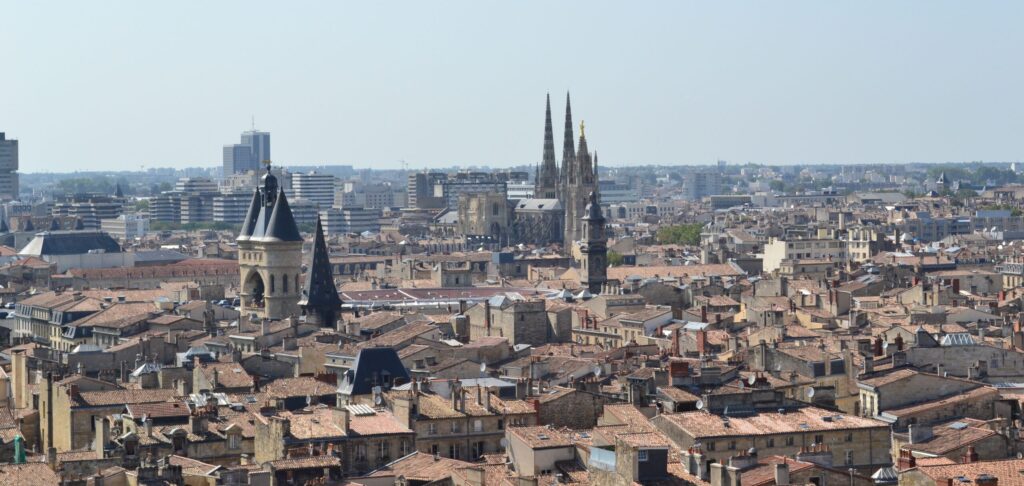
What the visitor walks through today is a city that, until quite recently, looked very different from what it looks like in 2026. Bordeaux’s nineteenth and twentieth centuries were not its golden age. The port silted, the wine industry contracted, the city’s commercial primacy declined relative to the more dynamic ports of northern France, and by the post-war decades Bordeaux had become widely regarded as one of the most architecturally beautiful but most economically and socially exhausted French cities. The stone facades had blackened with two centuries of coal smoke. The quays along the Garonne had become an industrial wasteland. Traffic dominated the centre. Tourists were rare. Then, in 1995, Alain Juppé — already a former Prime Minister of France under Jacques Chirac, and one of the most consequential French political figures of the late twentieth century — was elected mayor of Bordeaux. He held the office, with one interruption, until 2019. Over twenty-four years, Juppé’s administration undertook an urban regeneration programme that is now widely studied as a model. The entire historic centre was sandblasted and chemically cleaned, removing two centuries of pollution and exposing the original honey-coloured Lutetian limestone underneath. A modern tram network, sixty-two kilometres of track in three lines, was built from 2003 onwards with an innovative ground-level power-supply system that eliminated the visual clutter of overhead wires in the historic centre. The quays were pedestrianised. The industrial wasteland along the Garonne was transformed in 2006 into the Miroir d’Eau — the Water Mirror — a 3,450-square-metre reflecting pool that produces every twenty-three minutes a five-centimetre-deep film of water across black granite, reflecting the Place de la Bourse opposite, then drains and refills. It is the largest reflecting pool in the world. UNESCO inscribed the entire city centre of Bordeaux on its World Heritage List in 2007, at the time the largest urban ensemble ever inscribed in a single inscription. The city the visitor sees today is, in significant part, the result of Juppé’s twenty-four-year project. He was an effective and controversial mayor — convicted in 2004 of a political-financing offence and briefly removed from office, then pardoned and re-elected. The urban regeneration was the public payoff. The Bordeaux of 1990 was unloved. The Bordeaux of 2026 is one of the most visited and most beautiful mid-sized cities in Europe.
The Place de la Bourse is the city’s signature image. The square — originally the Place Royale, designed by the royal architect Ange-Jacques Gabriel between 1730 and 1755 as a symbolic gateway from the Garonne to the city — faces the river across the wide quays. Three sides of the square are formed by uniform three-storey neoclassical buildings in honey-coloured limestone, with a central pavilion housing the original Bourse (the stock exchange and customs house). The fourth side opens to the Garonne, with the Miroir d’Eau between the square and the river. On a still summer evening, with the reflecting pool full, the Place de la Bourse appears twice — once in stone above, once in water below — and the symmetry is one of the single most photographed compositions in modern French urbanism. Gabriel’s design was a deliberate statement of royal authority over the merchant city — Louis XV’s intervention in a Bordeaux that the king’s intendants considered insufficiently royal. The merchants accepted the royal gift. The square was built. Louis XV’s authority lasted less than thirty years; the merchants and their classified wines outlasted the monarchy by quite some margin. The architecture has outlasted everyone. It will outlast the visitors photographing it tonight, too.
This is the deeper character of Bordeaux. The city is the principal calibration point of the global fine wine industry, by virtue of a classification system written for a one-off exhibition in 1855. It is one of the architecturally most coherent neoclassical European cities, built almost entirely in the eighteenth century by a merchant class whose wealth came substantially from the Atlantic slave trade. It has, in the past three decades, undertaken one of the most successful European urban regeneration projects of the post-war era. The wine industry continues to produce roughly 700 million bottles per year from approximately 110,000 hectares of vineyard surrounding the city. The trade with the Atlantic continues, in different commodities, but it is still the same Atlantic. The same Garonne flows past the same quays where the eighteenth-century slaving ships were once outfitted. The same limestone is now the same honey-colour the original architects intended. The wine in the bottles is still ranked by a hierarchy written when Verdi was alive. The city has reckoned, to a degree, with the trade that financed its eighteenth century. It has not finished reckoning. The reckoning continues alongside the wine tastings, the tram lines, the tourist photographs, and the reflecting pool. None of this is staged. All of it is in current operation.
Some cities sell what they make. Some cities sell what they classify. This one became wealthy by trading what others made, classified what it sold, and is now slowly admitting how the wealth was actually earned.
Nine regions. One hundred and twenty destinations. Three hundred and twenty-four weeks remaining.
The journey continues. The next stop is a city famous for a colour, a herb, and three saints — south, inland, and pinker than most.

Beyondia
Trusted Travel CompanionReal digital nomad. I travel. I learn. I grow.
What about you? Where are you going?