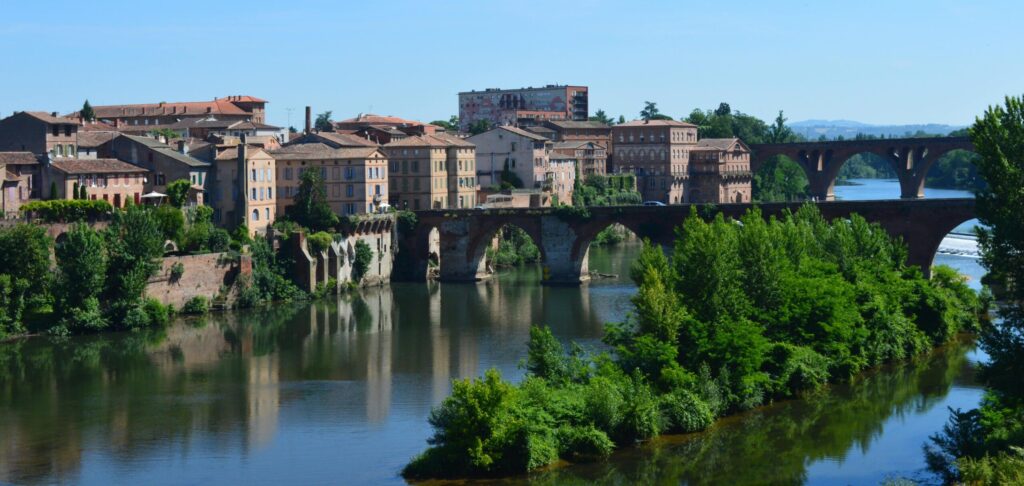
🌐 Around the World with Beyondia 🧵 Mediterranean Region 🪡 Episode 38: Toulouse
Toulouse, the city in southwestern France built almost entirely from rose-coloured brick, which was a sovereign Occitan-speaking state in the twelfth century, the target of a twenty-year crusade, and is today the largest aerospace manufacturing centre in Europe.
Toulouse used to be one of the largest cities in Europe
In the year 1200, the city of Toulouse — at that moment one of the largest cities in Europe, with a population of perhaps thirty thousand — was the capital of an effectively sovereign principality covering most of what is now southwestern France. The County of Toulouse held territory from the Atlantic at Bordeaux to the Rhône at Avignon, from the Pyrenees in the south to the Cévennes in the east — a country, roughly, the size of England. Its ruler was Count Raymond VI, a sophisticated, religiously tolerant, militarily competent prince in his early sixties whose court was widely regarded as one of the most cultured in Europe. The language of his court was Occitan — the langue d’oc, the language of the yes spoken as oc rather than as the northern French oïl. Occitan was the principal literary language of the troubadours, the poet-musicians who between roughly 1100 and 1250 created the lyric tradition that most literary historians regard as the foundation of all subsequent European vernacular love poetry. Dante studied the troubadours in their original Occitan. Petrarch consciously imitated them. The Occitan civilisation of southwestern France in the twelfth and early thirteenth centuries was, in cultural terms — in poetry, in music, in courtly literature, in legal sophistication, probably in literacy — ahead of the northern French civilisation that would shortly destroy it. By 1271, the County of Toulouse had been annexed by the French crown. The Occitan literary tradition had been silenced. The troubadours had dispersed. The Count was dead in exile. The reason was a twenty-year religious war that the Pope had declared against this city and the territory it controlled, beginning in 1208. This is the foundational fact about Toulouse and the one most casually-informed foreign visitors do not carry.
The religious war was the Albigensian Crusade — the only crusade in the entire medieval period that was declared by a Pope against a Christian territory inside Europe. The target was a heretical Christian movement, sometimes called Catharism and sometimes Albigensianism, that had spread across the Languedoc during the twelfth century. The Cathars taught a dualist theology — a doctrine of two principles, good and evil, light and dark, spirit and matter — that the Roman papacy regarded as fundamentally incompatible with orthodox Christianity. Count Raymond VI of Toulouse, while himself a conventional Catholic, tolerated the Cathars in his territories and refused to take serious action against them. Pope Innocent III’s repeated demands for suppression were ignored. In January 1208, the papal legate to Toulouse, Pierre de Castelnau, was murdered on the banks of the Rhône — possibly by an agent of the Count, possibly by an independent partisan, the historical record is unclear. Innocent III used the murder as the casus belli. In March 1208 he declared the Albigensian Crusade and called on the French nobility — particularly the northern French nobility, the Croisés, the cross-takers — to march south and exterminate heresy. The army assembled in 1209 was the largest crusading force ever raised in Europe up to that point, perhaps fifty thousand men, under the military command of Simon de Montfort, a minor northern French baron with extraordinary military talents and complete ruthlessness. The crusade lasted twenty years.
The single best-known atrocity of the Albigensian Crusade — and one of the most famous chilling moments of European medieval history — occurred at Béziers, a small Occitan city a hundred and thirty kilometres east of Toulouse, on the 22nd of July 1209. The crusader army arrived at the walls of Béziers and demanded that the city’s Catholic inhabitants identify and surrender the Cathar minority within the walls. The Catholic inhabitants refused — partly out of solidarity with their neighbours, partly out of resistance to a foreign army. The papal legate to the crusade, the Cistercian abbot Arnaud Amalric, was asked by one of his commanders how the army should distinguish Catholic from Cathar civilians during the inevitable sack. Arnaud Amalric’s reply, recorded in the Dialogue on Miracles of the Cistercian monk Caesarius of Heisterbach, written within a generation of the event, is reported as: Caedite eos. Novit enim Dominus qui sunt eius — Kill them all. God will know His own. Whether the abbot actually said exactly these words is debated — Caesarius was writing twenty years later, and the phrase is suspiciously rhetorical — but the underlying historical fact is undisputed: the crusader army sacked Béziers, killing essentially the entire population, perhaps fifteen thousand to twenty thousand people, including women, children, priests, and the city’s Catholic inhabitants alongside its Cathar minority. The bishop of Béziers wrote to the Pope describing the massacre. Innocent III, while expressing some regret, did not order the cessation of the crusade. The war continued for another nineteen years. By the time the Treaty of Paris was signed in 1229, the County of Toulouse had been gutted, the Cathar church had been substantially destroyed, the troubadour tradition had largely scattered, the Occitan language had begun its long administrative decline, and the city of Toulouse was on its way to being incorporated into the French crown — a process completed in 1271 when the last male heir of the Count’s lineage died and the territory passed to the French royal demesne. The University of Toulouse was founded in 1229, almost as the closing event of the crusade itself, as part of the treaty conditions imposed on the defeated city — a deliberate instrument of doctrinal control, established with papal authority to ensure that no future Toulousain generation would receive an unorthodox theological education. The Inquisition arrived in 1233, and was based in Toulouse for two and a half centuries, conducting investigations and trials of suspected heretics across the entire Languedoc.
This is what the contemporary visitor walks through. The city is famously called la Ville Rose — the Pink City — for the colour of its dominant building material, a warm rose-pink terracotta brick made from the alluvial clay of the Garonne river plain. The local brick — brique foraine or brique toulousaine — has been used in Toulouse since Roman times, partly because the clay is exceptional, partly because the region lacks the quarried limestone that built most of the great cities of northern France. The brick’s colour shifts dramatically with the light: pink at dawn, rose-orange at midday, warm red-brown at sunset, almost purple-brown after dark under the warm yellow streetlamps. The two greatest medieval buildings in the city are both brick — both Romanesque, both still functioning religious buildings, and both products of the centuries this article has just described. The Basilica of Saint-Sernin, begun around 1080 and substantially completed by 1120, is the largest Romanesque church in Western Europe — 115 metres long, with a 65-metre octagonal bell tower added between 1270 and 1478, holding the relics of Saint Saturnin (the third-century missionary bishop of Toulouse who, according to tradition, was martyred by being tied behind a bull and dragged through the city until he died). The basilica was, throughout the Middle Ages, one of the four most important pilgrimage destinations on the routes to Santiago de Compostela, and the brick exterior is a deliberately monumental expression of an Occitan city’s sense of its own spiritual centrality. The Église des Jacobins — the Dominicans’ mother-house, built between 1230 and 1335, immediately after the Albigensian Crusade — is the strangest and possibly most beautiful Gothic interior in southern France: a single double-naved chamber whose central row of columns culminates in a final column at the apse, called the Palmier (the palm tree), whose 22 ribs fan out across the vault overhead like the radiating leaves of a palm. The relics of Saint Thomas Aquinas, the order’s most consequential intellectual, have been preserved in a sarcophagus in this church since 1369, when they were transferred there from Italy at the order of Pope Urban V. The Dominican order was founded in Toulouse in 1216 by Saint Dominic specifically as a preaching order to combat Cathar heresy. The church is, in this sense, the institutional sequel to the Albigensian Crusade — the building from which the Catholic intellectual counter-attack on Occitan heresy was directed for the next four centuries. Walking through the brick interior of the Jacobins in 2026, with the palm tree of vaulting fanning out overhead and Aquinas’s bones in a chest behind the altar, is one of the most quietly intense experiences in southern French religious architecture. The casual visitor will find it beautiful. The visitor who knows what the building was built to do will find it more interesting still.
The University of Toulouse, founded in 1229 as a treaty condition, is one of the oldest universities in Europe and is now, alongside its sister institutions in the modern Université de Toulouse federation, one of the largest student bodies in France — approximately 130,000 students currently enrolled across the metropolitan area, making Toulouse one of the four largest university cities in the country alongside Paris, Lyon, and Lille. The student culture has shaped the city’s character continuously since the thirteenth century — the Latin Quarter of medieval Toulouse, the university courtyards, the bookshops along the Rue du Taur, the cafés around Place du Capitole, the unusually high cultural energy that distinguishes the city from comparable provincial centres. The Parliament of Toulouse, established in 1443 as one of the principal regional parliaments of the Ancien Régime, was the supreme judicial court for most of southwestern France for three and a half centuries, and gave the city a layer of legal and administrative weight that survives in its institutional infrastructure. The brick Hôtel d’Assézat (a Renaissance merchant townhouse from 1555, now an art museum) and the brick Capitole (the city hall, with its eight columns symbolising the eight medieval capitouls, the elected merchant magistrates who governed the city alongside the Counts and later the French crown) are the principal civic monuments of the post-medieval period — both built from the same rose-pink brick that links the entire centre into a single visual fabric.
The contemporary city is the largest aerospace manufacturing centre in Europe. Since 1969, when the European consortium that became Airbus was founded with Toulouse as its principal assembly site, the city has been the headquarters and primary assembly location of the A300, A310, A320, A330, A340, A350, and the A380 — the largest passenger aircraft ever built. Airbus directly employs approximately twenty-seven thousand people in the metropolitan area, and the broader aerospace cluster — manufacturers, suppliers, research institutions, the National School of Civil Aviation (ENAC), the Toulouse Space Centre (which operates France’s national space programme), the Centre National d’Études Spatiales, and the aerospace research labs of the University of Toulouse — supports approximately one hundred thousand jobs total. The A380 assembly plant at Blagnac, on the western outskirts of Toulouse, opened in 2005 with 122,000 square metres of floor space under one roof — at the time, briefly the largest building by floor area in the world. The aircraft sections were manufactured in Hamburg, Saint-Nazaire, Cádiz, and Filton, transported to the river port at Langon by sea, then carried by a specialised barge fleet up the Garonne, transferred to a 240-kilometre custom-built road convoy, and assembled in the Blagnac hangar. The A380 programme ended in 2021 — the aircraft was a magnificent engineering achievement that turned out to be commercially unviable in a market that had moved decisively toward smaller twin-engine long-haul jets — but the assembly facility continues to build the A350. The city’s population grew from approximately 380,000 in 1960 to approximately 510,000 in 2026, with a metropolitan area of about 1.5 million people. Toulouse is now the fourth-largest urban area in France, behind only Paris, Lyon, and Marseille. The aerospace economy is the principal reason for the growth. The university and research base is the principal reason for the cultural energy. The brick is the principal reason for the beauty.
The cuisine and the colour are what the visitor takes home. The cassoulet — the bean-and-meat stew slow-cooked for hours in a pottery vessel called a cassole (which gives the dish its name) — is the regional culinary signature, originally from the small town of Castelnaudary sixty kilometres east of Toulouse but cooked in every Toulousain restaurant. The classic Toulouse cassoulet contains white beans (specifically the haricot tarbais from the Pyrenean valleys), duck confit, saucisse de Toulouse (the regulated regional pork sausage), pork shoulder, and a thin breadcrumb crust formed and broken seven times during the slow oven cook (one of the regional disputes about cassoulet is whether the correct number is seven, nine, or eleven crust breaks — the article will not resolve it). The local wines — Fronton (from the appellation immediately north of the city), Gaillac (eighty kilometres east-northeast, one of the oldest wine-producing areas in France with continuous Roman viticulture), Madiran (in the Gers, ninety kilometres west, deep dense reds from the Tannat grape), and Cahors (a hundred kilometres north, the deep dark malbec the South Americans now grow more than the French do) — give the regional table its accompaniment. The violette de Toulouse — the deep purple Parma violet variety cultivated in the eastern suburbs of the city since the 1850s — gives the city its second flower symbol and its small annual February Fête de la Violette. The colour, the cuisine, the brick, the university, the aerospace, the violets, the cassoulet, the troubadours’ silent ghosts — all of it makes up a city that does not look or feel like the rest of France, and that has historically reminded itself of this distinction.
This is the deeper character of Toulouse. The city is the architectural memory of an Occitan civilisation that was destroyed by the French crown in the thirteenth century, the institutional memory of a Dominican intellectual counter-attack that defined Catholic doctrine for four centuries afterward, the working capital of one of the world’s largest aerospace industries, the academic centre of a hundred and thirty thousand students, and a brick city whose colour shifts with the light from pink to rose-orange to red-brown to almost purple. The Occitan language is still spoken by perhaps two hundred thousand people in the broader region — fewer than in 1900, perhaps slightly more than in 1980, the trajectory ambiguous. There is a small but committed Occitan cultural revival, with bilingual schools (calandretas), a regional television network, signs in some streets in Occitan alongside French, and a quiet political project that does not seek independence so much as a slow rehabilitation of the linguistic and cultural identity that was officially suppressed by the Ordonnance de Villers-Cotterêts in 1539. Toulouse is the city this revival is centred on. The Counts have been gone for seven hundred and fifty years. The language is not gone yet.
Some cities were always part of the country they belong to. This one was its own country, was crushed by a crusade, was incorporated by treaty, built jets in the country that conquered it, and still — quietly, slowly, partially — speaks the language the conquest tried to bury.
Nine regions. One hundred and twenty destinations. Three hundred and twenty-three weeks remaining.
The journey continues west. The next stop is a small town on a flat plain that produced the most-spoken language in the world after Mandarin.

Beyondia
Trusted Travel CompanionReal digital nomad. I travel. I learn. I grow.
What about you? Where are you going?