🌐 Around the World with Beyondia 🧵 Mediterranean Region 🪡 Episode 17
Rhodes is the Greek island that was everybody else’s before it was ever its own.
Rhodes — The Most Wanted Island
Rhodes has been wanted by almost every empire that ever existed in this part of the Mediterranean. It was founded as a Greek city-state in 408 BC, unifying three older Dorian settlements. The Persians took it. The Athenians took it back. The Spartans wanted it. Alexander the Great absorbed it. The Ptolemies of Egypt used it as a trading outpost. The Romans turned it into a free city. The Byzantines held it for seven hundred years. Arab raiders sacked it in 653 AD. The Genoese bought and sold rights to parts of it. The Knights Hospitaller seized it in 1309 and held it for more than two centuries. Suleiman the Magnificent took it in 1522 after a six-month siege. The Ottomans ran it for nearly four hundred years. The Italians took it in 1912 and spent thirty years rebuilding it in a colonial Art Deco style. The Germans occupied it in 1943. British and South African troops drove the Germans out in 1945. It became Greek, finally and formally, on the 7th of March 1948. Rhodes was one of the very last pieces of Greek soil to become Greece.
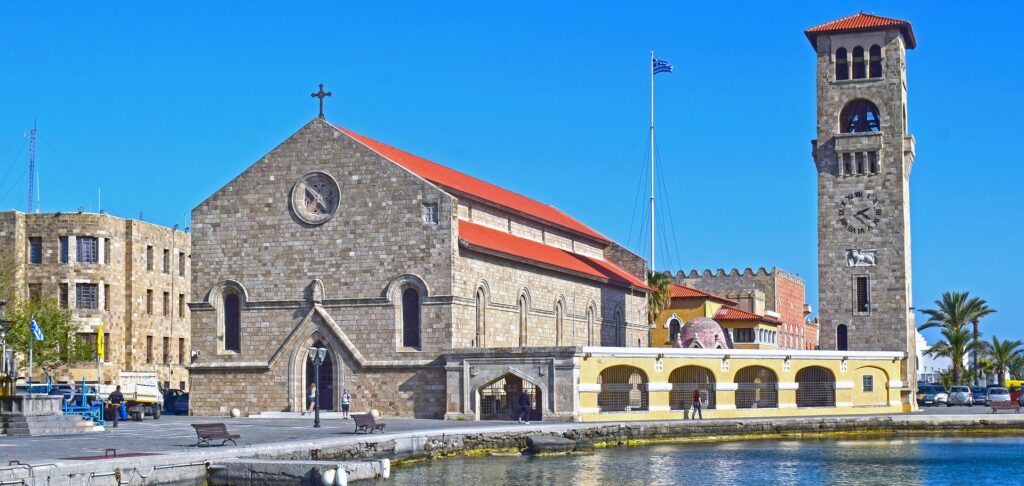
The old town of Rhodes — the walled medieval city, stepped and narrow, made entirely of honey-coloured stone — is the most intact medieval city in the eastern Mediterranean. UNESCO inscribed it in 1988. The walls are four kilometres long. The Palace of the Grand Master has 158 rooms. The Street of the Knights runs two hundred metres straight from the palace down to the hospital, and is lined, on both sides, by the Inns of the national tongues of the Knights Hospitaller — the Inn of France, the Inn of Spain, the Inn of Italy, the Inn of England, the Inn of Provence, the Inn of Auvergne, the Inn of Germany. Each inn housed knights from that country during their years of service on the island. The same Knights had begun as a medical order in Jerusalem in the eleventh century, been driven out by Saladin, held Acre until 1291, been driven from Cyprus, arrived on Rhodes in 1309, ruled it for more than two hundred years as an independent state, held the Ottomans off twice before falling to Suleiman in 1522, surrendered with honour, walked out of the city carrying their weapons, and relocated to Malta. Everything any visitor will ever have read about the Knights of Malta began here, in this city, in this stone. Malta is the sequel. Rhodes is the first book.
There was, also, a statue. The Colossus of Rhodes was completed in 280 BC — a bronze statue of the sun god Helios, about thirty-three metres tall, paid for with the sale of siege equipment left behind by Demetrius the Besieger when he failed to take the island. The Colossus stood at the edge of the harbour, not across it — the popular image of ships sailing between its legs is a Renaissance fantasy invented more than a thousand years after the statue no longer existed. It was recognised even in its own lifetime as one of the Seven Wonders of the Ancient World. It stood for fifty-four years. An earthquake in 226 BC snapped the figure at the knees and toppled the whole structure to the ground. The Rhodians received offers from Ptolemy III of Egypt to fund its rebuilding. They consulted the oracle at Delphi, and the oracle answered that the statue should not be raised again. The Rhodians obeyed. The broken pieces of the Colossus lay on the ground beside the harbour for roughly eight hundred years. Pliny the Elder, visiting the ruins in the first century AD, wrote that even the fallen fragments were astonishing — that few men could get their arms around one of its thumbs. The pieces were only finally carted off in 654 AD, after the Arab raid, and sold, according to Byzantine historians, to a Jewish merchant in Edessa who loaded them onto nine hundred camels. A Wonder of the World that was wondrous for fifty-four years as a statue and for eight hundred years as a ruin.
This is the Rhodes that every subsequent conqueror met. Not a young island. An old one, already carrying the memory of statues and sieges, already familiar with what rises and what stays down. The Hospitallers fortified a city the Byzantines had fortified on foundations the Romans had laid on walls the Greeks had built on harbours the Minoans had traded with. The Ottoman governors who took over in 1522 did not raze the Christian city they had just captured. They converted the cathedral into the Süleymaniye Mosque, built hammams and madrasas, and moved in. The Italian colonial administrators of 1912 did not tear down the Ottoman buildings. They restored the medieval palace, built an Art Deco post office next door, and planted palm trees along the waterfront. Each conqueror added their layer and most of them were eventually absorbed into the stone of the previous layer. This is what a very old place looks like. It is not a single period preserved. It is a lamination. The crust of twenty civilisations, pressed down onto the same rock, none of them winning.
On the east coast of the island, the village of Lindos sits beneath a hilltop acropolis where a Temple of Athena has stood in some form since the tenth century BC. The fortifications on the hill were reinforced by the Knights in the fifteenth century, and were originally built, in their earliest stone form, by the Greeks who founded the town in the eleventh century BC. The same hill was sacred to Saint Paul, who, tradition says, landed in the small cove below Lindos on one of his missionary voyages. Four distinct faiths and almost three thousand years of continuous sacred use on a single stone outcrop, and the view from the top is still, on the kind of summer afternoon when the light flattens out over the Aegean, the single most peaceful thing on the island. A place does not get like this by being left alone. It gets like this by being fought over, taken, lost, retaken, and eventually outlasting the people who cared most.
Some islands disappear when their era ends. Most islands fade once the conquerors lose interest. Rhodes does not. Rhodes has been here through every era, taken by every army, and released by every retreating fleet. It is the geographical equivalent of the oldest shopkeeper on a long street — the one who has seen neighbours come and go, has known their children, has watched their empires close, and is still, every morning, opening the same door.
Nine regions. One hundred and twenty destinations. Three hundred and forty-four weeks remaining.
Some places you conquer. This one, you only borrow.

Beyondia
Trusted Travel CompanionReal digital nomad. I travel. I learn. I grow.
What about you? Where are you going?