🌐 Around the World with Beyondia 🧵 Mediterranean Region 🪡 Episode 18
Crete is the island Greece learned from. Almost nobody outside Greece knows this. Most people inside Greece have made peace with it.
Crete is the island Greece learned from
In the year 3000 BC, give or take a century, while most of Europe was still living in unmortared stone houses and counting on their fingers, a civilisation began to assemble itself on the largest island in the southern Aegean. Within a few centuries, this civilisation — now called Minoan, after the legendary king Minos who is its last memory in mythology — was building four-storey palace complexes at Knossos and Phaistos and Malia, painting frescoes of dolphins and saffron-gatherers and bull-leaping athletes, running indoor plumbing that would not be matched in Europe for another three thousand years, and writing in two scripts that scholars still struggle to read today. The first of these scripts, Linear A, has never been deciphered; the language behind it remains a closed door. The second, Linear B, was finally cracked in 1952 by a young English architect named Michael Ventris, working in his spare time, who proved that Linear B was the earliest known written form of Greek. The Mycenaean Greeks of the mainland — the Greeks of the Iliad, of Mycenae, of Tiryns — had borrowed the Cretan writing system and used it to record their own language. The Greek language was first written down on this island. Greece, in the most literal sense, learned to write here.
The Minoan civilisation lasted roughly fifteen hundred years, which is longer than Christianity has been on the planet. It collapsed around 1450 BC, weakened by earthquakes, by the long aftermath of the Thera eruption that ended the previous chapter of these islands, and finally absorbed by Mycenaean Greeks who arrived from the mainland and took over its palaces. But the absorption was the wrong way around in every way that matters. The mainland Greeks took the Cretan writing system, the Cretan palace architecture, the Cretan trading network, and the Cretan religious imagery, and turned all of it into what we now call Greek civilisation. By the time Homer was writing the Odyssey in the eighth century BC, the Minoans had been gone for six hundred years, and the memory of them had already been folded into mythology — Minos as the dead king who judges souls in the underworld, the Minotaur in the labyrinth, Theseus arriving from Athens to kill it, Daedalus building wings to escape the island. Crete had become, for the rest of Greece, the place where their civilisation’s pre-history lived. The mythology was the last surviving form of an older, half-forgotten history.
Crete is the fifth-largest island in the Mediterranean
Crete is the fifth-largest island in the Mediterranean, after Sicily, Sardinia, Cyprus, and Corsica. It is over 250 kilometres long. The mountain ridges that run down its centre — the White Mountains in the west, Mount Ida in the middle, the Dikti range in the east — rise to over 2,400 metres and are still snow-capped in late spring. Cretans, accordingly, are not really an island people in the way that the Cycladic islanders are. Crete is large enough, varied enough, and self-contained enough to operate like a small country. It has its own dialect, which other Greeks find amusing and difficult to follow. It has its own bread — paximadi, twice-baked rusk that lasts for months at sea or in a sheepfold. It has its own knife — the cretan dagger, traditionally given as a gift from godfather to godson and inscribed with rhyming couplets. It has its own polyphonic music, played on the lyra, a small three-stringed bowed instrument no other Greek region uses. It has its own dances, its own honey, its own herbal mountain tea, and a very specific, only half-joking national pride. Cretans will, when pressed, tell you they are Greek. They will also, in the next sentence, tell you they are Cretan first.
This pride is not provincial. It is historical. Crete spent the entire modern era resisting Ottoman rule with a stubbornness that is hard to overstate. The Ottomans took the island in 1669 after a twenty-one-year siege of the Venetian capital of Heraklion — the longest siege in European history. Cretans rebelled in 1770, 1821, 1841, 1858, 1866, 1878, 1889, 1895, and 1897. Crete only became formally part of Greece in 1913, and even then with reluctance from many Cretans who considered union a demotion from sovereign autonomy. During the Second World War, Cretan civilians fought a brutal guerrilla war against the German occupation in the mountains of Sphakia and Anogia — entire villages were burned in reprisal, and the resistance never stopped. The German general Kurt Student, who commanded the airborne invasion of Crete in 1941, later wrote that the Cretan resistance shocked the German army more than any other civilian opposition they encountered in Europe. The cost of taking Crete was so high that Hitler abandoned all further large-scale airborne operations for the rest of the war. The island has been arguing with empires for three thousand years, and it has won more of those arguments than its size suggests.
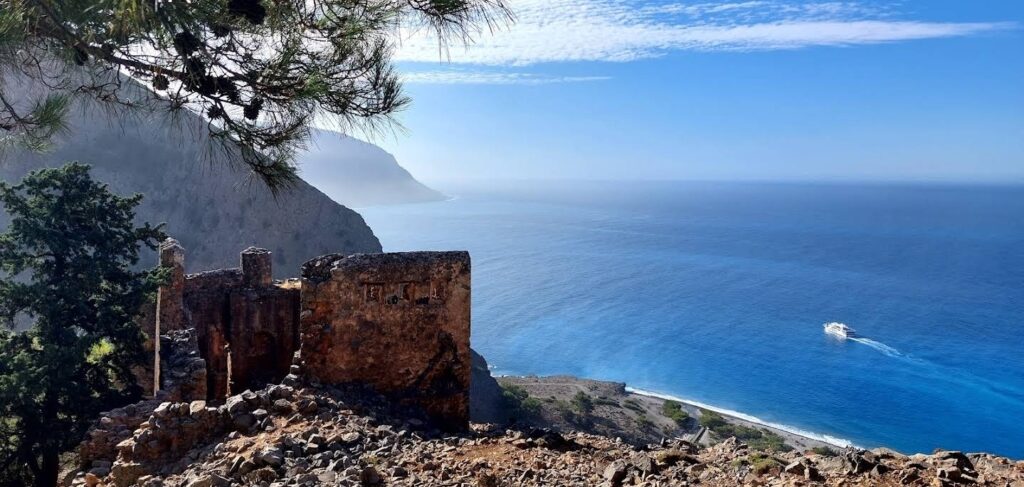
In the south of the island, on the Libyan Sea, lies a small village called Loutro. There is no road to Loutro. You arrive by boat or by a four-hour walk along the coast from Sphakia. The village has thirty year-round residents, fifteen tavernas in the summer, white houses pressed up against a curving stone harbour, and behind it a sheer mountain wall rising directly from the sea. The Romans called this place Phoenix, after the harbour. The apostle Paul tried to overwinter here in the first century AD on his voyage to Rome, mentioned by name in the Acts of the Apostles. The Venetians fortified it. The Cretan resistance used it during the Second World War as a clandestine evacuation point for Allied soldiers. Today, in the late afternoon, fishermen mend nets on the same stone quay where Paul almost stayed for a season. The chairs are wooden. The wine is local. The mountain stays where it has always stayed. The world has changed entirely around Loutro, and Loutro has not noticed, because it is occupied with the more important work of remaining itself.
Deepest secret of Crete
This is the deepest secret of Crete. The island is older than the rest of Greece, more independent than the rest of Greece, more stubborn than the rest of Greece, and quietly responsible for the bones of what the rest of Greece became. The Athenian who walks among the columns of the Acropolis is walking among an architectural language that was, four thousand years ago, first invented on this island. The poet who recites the Odyssey is reciting a story whose underworld king and labyrinth were Cretan before they were anyone’s. The Greek alphabet was first written down here. The Greek civilisation was, in its earliest moments, a Cretan civilisation taught to mainlanders.
Most countries celebrate their oldest region. Greece is unusual in that it is, in many ways, descended from its oldest region. Crete is not the periphery. Crete is the source. Everything that travelled north — the writing, the trading, the seafaring, the palace architecture, the bull-leaping iconography, the labyrinth myth itself — was an export from this island. The rest of Greece is what happened when Crete’s first civilisation grew up and moved away from home.
The arc of nine Greek episodes ends here, on the largest, oldest, and most original of the islands. Plaka in Athens taught the series that the neighbourhood is older than the monument. Meteora taught it that altitude is a vow. Naxos, Paros, and Mykonos taught it that islands famous for one thing are usually about something else. Santorini taught it that beauty is what came back. Rhodes taught it that places outlast their conquerors. Crete teaches all of them at once — and adds: and we were here first.
Nine regions. One hundred and twenty destinations. Three hundred and forty-three weeks remaining.
The Aegean closes here. The next shore is older still.

Beyondia
Trusted Travel CompanionReal digital nomad. I travel. I learn. I grow.
What about you? Where are you going?