Around the World with Beyondia 🧵 Nordic & Western Europe Region 🪡 Journal 21
Ireland. Dublin. Doolin. Dingle. A capital that conquered the language that conquered it, a village built around music and a cliff edge, and a peninsula where the road runs out and the Atlantic takes over.
Dublin argued with me from the moment I arrived.
Not aggressively. Wittily. The city talks. It talks in pubs, on bridges, through the windows of Georgian townhouses that line streets where writers walked before they became the writers the world reads. Dublin has produced more Nobel laureates in literature per capita than any other city — Yeats, Shaw, Beckett, Heaney — and walking through the streets, the impulse to put words on things is almost atmospheric. This is a city that treats language as a competitive sport and expects you to keep up.
I started at Trinity College and the Book of Kells — a 9th-century illuminated manuscript created by monks on Iona, a monastery founded by an Irish monk on a Scottish island, which tells you everything about how Irish culture has always operated. Not within borders. Across them. The manuscript survived Viking raids, centuries of damp, and the particular Irish talent for preserving things by hiding them. The Long Room library above it — 65 metres of oak shelving holding 200,000 of the college’s oldest books — smells like knowledge that has been composting for centuries. The busts lining both sides stare at each other across the aisle as if the argument hasn’t ended.
I crossed the Ha’penny Bridge over the Liffey — the river that cuts Dublin in two, northside and southside, a division the city takes with a seriousness that outsiders find baffling and Dubliners find essential. Temple Bar was loud and tourist-worn but the pubs behind it were real. I drank a pint of Guinness in a bar where the bartender took four minutes to pour it and would have taken five if the glass had asked. The Guinness in Dublin is different from the Guinness anywhere else and I can’t explain why scientifically, but the first sip had a creaminess and a weight that I’ve never tasted from a can or a tap in any other country. Dublin will tell you it’s the water. Dublin will tell you a lot of things.
I walked through Glasnevin Cemetery — the largest in Ireland, where Daniel O’Connell, Michael Collins, Éamon de Valera, and Constance Markievicz are buried alongside over a million ordinary Dubliners. Ireland buries its revolutionaries and its citizens in the same ground, and the stories on the headstones read like a history of the country told one family at a time. The round tower above O’Connell’s crypt is visible from across the city. Dublin doesn’t let you forget.
Kilmainham Gaol was the stop that changed the temperature. The prison where the leaders of the 1916 Easter Rising were held and executed — fourteen men shot in the stone-breaker’s yard over ten days, including James Connolly, who was so badly injured from the fighting that he was tied to a chair to be shot because he couldn’t stand. The executions turned public opinion. Before them, the Rising had limited support. After them, the independence movement became unstoppable. The British government executed fourteen men and created a nation. I stood in the yard where it happened and the walls were just walls. The power was in the knowing.
I ate a coddle — Dublin’s own dish, a stew of sausages, bacon, potatoes, and onions slow-cooked until everything surrenders into each other. Not photogenic. Not refined. Completely Dublin. The kind of food that exists because someone had leftovers and cold weather and no interest in pretending those two things needed anything more than a pot and time.
Then I went west – Doolin
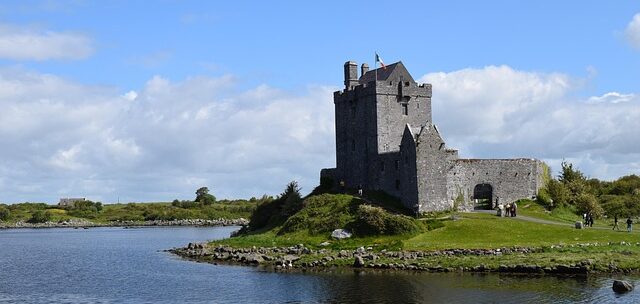
Doolin is a village. Three pubs, a hostel, a scattering of houses along a road that leads to the Cliffs of Moher and to the Aran Islands ferry. On paper, it’s almost nothing. In practice, it’s the traditional music capital of Ireland, and the sessions that happen in those three pubs are why musicians fly across the Atlantic to sit on a wooden chair in a room the size of a living room and play.
I walked into a pub on a Tuesday evening and a session was already running. No stage. No microphone. No announcement. Five musicians sitting in a corner — fiddle, concertina, bodhrán, tin whistle, guitar — playing jigs and reels at a speed and precision that made my chest tighten. Trad music in Doolin isn’t a performance. It’s a conversation. The players watch each other’s fingers, not the audience. They start a tune and the others join when they recognise it. If you don’t know the tune, you wait. The music doesn’t stop for you. You earn your place in the room by listening.
I sat for three hours. My pint went warm. I didn’t care. The music built and released and built again, and the room moved with it — not dancing, just a collective breath, a shared rhythm that had nothing to do with entertainment and everything to do with the fact that these tunes have been played in these pubs for generations and the tradition survives because someone shows up every Tuesday and starts playing.
The Cliffs of Moher are eight kilometres from Doolin and I walked along the coastal path to reach them. The cliffs rise 214 metres from the Atlantic and they don’t build up to it — you walk along a gentle green slope and then the ground simply ends. The drop is vertical. The ocean hits the base with a sound I felt in my knees. Seabirds — puffins, razorbills, guillemots — nest on ledges halfway down, unbothered by a height that made me step back. The Aran Islands sat on the horizon, limestone and stubborn, and beyond them nothing. Open Atlantic. The next stop west is North America.
I ate seafood chowder in Doolin — thick, creamy, heavy with whatever came out of the ocean that day — with brown bread that was still warm and butter that tasted like grass. The food in the west of Ireland doesn’t try. It just is. The raw materials are so good that ambition would be an insult.
Dingle was where Ireland became something else entirely.
The Dingle Peninsula pushes into the Atlantic like a last argument from the continent. The road from Tralee winds along the coast, climbing over the Conor Pass — the highest mountain pass in Ireland — and the views from the top swallowed everything. Valleys dropping in both directions, lakes sitting in corries like the mountains were holding water in their palms, and the Atlantic waiting at the end of every sightline.
Dingle town sits in a harbour on the southern side, small enough to walk in twenty minutes, dense enough to spend days. The pubs are painted in colours that shouldn’t work together but do — blue next to yellow next to red — and the sound of Irish drifts out of doorways because the Dingle Peninsula is a Gaeltacht, one of the remaining areas where Irish is the daily spoken language. The language that England spent centuries trying to eliminate — through penal laws, through education policy, through famine and emigration that emptied the communities where Irish was strongest — is still alive here. Not as a museum exhibit. As conversation. As the language children use in the playground, shopkeepers use at the counter, and old men use in the pub when they don’t want the tourists to understand.
I drove Slea Head — the loop road around the western tip of the peninsula — and the landscape was so raw it felt like the earth hadn’t decided if it was finished yet. Stone walls running across fields that drop to the ocean. Beehive huts — clochán — built from dry stone without mortar, standing since the early medieval period, maybe earlier. The Blasket Islands offshore, abandoned in 1953 when the remaining population was evacuated because life there had become unsustainable, visible from the mainland like a memory the peninsula can’t stop looking at.
The Blasket Islanders left behind literature. Tomás Ó Criomhthain, Peig Sayers, Muiris Ó Súilleabháin — writers from a community of fishermen and farmers on a rock in the Atlantic who produced books in Irish that are now taught in every school in the country. An island of fewer than two hundred people, with no electricity and no running water, that generated some of the most important prose in the Irish language. That’s the Dingle Peninsula’s argument — that remoteness and hardship don’t destroy culture. They distil it.
I ate in Dingle — fish and chips from a harbour-front shop where the fish had been landed that morning and the chips were fried in beef dripping. I had Dingle gin at a bar where the distiller came in and sat next to me and talked about botanicals like someone describing close friends. I ate a Dingle pie — a mutton pie with a suet crust that weighs as much as a small promise. The food on the peninsula is not sophisticated. It is exact. Every ingredient is local not because of a philosophy but because there’s nothing else. The Atlantic is right there. The sheep are on the hill. The rain grows everything green. The peninsula feeds itself and doesn’t apologise for the simplicity.
I stood at Dunmore Head — the westernmost point of mainland Ireland — and looked out at the Blaskets and beyond them at the Atlantic stretching to a horizon that offered nothing. This is where Europe ends. Not politically, not symbolically — physically. The continent runs out of ground here, on a green cliff, in the rain, with sheep behind me and the ocean ahead, and the feeling wasn’t emptiness. It was completion. The land had said everything it had to say and now the water takes over.
Three stops. A capital that lost its native language and conquered the replacement so thoroughly that it produced more great writers per square mile than any city on earth. A village with three pubs and a cliff where the tradition of playing music in a room full of strangers is treated with the seriousness of a sacrament. A peninsula where the road ends, the language survives, and an abandoned island of fishermen left behind literature that a nation still reads.
The journey through these islands continues. But Doolin’s session is still playing in my head, and I don’t want it to stop.

Beyondia
Trusted Travel CompanionReal digital nomad. I travel. I learn. I grow.
What about you? Where are you going?