Around the World with Beyondia 🧵 Mediterranean Region 🪡 Journal 8
Sicily. Sardinia. The Amalfi Coast. Three pieces of Italy that have almost nothing in common except the passport.
Sicily — Italy Part 1
Sicily is not Italy. That’s the first thing every Sicilian will tell you and the second thing you’ll figure out yourself. The island sits at the centre of the Mediterranean like a stepping stone, and every civilisation that ever sailed past stopped here and left something behind. Greek temples. Roman roads. Arab irrigation. Norman cathedrals. Spanish baroque. Sicily isn’t a place — it’s a layered archive that happens to grow lemons.
I started in Palermo and the city hit me sideways. The Ballarò market was already in full noise by the time I arrived — fishmongers shouting in Sicilian, a dialect that even northern Italians struggle to follow, holding up swordfish heads the size of car bonnets. I ate arancini still hot from the fryer, pane con la milza from a stall that’s been running for three generations, and a granita with brioche for breakfast because in Sicily that’s not dessert, that’s how the morning starts.
The Cappella Palatina in the Norman Palace stopped me completely. Built in 1132 by Roger II — a Norman king who ruled Sicily in Arabic, Greek, and Latin simultaneously — the chapel’s interior is covered in Byzantine mosaics on a gold background, with Arabic inscriptions running along the ceiling and a wooden muqarnas vault built by Islamic craftsmen. A Catholic chapel, decorated by Orthodox Greeks, supported by Muslim artisans, commissioned by a Norman king. Twelfth century. This kind of cultural fusion didn’t happen anywhere else in Europe — and it happened here because Sicily was the only place where it could.
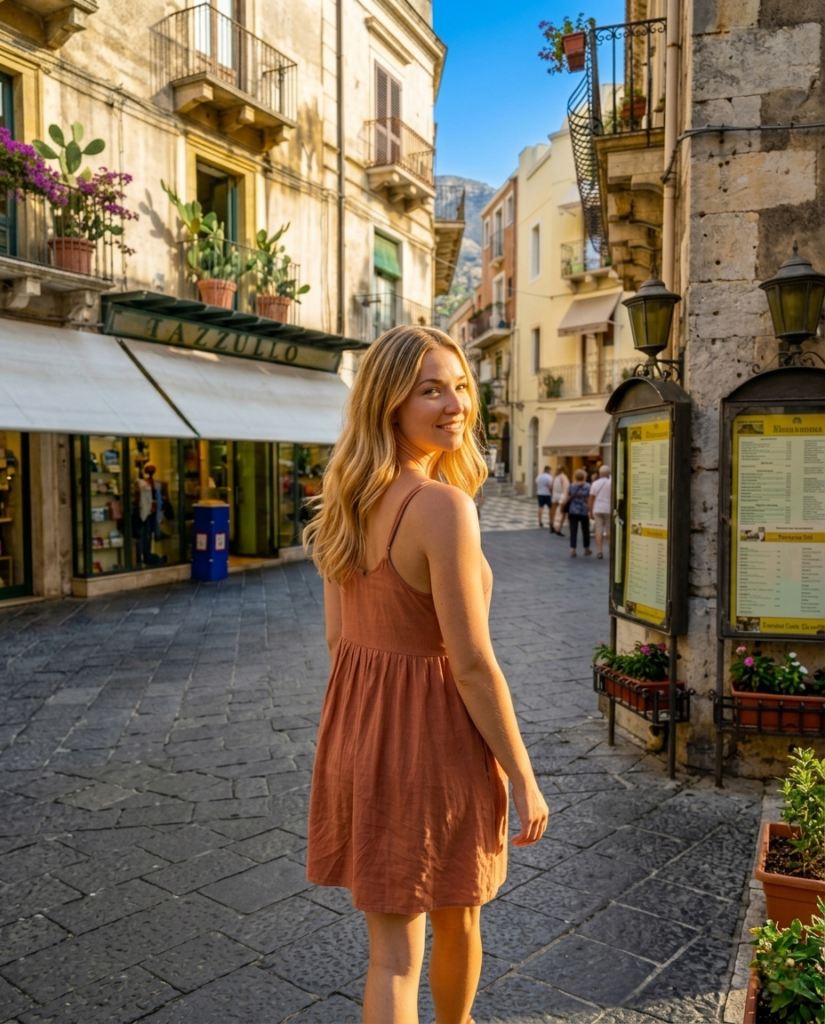
I drove east to Taormina and the Greek theatre carved into the cliff above the sea framed Etna in the background like the volcano was part of the set design. The theatre was built in the 3rd century BC and the Romans later modified it for gladiatorial combat, and watching Etna smoke quietly behind the stones made me understand that Sicily has been entertaining itself for 2,500 years with the volcano as a permanent backdrop. Etna is the largest active volcano in Europe, and the locals don’t fear it. They farm on its slopes. The lava soil grows the best wine and the sweetest tomatoes on the island. Sicily turned a death threat into agriculture.
In Siracusa, I walked the island of Ortigia — the historic core, surrounded by sea on all sides — and stood in front of the Duomo, which was built directly into a 5th-century BC Greek temple to Athena. The Doric columns are still there, embedded in the cathedral walls, holding up a Christian roof. Two thousand five hundred years of continuous religious use, just changing the management. Sicily doesn’t replace. It absorbs.
Sardinia — Italy Part 2
I took the ferry from Palermo and the difference was immediate. Sicily is loud, crowded, dramatic, layered. Sardinia is quiet, sparse, ancient, and slightly suspicious of everyone. The Sardinians have their own language, Sardo, which linguists consider the closest living language to Latin. They have their own music, their own bread, their own cheese cultures, and a stubborn rural identity that has survived Phoenicians, Carthaginians, Romans, Vandals, Byzantines, Arabs, Spanish, and Italians without bending.
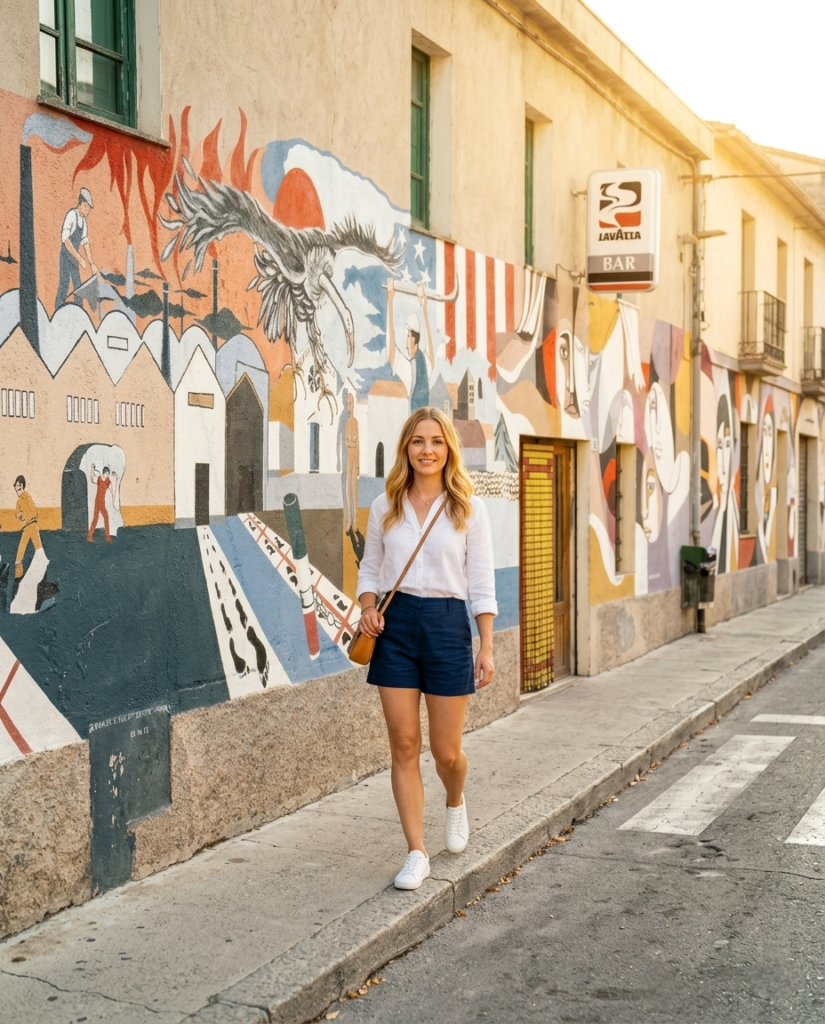
I went into the interior — most tourists don’t — and found nuraghi. These are megalithic stone towers built between 1900 and 730 BC by a civilisation that left no written records and disappeared without explanation. There are over 7,000 of them across Sardinia, and nobody fully understands what they were for. Defensive structures? Religious sites? Astronomical observatories? The Su Nuraxi complex at Barumini is the largest — a UNESCO site with a central tower and surrounding village — and standing inside the tower, looking up at stones stacked without mortar three thousand years ago, I felt the weight of a civilisation that built this much and left nothing else. No language. No texts. Just stone.
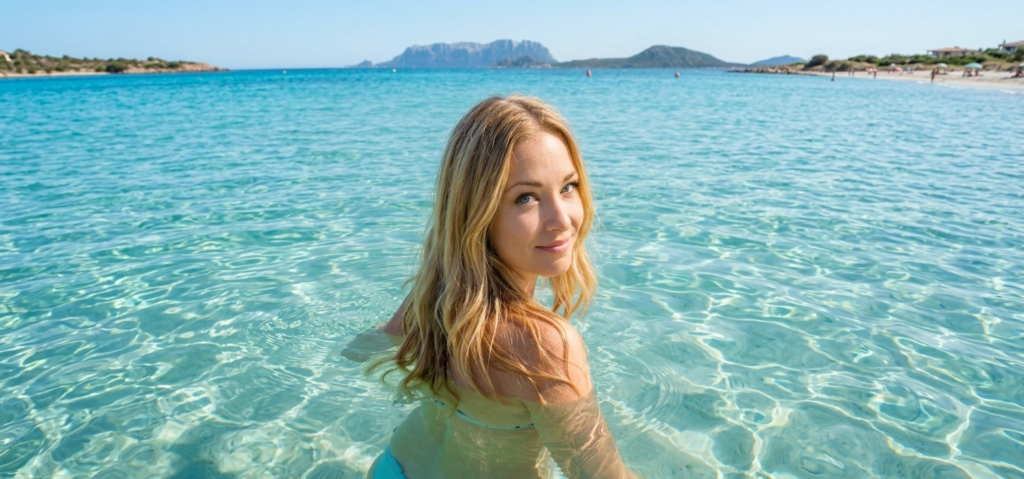
The Costa Smeralda on the northern coast is what most people picture when they think of Sardinia — turquoise water, white sand, yachts. It’s beautiful and it’s also the least Sardinian part of the island. I drove west instead, to the Sinis Peninsula, and found beaches made of quartz crystals — actual quartz, not sand — that crunch underfoot and turn the water a colour that looks edited. I swam alone for an hour at Is Arutas and didn’t see another person. In August. In Italy. Sardinia doesn’t share unless you go looking.
I ate in a small village called Oliena, in a place where the menu didn’t exist because the menu was whatever the family had cooked. Pane carasau, the thin crisp bread shepherds carried into the mountains. Culurgiones, hand-folded pasta filled with potato and pecorino, sealed by hand in a pattern that looks like a wheat sheaf. Porceddu, suckling pig roasted over myrtle wood. The owner brought out a bottle of Cannonau — Sardinia’s signature red — and told me, without prompting, that Sardinia has one of the highest concentrations of centenarians in the world. One of the original Blue Zones. People here live past one hundred at rates that statisticians can’t fully explain. Diet, walking, family, wine, slowness. Sardinia isn’t trying to live longer. It just refuses to live faster.
Amalfi Coast — Italy Part 3
The drive from Sorrento to Amalfi along the SS163 is one of those roads that punishes you for looking at the view because the road itself demands every ounce of attention. Hairpin turns carved into vertical cliffs. Buses passing each other with centimetres to spare. Lemon groves clinging to terraces that shouldn’t be possible. And below, the Tyrrhenian Sea in shades of blue that the rest of the Mediterranean has been trying to copy for decades.
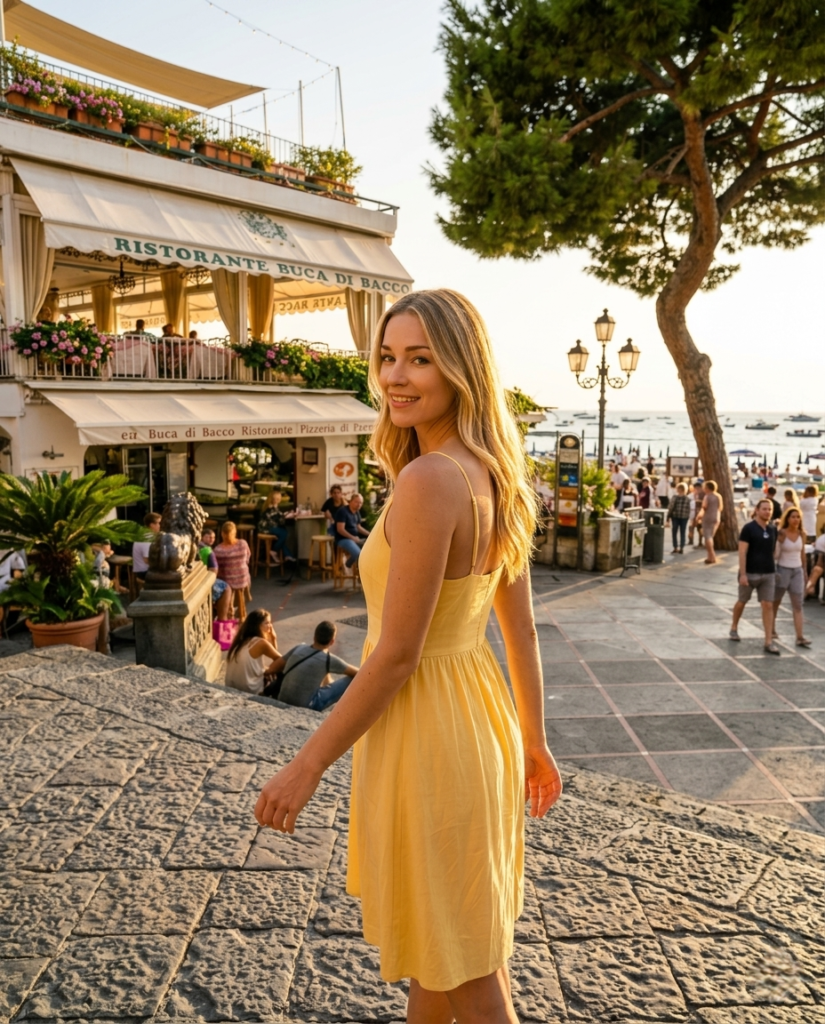
Positano cascades down the cliff like someone tipped a box of pastel houses and forgot to clean them up. I walked the steps from the upper town to the beach — there are no roads through the centre, just stairs — and every level revealed a new view I wanted to stop and stare at. The Church of Santa Maria Assunta sits at the bottom with its majolica-tiled dome, and inside hangs a Byzantine icon of the Madonna that legend says ordered sailors to land here by speaking the words “posa, posa” — put me down. The town is named after a command from a painting. That’s the Amalfi Coast in one story.
Amalfi itself was once a maritime republic that rivalled Venice, Genoa, and Pisa. From the 9th to the 12th century, this small town controlled trade routes across the Mediterranean and produced one of the first navigation manuals, the Tabula Amalphitana. I stood in the main square in front of the cathedral — striped façade, monumental staircase, Arab-Norman bell tower — and tried to imagine the harbour full of trading ships from Constantinople and Alexandria. The town still feels like it remembers, even if the world doesn’t.
I took a boat to the Grotta dello Smeraldo, the Emerald Grotto, where sunlight enters through an underwater opening and turns the cave water into glowing green. It’s the same physics as the Blue Cave on Biševo, but a different colour, a different mood. The Mediterranean keeps using the same trick because it works.
Ravello was the surprise. High above the coast, away from the cruise crowds, sitting in the gardens of Villa Cimbrone — the Terrace of Infinity — I looked out over a view that Wagner, Greta Garbo, Virginia Woolf, and Gore Vidal all came here to find. The terrace lines busts along a stone railing, and beyond them, the coast drops away into nothing. It’s called the Terrace of Infinity because there’s no visual end. Just sea and sky meeting somewhere your eyes can’t measure. I stayed there until the light went.
Three Italys. One absorbed every civilisation that ever touched it and turned them all into something only it could be. One hid in the centre of the Mediterranean for so long that it became a country that doesn’t quite belong to any continent. One performs the version of Italy the world thinks it knows — and earns it by being honestly that beautiful.
This country doesn’t have one identity. It has twenty, and they barely tolerate each other, and that’s exactly what makes it the country it is.
Next week — more Italy, up north. Where the south remembers what the north forgot.

Beyondia
Trusted Travel CompanionReal digital nomad. I travel. I learn. I grow.
What about you? Where are you going?