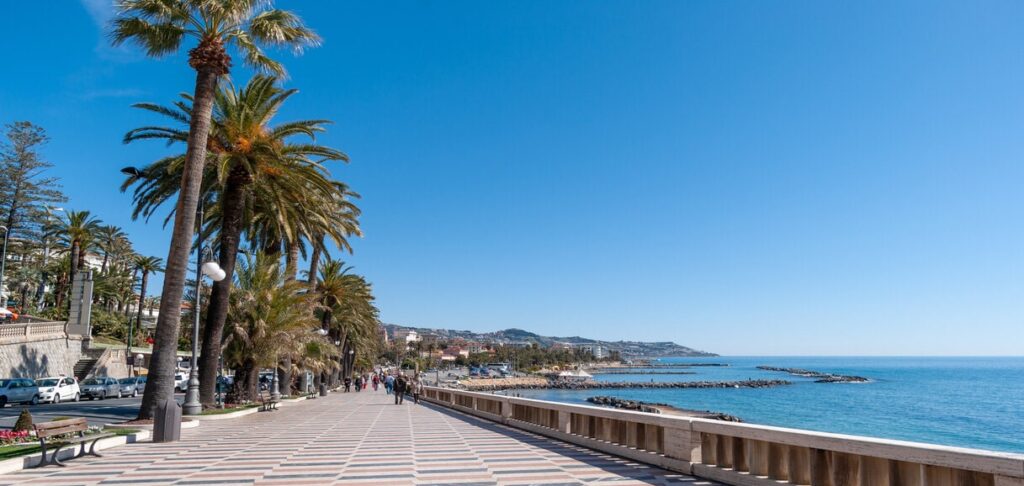
🌐 Around the World with Beyondia 🧵 Mediterranean Region 🪡 Episode 30: Sanremo
A flower town with a casino. A casino with a singing competition. A singing competition that, by 1956, the entire continent had agreed to copy.
Sanremo — Riviera dei Fiori
In the late nineteenth century, on a small stretch of the western Ligurian coast that the Italians had begun to call the Riviera dei Fiori — the Flower Coast — a town named Sanremo began doing something other Italian towns were not doing. It grew flowers commercially, at industrial scale, for export. Carnations, roses, mimosa, ranunculi, gerberas, anemones — all cultivated on terraced fields above the coast, irrigated by hand, cut at dawn, and packed onto refrigerated trains that ran north through Marseille and Lyon to Paris, Brussels, London, Berlin, Vienna, and on across the Russian border to Saint Petersburg. The town did this because the geography made it possible. The Maritime Alps rise to over two thousand metres directly behind the coast at this point, blocking the cold northern airflows that produce winter frost everywhere else in northern Italy. The Mediterranean Sea, immediately south, provides thermal mass. The two together produce a coastal slope with the highest annual sunshine hours in northern Italy and a climate that is essentially Provençal — flowers in February, roses through May, mimosa from late January. By the 1880s, Sanremo was supplying the cut-flower needs of every major European court. By 1900, it was Europe’s largest wholesale flower market. The town’s economy was, for nearly a century, almost entirely floral.
The European royalty who had been buying these flowers gradually began to arrive in person. The pattern repeated across the late nineteenth century. The Empress Maria Alexandrovna of Russia spent the winter of 1874 in Sanremo for her health and brought a Russian court entourage with her; her son, the future Czar Alexander III, came to visit. Empress Elisabeth of Austria — Sissi — wintered there repeatedly between 1881 and 1894. The Romanian Queen Elisabeth, the German Empress Frederick, the British royal cousins, and a steady tide of lower European nobility followed. Sanremo became one of the four or five great winter resorts of the European belle époque, alongside Nice, Monte Carlo, Menton, and Cannes — the others on the French side of the same coast. The architecture of the town’s old promenade, the Corso Imperatrice, was named after the Russian empress and built largely with funds she donated. The grand hotels — the Hotel Royal, opened in 1872, still operating — were built specifically to house this clientele. The town built a casino in 1905. Aristocrats had to gamble.
Among the foreign residents who came to Sanremo for the climate and stayed was the Swedish industrialist Alfred Nobel — the inventor of dynamite, the patent-holder of the detonator that built the modern industrial age, and the man whose will, signed in 1895, established the prizes that bear his name. Nobel suffered from chronic heart trouble and was advised to spend winters in mild coastal climates. He bought a villa in Sanremo in 1891 — the Villa Nobel, on the Corso Imperatrice, surrounded by gardens of mimosa and palms — and lived there for the last five years of his life. He died in his bedroom in the Villa Nobel on the 10th of December 1896. His will had been signed in Paris the previous year. The Nobel Prizes were first awarded in 1901, five years after his death. The man who created the framework that the world still uses to recognise its greatest scientific, literary, and humanitarian achievements wrote, signed, and concluded his testamentary intentions in a flower town on the Italian Riviera, dying in a bedroom with a view of bougainvillea. The villa is now a small museum. The bedroom is preserved. The geraniums on the windowsill are replaced seasonally.
Then came the war, and after the war, Europe’s royal class was largely gone — abdicated, executed, exiled, or absorbed into republics that no longer required winter resorts. Sanremo’s grand hotels emptied. The casino, opened in 1905, struggled. The flower industry survived, but the aristocratic tourism that had paid for the architecture did not. By the late 1940s, the town’s leadership was looking for a way to revive winter revenue. In 1951, the casino’s management, supported by the Italian state radio broadcaster RAI, proposed something unprecedented: a national song competition. Italian composers would submit original songs. Established singers would perform them. A jury would vote. The entire competition would be staged inside the Sanremo Casino’s Salone delle Feste and broadcast live on Italian national radio. The first Festival della Canzone Italiana opened on the 29th of January 1951 with three nights of performances by three singers — Nilla Pizzi, Achille Togliani, and the Duo Fasano — performing twenty different songs in rotation, every song competing against every other song. Pizzi won with Grazie dei Fiori — “Thanks for the Flowers” — a song whose title was, in retrospect, the article’s entire history in three Italian words. The festival was an immediate national sensation. RAI broadcast it nationally the following year. By 1953, it was the most-watched television programme in Italy.
The European Broadcasting Union, the consortium of Western European state broadcasters established in 1950, had been looking for a way to demonstrate the technical possibilities of live cross-border television transmission. In 1955, Marcel Bezençon, the director general of Swiss public broadcasting and a founding member of the EBU, proposed a continental song contest modelled directly on Sanremo. The EBU adopted the proposal. The first Eurovision Song Contest was held in Lugano, Switzerland, on the 24th of May 1956 — five years and four months after Sanremo had invented the format. The Eurovision rules were essentially the Sanremo rules transposed to a continental scale: national submissions, original compositions, live performance, jury voting, live broadcast. Switzerland won the first contest. Italy was one of the seven founding nations. Every Eurovision Song Contest since — sixty-eight editions through 2025, broadcast to between 150 and 200 million viewers annually — has been a direct descendant of what the Sanremo Casino broadcast on three nights at the end of January 1951. The cultural genealogy is unbroken. ABBA’s Waterloo in 1974, Conchita Wurst in 2014, Måneskin in 2021, Loreen winning twice — all of it ultimately traces back to a flower-town casino in Liguria competing for radio airtime in the winter off-season.
The contest stayed in Sanremo. The Festival della Canzone Italiana — known internationally simply as Sanremo — has been held in the same town every year since 1951, with the exception of one cancelled year during a regulatory dispute. It is now held in the Teatro Ariston rather than the original casino, because by the 1970s the festival’s audience had outgrown the casino’s hall. The festival runs five nights every February and remains, every year without fail, the most-watched television event of the year in Italy. In 2024, the festival attracted over twelve million viewers per night, with audience shares above 65%. The winner of Sanremo earns the right to represent Italy at Eurovision. Italian artists who have won Sanremo include Domenico Modugno (Nel blu dipinto di blu — Volare — 1958, which then placed third at Eurovision and went on to become the most successful Italian pop song in history, recorded by Dean Martin, Frank Sinatra, Bobby Rydell, Cliff Richard, and hundreds of others). Eros Ramazzotti. Laura Pausini. Andrea Bocelli (presented his first solo song at the festival in 1994). Måneskin won in 2021 and then won Eurovision the same year. The festival is the engine. The country runs on it.
This is what Sanremo has been doing for a hundred and fifty years. The flowers were the original export. The aristocratic tourism was the consequence. The casino was the financial infrastructure. The song festival was the post-war reinvention. The Eurovision Song Contest is the worldwide descendant of the format. The microclimate on a slope of the Maritime Alps produces three things at industrial scale: cut flowers, winter tourists, and pop music. The chain is real, if you trace it. Most visitors do not.
This is, in a quieter way, the story of the entire Italian arc this series has just walked through. Sicily was a country before Italy existed. Amalfi was the postcard that had been a republic. Rome was every era of Europe still in business. Sardinia was the island Rome could not conquer. Florence was the town of forty thousand that invented modernity. Venice was the republic in a swamp that ran the Mediterranean. Bolzano was the city that refused to become Italian. Garda was the Mediterranean climate the Alps were holding. Sanremo is the small port that quietly wrote the genetic code of European pop, after first growing the flowers that brought the royalty that built the casino that hosted the festival that became the contest the continent now watches every May. None of these articles is the Italy of the postcard. All of them are Italy. The country exports more than it ever advertises. It has been doing this for two and a half thousand years. The current shipment is roses, songs, and the format of every televised competition on the continent.
The Italian arc closes here, on a flower town that thinks of itself, modestly, as a place where flowers grow and singers sing. The rest of the country, behind it, contains everything else.
Nine regions. One hundred and twenty destinations. Three hundred and thirty-one weeks remaining.
The next shore is French, and starts with a small Italian-speaking town that has not entirely agreed with the border.

Beyondia
Trusted Travel CompanionReal digital nomad. I travel. I learn. I grow.
What about you? Where are you going?