Around the World with Beyondia 🧵 Mediterranean Region 🪡 Journal 10
Bolzano. Lago di Garda. Sanremo. The part of Italy that makes you question everything you thought Italy was.
Bolzano — The Alps
I took a train north from Verona and watched Italy dissolve out the window. The vineyards stayed but the language on the station signs changed. By the time I stepped off in Bolzano, the announcements were in German first, Italian second, and the architecture looked like it had been airlifted from Innsbruck.
Bolzano is the capital of South Tyrol — a province that belonged to Austria until 1919, when the Treaty of Saint-Germain handed it to Italy after World War I. A hundred years later, the identity question still hasn’t settled. Street signs are bilingual. Menus list Knödel and Strudel alongside pasta. The cathedral is Gothic, not Baroque. The main square, Piazza Walther, is named after a medieval German poet. I sat in a café eating apple strudel and drinking espresso and couldn’t decide which country I was in. That’s the point. Bolzano doesn’t choose. It holds both and dares you to be uncomfortable with it.
I went to the South Tyrol Museum of Archaeology for one reason — Ötzi. The Iceman. A 5,300-year-old mummified man found in 1991 in a glacier on the Austrian-Italian border, preserved so perfectly that scientists identified his last meal, his tattoos, his diseases, and the arrowhead lodged in his shoulder that killed him. He’s displayed in a refrigerated chamber behind a small window, and looking at his face — an actual human face from 3,300 BC — was one of the strangest moments of this entire journey. Not because of the science. Because he looked tired. Five thousand years and the expression on his face was the same one I’ve seen on commuters at rush hour. Some things about being human haven’t changed at all.
I walked through the old town under arcaded streets where the market has been running since the Middle Ages. Fruit stalls selling apples from orchards visible from the town centre. Speck hanging in shop windows — the smoked, cured ham that South Tyrol does better than anywhere and argues about constantly. The Dolomites framed the end of every street, pale limestone towers catching the afternoon light, turning pink at sunset in a phenomenon called enrosadira that the Ladin people — the third linguistic group here, after German and Italian — have explained through mythology for centuries. Bolzano isn’t confused. It’s layered. Three languages, two countries’ worth of history, and mountains that don’t care about borders.
Lago di Garda — The Lake
The exhale.
I drove west and the mountains opened into the largest lake in Italy — 51 kilometres long, stretching from Alpine cliffs in the north to gentle Mediterranean hills in the south. The lake is so large it creates its own microclimate. Lemon trees grow on the northern shores at a latitude where they have no business surviving. The limonaie — the terraced lemon houses built into the cliffs around Limone sul Garda — have been protecting citrus trees from Alpine winters since the 13th century. Lemons at the foot of the Alps. Garda doesn’t follow rules.
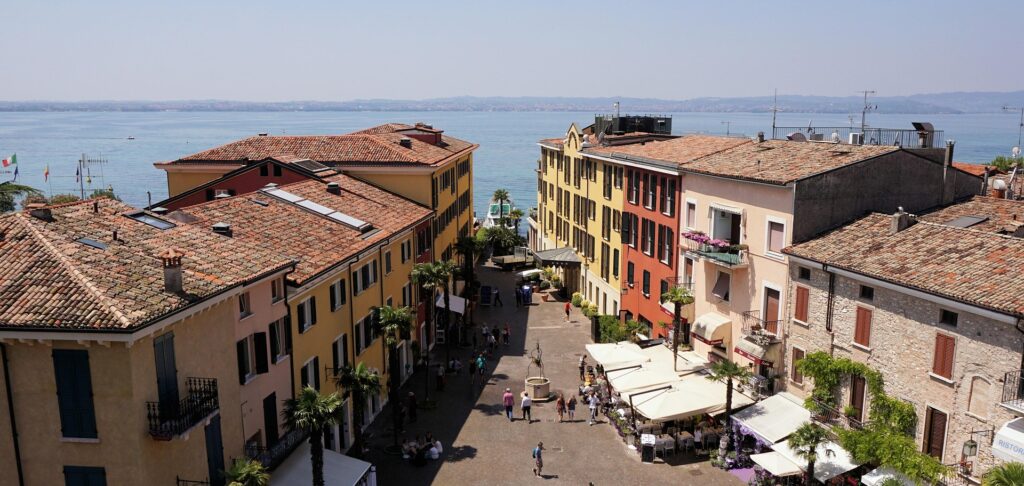
I took a ferry from Riva del Garda in the north to Sirmione in the south and watched the lake change character in real time. The north is fjord-like — steep, dramatic, wind-surfed by Germans and Austrians who treat it as their Adriatic. The middle softens. By the time I reached Sirmione, the water was warm and flat and the peninsula pushed out into the lake with a Scaligero castle at its tip, built in the 13th century by the lords of Verona, its walls rising directly from the water like someone dropped a fortress into a bathtub.
I walked to the far end of Sirmione and found the Grotte di Catullo — the ruins of a Roman villa from the 1st century BC, named after the poet Catullus who wrote about the peninsula. Whether Catullus actually lived here is debated. What isn’t debated is the view — olive trees growing through ancient stone, the lake stretching in every direction, and a silence that felt earned after weeks of Italian noise. I sat among the ruins and ate an olive oil gelato that tasted like Garda had figured out how to put the whole lake into a cup.
Sanremo — The Riviera
Italy changed costume again.
The Ligurian coast caught me off guard. I was expecting the French Riviera’s quieter cousin. What I got was a town with a split personality and no interest in therapy.
The Casino Municipale sits on the main road, Art Nouveau, white and ornate, built in 1905 — Sanremo has been a gambling destination since the 19th century, when European aristocracy came for the mild winter climate and stayed for the roulette tables. The building still operates and still carries the faded glamour of a time when the Riviera meant fur coats and scandal.
But Sanremo is also the home of the Festival della Canzone Italiana — the oldest popular music festival in Europe, running since 1951. Every February the town transforms. The Ariston Theatre hosts a competition that has launched careers across Italy and beyond. Eurovision owes its format to Sanremo. I walked past the theatre on a quiet Tuesday and it was just a building on a normal street, which made it more impressive somehow — the idea that this ordinary-looking place has been the starting line for Italian music for over seventy years.
I climbed into La Pigna — the old town — and the glamour vanished. Medieval streets stacked on top of each other, dark and narrow, laundry overhead, cats claiming every available surface. La Pigna is what Sanremo was before the casino and the music festival arrived, and it sits directly above the manicured seafront like a reminder that the town has a backbone under the sequins.
The flower market was the part I didn’t expect to care about and couldn’t stop thinking about. Sanremo is one of the largest flower markets in Europe — the Mercato dei Fiori moves millions of stems daily, roses and carnations and mimosa grown in the hills behind the town where the climate cooperates year-round. I walked through at five in the morning when the trading floor was alive and the smell was almost violent — that much concentrated flower in one enclosed space does something to your brain that coffee can’t compete with. The entire economy of the hills above Sanremo is built on something beautiful and perishable. There’s a metaphor in there but Sanremo isn’t the kind of town that needs me to spell it out.
Three stops in the north. One couldn’t decide which country it belongs to and is better for the confusion. One stretched from the Alps to the Mediterranean in a single body of water and broke every climate rule along the way. One hid a medieval town behind a casino and a song contest and grew flowers like its life depended on it — because it does.
I came to Italy the first time and saw Rome, Florence, Venice. The Italy everyone knows. This time I went north and found an Italy that doesn’t match the brochure, doesn’t speak one language, and doesn’t apologise for any of it.
The brochure was never the real country. This is.
The journey continues. But northern Italy taught me to stop assuming I know what’s next.

Beyondia
Trusted Travel CompanionReal digital nomad. I travel. I learn. I grow.
What about you? Where are you going?