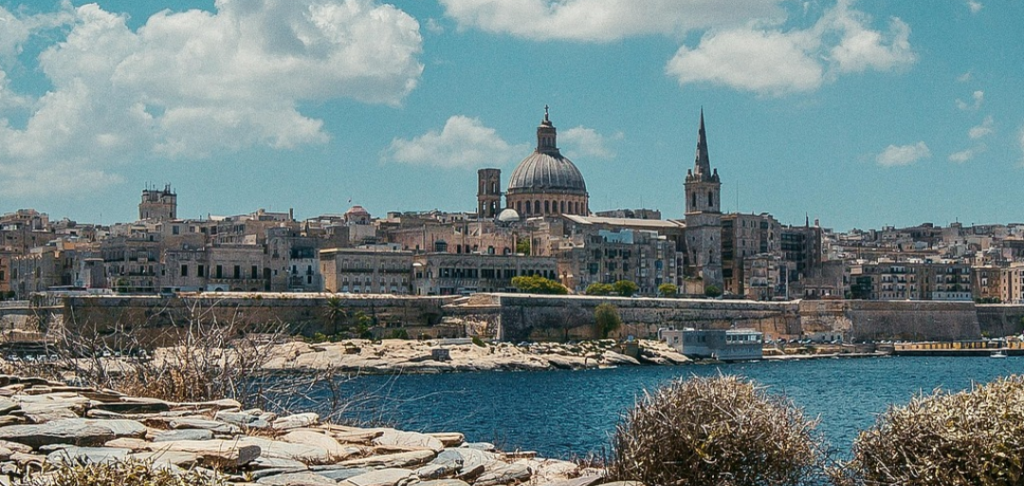
🌐 Around the World with Beyondia 🧵 Mediterranean Region 🪡 Episode 21
Valletta was designed entirely on paper before anyone laid a stone. The drawing is what the city actually became
Valletta — Named after Jean Parisot de Valette
In September 1565, on a small island in the central Mediterranean, an army of religious knights — outnumbered roughly four to one — survived a four-month siege by the Ottoman Empire and forced its withdrawal. The siege had been mounted by Suleiman the Magnificent, who had also taken Rhodes from the same Order forty-three years earlier and was now trying to finish what he had started. The Knights’ commander on Malta, an aged French nobleman named Jean Parisot de Valette, did not surrender his ruined fortifications. He held. When the Ottoman fleet finally turned for home in September, contemporaries across Europe described it as the most consequential Christian military victory of the century. Voltaire, two hundred years later, would write that nothing was better known than the Siege of Malta. The man who held it, de Valette, was sixty-eight years old. The Knights had lost roughly a third of their men. The fortifications they had defended were rubble.
The year after the siege ended, the Order took a decision unlike any military reorganisation in Mediterranean history. Instead of repairing what was destroyed, they commissioned a new capital from scratch — built on the highest, narrowest, most defensible peninsula on the island, the rocky finger of land called Sciberras, between two natural harbours. They hired an Italian military engineer named Francesco Laparelli, who had worked for Michelangelo on Saint Peter’s in Rome, to design the entire city before any of it was built. Laparelli arrived in Malta in December 1565. By March 1566 he had completed the master plan: a grid of nine streets running the length of the peninsula, crossed by twelve streets at right angles, terminating at bastioned walls on three sides facing the sea. Wide thoroughfares for the movement of artillery. Underground water cisterns under every house. Sloped streets running uphill from the harbour for natural drainage. Defensible against landward and seaward attack simultaneously. On 28 March 1566, with the foundation stone laid by de Valette himself, the first European capital of the modern era to be entirely planned in advance began to rise. Five years later, by 1571, the basic city was substantially complete. The capital that would carry the Order’s name was finished while the Grand Master who had inspired it lay buried inside its first cathedral. He had died in 1568, three years into the construction. The city was named Valletta for him in his lifetime, and remained Valletta after his death.
The fact that this happened in 1566 should be impossible. Versailles, the next great planned project in European capital design, would not begin for another century. Saint Petersburg, conceived from scratch by Peter the Great, would not be founded until 1703. Washington DC, designed by Pierre L’Enfant on a similarly comprehensive plan, would not be drawn until 1791. Valletta predates every one of them. It is the first European city built from a single drawing, by a single architect, in a single decade — and the drawing is largely what the city is today. Walk the grid now and you are walking Laparelli’s 1566 plan with very few significant deviations. The streets are the streets he drew. The bastions are the bastions he designed. Most of the major palaces — the Grand Master’s Palace, the Auberges of the national tongues of the Knights, the Sacra Infermeria hospital — sit on the plots Laparelli marked for them when the city was still bare rock. UNESCO inscribed the entire city in 1980.
Valletta was not a royal capital
What is harder to convey is what kind of city this was meant to be. Valletta was not a royal capital. It was not a commercial entrepôt in the manner of Venice or Genoa. It was a convent, in the original militant medieval sense — the headquarters of a religious-military order whose individual members took vows of chastity, poverty, and obedience while running one of the most sophisticated naval operations in the early modern Mediterranean. The Knights of Malta were monks who fought as a corporation. They paid a small annual tribute to the Holy Roman Emperor — symbolically, one Maltese falcon, sent each year. That bird is the origin of the title of Dashiell Hammett’s 1930 novel and the 1941 film, neither of which most viewers connect, when they say the words, to a real tribute paid for two hundred and sixty-eight years to keep the Knights’ lease on the island. The Knights were also, in their day, the largest single charitable medical organisation in Europe. The Sacra Infermeria they built in Valletta in the 1570s had wards with marble floors, individual silver plate for each patient, separate quarantine corridors, and a long ward — the Great Ward — over 150 metres long, considered the longest hospital ward in early modern Europe. They cared for any Christian who needed care, regardless of nationality, and for Jews and Muslims in separate but functional wards. It was a city run by men sworn to medicine and to war.
The painting they commissioned, when they finally needed art equal to the architecture, is the single greatest painting Caravaggio ever made. Caravaggio arrived in Valletta in the summer of 1607, on the run from a murder charge in Rome. The Knights, almost incredibly, took him in. He was knighted into the Order in July 1608, sworn to chastity, poverty, and obedience like every other member. He immediately began the great altarpiece for the chapel of the Italian langue in the Co-Cathedral of Saint John: The Beheading of Saint John the Baptist, three and a half metres by five metres, the largest painting he ever produced. He completed it in 1608. In the executioner’s blood, pooling at the saint’s neck, Caravaggio signed his Knight’s name — F. Michelangelo — and that is the only signature he ever put on any painting in his life. The painting still hangs where he painted it. The chapel is the chapel. The cathedral is the cathedral. Almost no other major Caravaggio in the world is in the room it was painted for. This one never moved. By the autumn of 1608, Caravaggio had assaulted a senior knight, been imprisoned, escaped, fled Malta, and been expelled from the Order in absentia. He was dead within two years. The painting stayed.
This is what Valletta does. The city was built once, designed once, and never significantly rebuilt. The hospital still stands. The Co-Cathedral still holds the Caravaggio. The Auberges — the inns of the national tongues — are now Maltese government ministries, but they are in the same buildings, on the same plots, with the same coats of arms above the doors. During the Second World War, Valletta and Malta endured one of the longest and heaviest aerial bombardments of any sustained civilian target in the war — 3,000 air raids over two years. The island was awarded the George Cross by King George VI in 1942, the only time the medal has been collectively awarded to a civilian population. The Maltese repaired the rubble and put the city back where Laparelli had drawn it. The wartime damage is visible, in places, as patches of newer stone. The plan beneath it is still 1566.
Some cities grow until they forget what they were. Valletta has been the same city, in the same shape, on the same plan, doing roughly the same things, for four hundred and fifty-nine years. It is one of the smallest national capitals on Earth — barely a kilometre long, half a kilometre wide, with a permanent population of about six thousand. The country it governs has half a million people. The harbour it overlooks is one of the great natural harbours of the Mediterranean. And somewhere in the same compressed grid where a Caravaggio hangs, the Maltese parliament is in session, a bar is serving pastizzi to office workers, and the wind off the Grand Harbour is moving across honey-coloured limestone laid down by an Italian engineer who had never been to Malta until the year he designed its capital.
Some places are made by accident. This one was drawn first, then built.
Nine regions. One hundred and twenty destinations. Three hundred and forty weeks remaining.
The central Mediterranean closes here. The next shore is Italy again.

Beyondia
Trusted Travel CompanionReal digital nomad. I travel. I learn. I grow.
What about you? Where are you going?