🌐 Around the World with Beyondia 🧵 Mediterranean Region 🪡 Episode 49: Casablanca
Casablanca is the largest city in Morocco, the largest port on the North African Atlantic coast, and one of the largest cities in Africa. The commune has a population of approximately 3.7 million; the greater metropolitan area is close to 4.4 million.
Casablanca is the working modern economic capital
It sits on the Atlantic coast approximately ninety kilometres south of Rabat, and functions as the country’s economic capital in almost every measurable sense: approximately 80% of Morocco’s financial services, 60% of Morocco’s industrial production, the largest port in North Africa by container volume (approximately 27 million tonnes of cargo per year), the Casablanca Stock Exchange (the third-largest African stock exchange by market capitalisation after Johannesburg and Cairo), the headquarters of Royal Air Maroc, of the four largest Moroccan commercial banks, and of most major Moroccan corporations. Mohammed V International Airport, thirty kilometres south of the city, is Morocco’s principal international gateway and one of the busiest airports in Africa, handling approximately 12 million passengers per year. The political capital of Morocco is Rabat, ninety kilometres north; the tourism capitals are Marrakech, Fez, and Chefchaouen further inland; the historic imperial capital was Meknes further east. Casablanca is none of those things. Casablanca is the working modern economic capital of a country whose historic and touristic identities are elsewhere.
The remarkable fact about the city — and the one that most foreign visitors do not carry — is that Casablanca as it currently exists is barely older than the average European reader’s grandparents. In 1907, when French colonial forces landed at the port to protect European economic interests after violence against European workers, Casablanca (or Dar el-Beida in Arabic, “the white house,” the name from which the Spanish and Portuguese Casablanca derive) was a small Atlantic port of approximately 25,000 people. It had a small medina behind a defensive wall, a working harbour used primarily for the export of wool, cereals, and small quantities of local craft goods, and no significant contemporary international economic role. It had been a small trading port for centuries — the Portuguese had briefly occupied it in the sixteenth century, calling it Casa Branca, before an earthquake in 1755 caused them to abandon it — but at the beginning of the twentieth century it was substantially smaller and less economically significant than Rabat, Fez, Marrakech, Tangier, or Meknes. The Alaouite Sultan Moulay Abdelaziz ruled Morocco from Rabat and Fez. Casablanca was, by Moroccan standards of the time, provincial.
The 1907 French landing was the beginning of the transformation. The intervention was ostensibly to protect European lives after violence against port workers, but it triggered the sequence of diplomatic and military manoeuvres that culminated, in 1912, in the establishment of the French Protectorate of Morocco under the Treaty of Fez. Marshal Hubert Lyautey, appointed as the first French Resident-General, arrived in 1912 with a distinctive urban planning philosophy: he refused to allow European construction inside the historic medinas of Moroccan cities, insisting instead that new European-style cities (villes nouvelles) be built adjacent to the existing Arab-Andalusian settlements, preserving the traditional urban fabric while creating modern French infrastructure alongside it. Lyautey selected Casablanca as the primary economic development site of the Protectorate — precisely because, unlike Rabat, Fez, or Marrakech, it had no significant historic urban fabric to conserve, no established religious or noble institutions to negotiate around, and an excellent natural harbour that could be expanded into a modern deep-water port. He commissioned the urban planner Henri Prost, one of the leading European urban theorists of the early twentieth century (later famous for his major redesign of Istanbul in the 1930s), to design the ville nouvelle of Casablanca on a scale appropriate to the economic capital of the Protectorate.
Prost’s plan was executed with unusual speed and ambition. Between 1912 and 1930, adjacent to the small existing medina, an entirely new city was constructed on what had been agricultural land. Wide boulevards radiating from the central Place de France (now Place des Nations Unies). A modern deep-water port with grain silos, container facilities, and passenger terminals. Tramways, water supply, sewage, electric lighting. Administrative buildings, banks, offices, apartment blocks, cinemas, cafés, and department stores. The architectural language of the new city was aggressive and stylistically ambitious: art deco (particularly from the mid-1920s onwards), Mauresque (a hybrid style incorporating Moroccan geometric and Islamic decorative motifs into art deco frames — a specifically Moroccan colonial architectural invention), and streamline modernist styles from the 1930s. The individual buildings were designed by a group of architects including Marius Boyer, Édouard Brion, Auguste Cadet, Pierre Jabin, and Emile-Jean Duhon, most of whom worked in Casablanca continuously through the 1920s and 1930s and produced substantial personal portfolios of interconnected work. The result — completed by the mid-1930s but continuously extended through the 1940s and 1950s — is one of the largest concentrations of early twentieth-century art deco architecture anywhere in the world. Casablanca’s art deco quarter contains, by various estimates, several thousand individual heritage-worthy buildings across roughly ten square kilometres of the city centre, and is sometimes described as containing more art deco buildings than Miami Beach and Napier (the two other most-cited global art deco urban concentrations) combined. Most foreign readers who fly into Casablanca and go directly to the medina or the Hassan II Mosque never see it. The visitor who spends a morning walking from Place des Nations Unies along Boulevard Mohammed V to the old central market at Marché Central sees the largest early-twentieth-century art deco urban ensemble in Africa, and one of the largest in the world.
Casablanca contains substantial informal settlements
The population growth during this period is the second remarkable fact about Casablanca. From 25,000 in 1907, the city grew to approximately 100,000 by 1921, to 250,000 by 1936, to 700,000 by 1952 (when it had already become the largest city in Morocco), to 1.5 million by 1971, to 3 million by 1994, to approximately 3.7 million in the commune today. That is a 148-fold increase in 119 years — one of the fastest sustained urban growth rates of any major city in twentieth-century world history. The growth reflected internal Moroccan migration from the countryside toward the industrial economy that the French Protectorate was building in Casablanca, external migration from France and other European countries to the colonial economy, and post-independence internal migration continuing at high rates from rural Morocco toward the country’s principal source of industrial employment. The consequence, still visible in the contemporary city, is that Casablanca contains substantial informal settlements (bidonvilles) around its periphery — informal housing constructions built by rural migrants without official planning permission, some of which have been in place for generations and have gradually acquired urban infrastructure, others of which remain in fundamentally precarious conditions. Successive Moroccan governments have pursued programmes to convert or replace the bidonvilles with formal housing, with mixed and partial results. The city’s contemporary social geography — the wealthy neighbourhoods of Ain Diab and Anfa on the Atlantic coast west of the centre, the middle-class art deco central districts, the working-class quarters of Ben M’sik and Sidi Bernoussi, the peripheral bidonvilles — reflects a century of rapid, layered growth that has never quite been fully absorbed into formal urban planning.
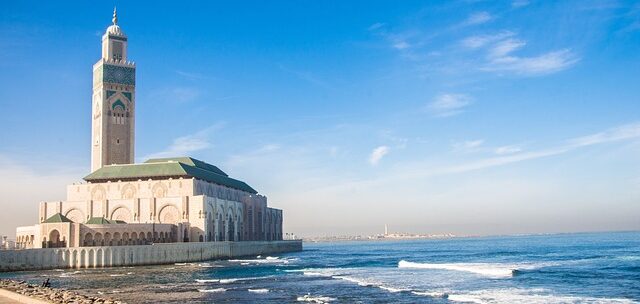
The most visible single addition to the city in the past forty years is the Hassan II Mosque. Commissioned by King Hassan II in 1980 to commemorate his sixtieth birthday, designed by the French architect Michel Pinseau (who lived in Morocco for most of the project’s duration), and built between 1986 and 1993 on a partly artificial platform extending over the Atlantic Ocean at the western edge of the city centre, the mosque is one of the largest religious buildings in the world. The prayer hall, which measures 200 metres by 100 metres, can hold 25,000 worshippers; the surrounding courtyard can hold an additional 80,000, for a total capacity of 105,000 people. This makes it the second-largest functioning mosque in the world by capacity, after Masjid al-Haram in Mecca. The minaret is 210 metres tall — at the time of completion in 1993, this made it the tallest religious structure in the world; it remains among the tallest such structures today, exceeded only by a small number of Christian cathedral spires and by more recent mosque constructions. Portions of the prayer hall floor are transparent glass over the Atlantic, so worshippers pray literally above the ocean. The roof of the prayer hall opens hydraulically to reveal the sky. A laser mounted at the top of the minaret projects a beam eastward toward Mecca. The mosque was built by approximately 10,000 Moroccan craftsmen using primarily local materials — marble from Agadir, cedar wood from the Middle Atlas mountains, granite from the Tafraout region — and represents one of the largest single organised showcases of traditional Moroccan craftsmanship in the modern era. The financing came from public subscription: approximately 12 million Moroccan citizens contributed to the construction fund, with the state providing the balance. Estimates of total construction cost range from $500 million to $800 million. The project was celebrated by many Moroccans as a genuine national achievement of craftsmanship and religious expression; it was also criticised by some as a monumental expenditure at a time when significant portions of the Moroccan population lived in poverty. Both positions are honestly held. The mosque is now one of the most-visited monuments in Africa, and one of the few large functioning mosques in the world routinely open to non-Muslim visitors on organised tours.
The Hassan II Mosque is a useful case study in monumental religious construction in the modern era, and the analogy that lands most cleanly for European readers is the Sagrada Família in Barcelona. Different faiths, different centuries, different scales, but comparable patterns: monumental religious buildings that concentrate national craftsmanship traditions, generate substantial public participation (Sagrada Família through visitor donations at a rate of approximately €25 million per year, Hassan II Mosque through direct public subscription of the initial construction), function as continuous employment for traditional craftsmen (Gaudí’s continued stone-carving school; Hassan II’s zellige tilework and cedar carving workshops), and become defining civic symbols of their cities that outlast the political circumstances of their commission. Both buildings were controversial in their times. Both are now essentially unchallenged as their cities’ most photographed structures. The article does not need to resolve the debate about whether monumental religious construction is the correct use of public and private resources in economically stratified societies. The article simply notes that Casablanca now has one, that Barcelona now has one, and that both are inescapable features of their cities’ contemporary experience.
Pre-colonial Casablanca
Underneath the twentieth-century city, some older Casablanca survives. The Ancienne Médina — the pre-1907 walled old city — is small by Moroccan standards (approximately 45 hectares, compared to Fez’s 280-hectare medina or Marrakech’s 700-hectare medina) and less architecturally distinguished than its counterparts inland. It is still worth visiting: the winding streets, the small souk, the historic mosques (the Grand Mosque of the medina dates from the eighteenth century), the fishing port at the western edge where small boats still land daily catches, are the surviving fragment of pre-colonial Casablanca. The New Medina (Quartier des Habous) is more interesting architecturally, though it is not old in any strict sense: it was constructed by the French colonial administration in the 1930s as a designed “traditional Moroccan quarter” for the growing local population that was being displaced by the ville nouvelle construction. The Habous quarter, built between 1918 and 1955 in an arabisant architectural style that combines Andalusian, Moroccan, and modernist elements, is the closest thing central Casablanca has to a traditional Moroccan cityscape — narrow whitewashed streets, arched passageways, small squares with fountains, and craft shops and bookshops (Habous is the traditional bookseller quarter of the city). It is not an authentic medieval medina. It is a twentieth-century French colonial construction of what a medieval medina might look like if planned rather than accumulated. It is, in its own way, an interesting cultural artefact.
The contemporary city socialises along the Corniche — the long Atlantic seafront promenade running west from near the Hassan II Mosque toward the wealthy neighbourhood of Ain Diab. Cafés, restaurants, beach clubs, and boardwalks stretch for several kilometres along the ocean, and the promenade is one of the most heavily-used public spaces in the city on evenings and weekends. Ain Diab itself contains the historic Villa des Arts contemporary art centre, the Notre Dame de Lourdes cathedral (an unexpectedly striking 1950s modernist Catholic cathedral, with stained glass by the French artist Gabriel Loire), and some of the most expensive residential real estate in Morocco. The port district on the eastern side of the Hassan II Mosque handles the commercial working city — Morocco is the world’s largest exporter of canned sardines, an industry concentrated in the Casablanca-Safi-Agadir Atlantic corridor, and much of the actual canning production takes place in industrial facilities on the port perimeter. The Casablanca sardine industry accounts for approximately 40% of the entire global canned sardine trade. Most tourists who take photographs of the Hassan II Mosque do not realise they are also photographing, in the background, one of the largest fish-processing complexes in Africa. Both are Casablanca. Both are true simultaneously.
There is one final observation the article should make, gently. The 1942 film Casablanca, directed by Michael Curtiz, starring Humphrey Bogart and Ingrid Bergman, was one of the most successful films of Hollywood’s studio era, won the Academy Award for Best Picture, and remains one of the most-quoted films in English-language cinema. It was shot entirely on a Warner Brothers soundstage in Burbank, California, over 59 days in the summer of 1942. Its writers — the Epstein brothers and Howard Koch — had never been to Casablanca. The film’s plot bears essentially no relation to the actual city that Vichy French colonial administration was operating in 1942 (though there was a genuine wartime refugee population passing through Casablanca en route to neutral Portugal and then to the Americas). Rick’s Café Américain does not exist and did not exist in 1942 — it was a Hollywood set. The Rick’s Café that operates in Casablanca today, in a restored riad on the edge of the medina at 248 Boulevard Sour Jdid, was opened in 2004 by an American former commercial-attaché diplomat named Kathy Kriger, as a deliberate tourism recreation of the fictional set. It is a competent restaurant with a piano that plays “As Time Goes By” on request. It is not a historic site. It is a themed restaurant based on a film shot in California about a place its writers had never visited. Any foreign visitor who wants to visit Rick’s Café should be allowed to enjoy the experience without correction. The article notes this only because the gap between what the film represents and what the city actually is remains one of the most substantial mismatches between foreign preconception and local reality of any major city in the world. The actual Casablanca — the working modern city with the largest port in North Africa, the vast art deco quarter, the second-largest mosque in the world, the growing financial services sector, and the multi-generational internal migration story of nearly four million people — is more interesting than the film. It just requires seeing it as itself, rather than as the soundstage that Hollywood imagined it might be.
This is the deeper character of Casablanca. The city is a twentieth-century French colonial planning project that grew from 25,000 people to nearly four million in the space of a hundred and nineteen years — one of the fastest sustained urban growth rates in modern world history. It contains one of the largest and least-visited art deco urban ensembles anywhere on Earth, produced between 1912 and 1955 by a distinctive group of architects working in the Mauresque and streamline modernist styles. It hosts the second-largest functioning mosque in the world, financed by public subscription from 12 million Moroccan citizens and built partly over the Atlantic Ocean, opened in 1993 and now among the most-photographed religious buildings on the planet. It contains a working commercial port that handles the largest container volumes in North Africa, industries that produce forty per cent of the world’s canned sardines, a stock exchange that is one of the three largest in Africa, and a contemporary Moroccan economy that operates almost entirely separately from the tourist Morocco of Marrakech, Fez, and Chefchaouen. It is not the film. It is not the postcard. It is the working modern economic capital of a country of forty million people, and if you arrive here expecting Bogart, you will miss what is actually here.
Some cities were built slowly, by many generations, following the shape of the land. This one was built quickly, in a hundred and twenty years, by administrative decision and industrial demand, and the fact that it is here at all — a city of four million people where there was a village of twenty-five thousand five generations ago — is more remarkable than anything Hollywood ever imagined.
Nine regions. One hundred and twenty destinations. Three hundred and twelve weeks remaining.
The journey continues. The next stop is inland, in the mountains — a blue-painted town at the foot of the Rif range, where a small mountain sanctuary became the most photographed street corner in Morocco.

Beyondia
Trusted Travel CompanionReal digital nomad. I travel. I learn. I grow.
What about you? Where are you going?