🌐 Around the World with Beyondia 🧵 Mediterranean Region 🪡 Episode 50: Rabat
Rabat is the political capital of Morocco, the seat of the Moroccan monarchy since 1912, and the diplomatic centre of the country, hosting over ninety embassies and giving it one of the largest concentrations of diplomatic missions in Africa. It sits on the Atlantic coast at the mouth of the Bou Regreg river, approximately ninety kilometres northeast of Casablanca, and shares its estuary with the smaller city of Salé on the opposite bank.
Rabat is Morocco’s seventh-largest city
The commune of Rabat has a population of approximately 580,000; the greater Rabat-Salé-Kénitra region contains approximately 4.6 million residents. It is Morocco’s seventh-largest city by commune population and its second most important administrative centre after Casablanca. But population and economic ranking are not why Rabat matters. Rabat matters because it contains, arranged in geographic sequence along the Bou Regreg, four distinct urban layers spanning nine hundred years of continuous inhabitation, and because those four layers were formally recognised in 2012 by UNESCO as a single integrated heritage under the inscription Rabat: Modern Capital and Historic City — a Shared Heritage. Most capital cities have one dominant historical register. Rabat has four, and all four are still functioning as living urban spaces rather than preserved museum districts.
The deepest of the four layers is Almohad. The Almohad Caliphate — the Berber-Arab Islamic dynasty that ruled most of the western Mediterranean between 1121 and 1269, from the Atlantic coast of Morocco through Iberia to the Balearic Islands — established a fortified religious frontier post (ribat, in Arabic) at the site of modern Rabat in the late twelfth century, under Caliph Abd al-Mumin (r. 1130–1163). The full name of the city derives from this: Ribat al-Fath, “the fortified place of victory,” commemorating an Almohad military campaign. The original ribat was a small walled compound on the Atlantic bluff at the mouth of the Bou Regreg — the position now occupied by the Kasbah of the Udayas — and functioned as a base for Almohad naval operations, religious teaching, and administration of the Atlantic coastal territories. The site had been sparsely inhabited before this: the Romans had built a small settlement called Sala Colonia approximately three kilometres upstream on the Bou Regreg, active between the second century BC and the third century AD, but the Roman city had been abandoned before the Islamic conquest of North Africa in the seventh century. The Almohad ribat of the twelfth century was, in urban terms, essentially a new foundation.
The most consequential Almohad decision at Rabat was made by Caliph Yaqub al-Mansur (r. 1184–1199), the grandson of Abd al-Mumin and the most ambitious of the Almohad rulers. Al-Mansur ruled at the peak of Almohad power, from a caliphate stretching from the Sahara through Iberia. He was the patron of the Giralda in Seville — the great Almohad minaret completed in 1198 that survived the Reconquista and now serves as the bell tower of Seville Cathedral, treated in Episode 44 of this series. He was also the patron of the Koutoubia mosque in Marrakech, whose 77-metre minaret was completed around 1195 and remains one of the defining monuments of that city. And at Rabat, in the late 1190s, al-Mansur commissioned what was intended to be the largest mosque in the western Islamic world — a monument scaled to represent Almohad imperial ambition at its absolute peak. The prayer hall was designed to measure 183 metres by 139 metres, holding approximately 40,000 worshippers. The minaret was designed to rise 86 metres. The construction employed thousands of workers, quarried marble and sandstone from sites across the Almohad territory, and progressed at an unprecedented scale. When al-Mansur died in 1199, the mosque was approximately half built. His successor, Muhammad al-Nasir, redirected imperial resources toward the Iberian military campaigns that would culminate in the disastrous Almohad defeat at Las Navas de Tolosa in 1212. Construction at Rabat was suspended and never resumed. The Almohad Caliphate itself collapsed over the following decades, and the unfinished mosque became a partially-preserved ruin at the northern edge of the city.
Six centuries later, the Lisbon earthquake of 1755 destroyed most of the remaining prayer-hall walls. What survives today is the truncated stump of the intended minaret — the Hassan Tower (Tour Hassan), 44 metres tall (approximately half its intended height), one of the most iconic monuments in Morocco — and approximately 200 truncated stone columns arrayed across the foundation of the intended prayer hall, in geometric formation, in an open esplanade approximately half a kilometre from the Kasbah. The site is enormous, silent, and evocative in ways that completed monuments rarely are. The reader who has walked the Giralda in Seville — treated in Episode 44 — should understand the direct connection: the Hassan Tower is the Giralda’s sister minaret, commissioned by the same caliph, in the same decade, in the same architectural tradition (Almohad brick-lantern-tower construction, with alternating patterns of horseshoe-arched openings and geometric brick relief), at similar intended scale. The Giralda was completed and stands today as a bell tower attached to a Christian cathedral. The Hassan Tower was abandoned at half height and stands today as an unfinished minaret in an open field of column stumps. Both survive. Both are legible as products of the same civilisation. Together they represent one of the most evocative pairs of medieval Islamic monumental architecture in the western Mediterranean.
The second layer at Rabat is Merinid
The Merinid dynasty — the Zenata Berber successors to the Almohads, ruling Morocco from 1244 to 1465 — established a small dynastic necropolis approximately two kilometres upstream from the Almohad ribat, on the site of the abandoned Roman city of Sala Colonia. Between 1284 and 1339, the Merinids built the Chellah (from Arabic shalla, “the fortified place”) — a walled royal necropolis containing tombs, a small mosque, a minaret, ritual pools, and gardens, all constructed on top of the ruins of the Roman city. The Merinid tombs at Chellah include those of Sultan Abu al-Hasan Ali (d. 1351) and his wife Shams al-Duha (d. 1349). The site is now one of the most visually striking archaeological complexes in Morocco: the Roman street grid is partially excavated and visible; the Merinid tomb complex rises above it; the surrounding walls contain approximately fifteen storks’ nests active during the northern-migration season (Chellah is a stopping point on the European-African bird migration corridor); and the whole complex sits within a small landscaped garden that was originally the Merinid tomb garden and is now a public park. The layering — Roman archaeology under medieval Islamic mausoleum under contemporary garden, all functioning simultaneously — is the article’s most concentrated example of the twelve centuries in twelve kilometres claim.
The third layer at Rabat is Andalusian
In the early seventeenth century — specifically between 1609 and 1614, following the Morisco expulsion from Spain treated at length in the Seville Ep 44 article — Rabat received one of the largest waves of Andalusian Muslim refugees to arrive anywhere in Morocco. Approximately 15,000 Moriscos are estimated to have settled in Rabat and Salé between 1609 and 1650, joining smaller earlier waves of Sephardic Jewish refugees from the 1492 Spanish expulsion. The refugees brought with them Andalusian architectural traditions, Spanish-inflected Arabic dialect, Andalusian music (particularly the classical nuba tradition that survives in Moroccan concert repertoire today), Andalusian cuisine (the still-eaten pastilla incorporates Andalusian pastry techniques, and the traditional harira soup has documented Andalusian antecedents), and Andalusian craft traditions in ceramic, metalwork, and textile production. They settled in two main areas: the previously-underused Kasbah of the Udayas (the Almohad twelfth-century fortress at the river mouth, which they populated and expanded, painting the houses in the distinctive blue-and-white pattern that survives today and constructing the Café Maure overlooking the river and Salé), and the newly-founded Andalusian medina on the western bank of the Bou Regreg (the current Rabat medina, planned and constructed in the 1610s and 1620s on grid patterns explicitly modelled on Seville and Cordoba, with the muralla andalousie — the Andalusian wall — still standing as the northern boundary).
The Rabat and Salé refugee community developed a distinctive maritime culture in the seventeenth and eighteenth centuries. The two cities, sitting on opposite banks of the Bou Regreg estuary, functioned effectively as a single Andalusian-Muslim naval republic — the Republic of Salé or République de Bou Regreg — that operated substantially independently of the central Moroccan sultanate between 1627 and 1668, engaged extensively in Atlantic corsairing (privateering) against European Christian shipping, and made Salé specifically one of the most notorious corsair ports of the seventeenth-century Atlantic. The Salé corsairs raided as far north as Iceland (the 1627 raid on Iceland, the Tyrkjaránið or “Turkish raid” as it is still known in Icelandic historiography, was conducted primarily by Salé corsairs and carried off approximately 400 Icelanders into slavery). The corsair economy peaked in the mid-seventeenth century and declined through the eighteenth as European naval power grew and internal Moroccan political consolidation reduced the semi-autonomous status of the Rabat-Salé republic. But the physical inheritance of the corsair century — the walls, the fortified gates, the small courtyards, the Andalusian mosque interiors — remains legible in the Kasbah and the medina today.
The fourth Rabat layer is French colonial
When France established the Protectorate in 1912 under the Treaty of Fez, the first French Resident-General, Marshal Hubert Lyautey (also the founder of modern Casablanca, treated in Episode 49), made a decisive choice: he moved the working political capital of the Protectorate from Fez (the historic Moroccan imperial capital under the Alaouite dynasty) to Rabat. The reasoning was strategic. Fez was inland and dominated by traditional religious and noble institutions that Lyautey did not want to work around. Rabat was Atlantic-facing, closer to the developing commercial economy at Casablanca, and had smaller and less entrenched local elites. The Sultan Moulay Yusuf (r. 1912–1927) accepted the move; the royal palace was constructed in Rabat, the ministerial buildings followed, and the diplomatic corps established itself in the ville nouvelle. When Morocco gained independence in 1956, King Mohammed V retained Rabat as the political capital, and it has remained so continuously. The ville nouvelle of Rabat, designed by Henri Prost between 1912 and 1925 following the same planning principles as his Casablanca work — European-style boulevards adjacent to the historic medina rather than inside it, art deco and Mauresque architectural registers, wide central squares, tramways — occupies approximately three square kilometres between the medina and the coast to the west. The architectural quality of the Rabat art deco quarter is comparable to Casablanca’s on a smaller scale, and includes some of Prost’s most refined work: the Bank Al-Maghrib building on Avenue Mohammed V, the Parliament building, the main post office, and the Cathedral of Saint Peter (a 1930s art deco cathedral that is one of the more architecturally interesting mid-twentieth-century Christian buildings in North Africa).
Four layers. Twelve centuries. Twelve kilometres. All four still functioning as active urban spaces.
The contemporary city functions primarily as a political and administrative capital. The Royal Palace of Rabat (Dar al-Makhzen), rebuilt in its current form in 1864 and continuously expanded since, is the working residence of King Mohammed VI when in Rabat (the king also uses palaces in Casablanca, Marrakech, and elsewhere) and one of the more architecturally significant royal palaces in North Africa. The palace complex includes the mosque of Ahl Fas, the royal library, and the mechouar — the ceremonial court where the Fête du Trône and other national ceremonies take place. The Moroccan parliament sits in the Palais du Parlement on Avenue Mohammed V, in the ville nouvelle. The Ministry of Foreign Affairs, the Ministry of Interior, and the majority of Moroccan ministerial infrastructure occupy the western districts of the ville nouvelle. Over ninety embassies operate in Rabat, giving the city a diplomatic geography reminiscent of Washington, Brussels, or Vienna — foreign missions distributed through specific residential districts, particularly around Souissi and Agdal in the western city.
The most-visited single monument in modern Rabat is the pairing of the Hassan Tower and the Mausoleum of Mohammed V. The Almohad twelfth-century unfinished minaret and the 1971 royal mausoleum share a single monumental esplanade, and the visual pairing — the medieval brick-and-stone stump alongside the twentieth-century white-marble modernist tomb — is one of the more striking urban planning decisions in modern Morocco. The Mausoleum of Mohammed V was designed by the Vietnamese-French architect Cong Vô Toàn and completed in 1971. It contains the tombs of King Mohammed V (r. 1927–1953 and 1955–1961, the monarch under whom Morocco gained independence in 1956), his son King Hassan II (r. 1961–1999, who oversaw the construction of both the mausoleum and the Hassan II Mosque in Casablanca), and Prince Moulay Abdellah (Mohammed V’s second son, d. 1983). The architectural language is a hybrid of traditional Moroccan craftsmanship (zellige tilework in geometric patterns, cedar wood ceiling with painted decoration, plaster tracery on the interior walls) and mid-twentieth-century monumental modernist planning (white marble exterior, precise geometric proportions, freestanding central sarcophagus visible from a raised gallery). It is one of the earliest post-independence Moroccan monumental buildings, and its architectural formula — traditional craft executed at monumental modernist scale — set the pattern for later projects including the Hassan II Mosque in Casablanca and the Mausoleum of Mohammed V’s grandson (the current king, whose future mausoleum has been discussed but not commissioned).
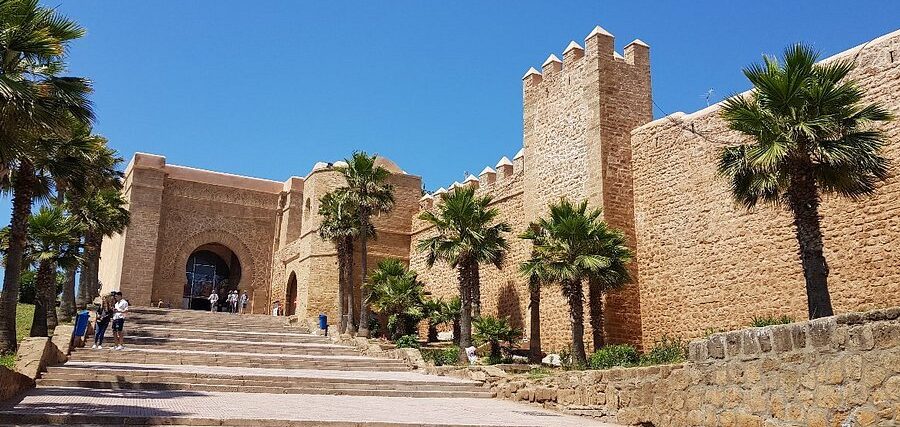
The Kasbah of the Udayas is the small twelfth-century Almohad fortress at the mouth of the Bou Regreg, expanded and populated in the seventeenth century by the Andalusian refugees, and now one of the most self-contained and visually complete small medinas in Morocco. Blue-and-white painted houses in the Andalusian-refugee tradition. Narrow alleys of approximately one metre in width. A small Andalusian garden — the Jardin des Oudayas, planted with citrus, jasmine, and bougainvillea — at the eastern edge. The Andalusian mosque at the centre of the Kasbah is still active. The Café Maure on the eastern rampart overlooks the Bou Regreg estuary, with Salé visible across the river and the Atlantic to the north; the café serves mint tea and traditional chebakia (honeyed sesame pastries) and has done so continuously since the eighteenth century. The Kasbah is small enough to walk entirely in an hour and dense enough to reward a full afternoon. It is where the Iberian and Moroccan threads meet physically — the refugees from Seville and Cordoba brought their architectural, culinary, and musical traditions here, and those traditions are still legible in the neighbourhood today.
This is the deeper character of Rabat, and the article proposes to close on it. The city contains four distinct historical urban layers arranged in geographic sequence along a single river. The Almohad twelfth-century ribat and unfinished imperial mosque, with the Hassan Tower as sister monument to Seville’s Giralda. The Merinid fourteenth-century necropolis at Chellah, built on the Roman foundations of Sala Colonia. The seventeenth-century Andalusian refugee medina, populated by Moriscos expelled from Spain after 1609, whose descendants ran one of the more notorious corsair republics of the seventeenth-century Atlantic. The French colonial ville nouvelle designed by Henri Prost between 1912 and 1925, which remains the working administrative and diplomatic capital of contemporary Morocco. All four layers are simultaneously legible in the contemporary city. All four are still functioning as living urban spaces. All four are UNESCO-inscribed as a single integrated heritage under the 2012 designation Rabat: Modern Capital and Historic City — a Shared Heritage. The city sits on the Atlantic, at the mouth of a river, ninety kilometres from the largest working commercial city in the country, and functions as the political capital of Morocco because a French colonial administrator decided in 1912 that it would be, in a decision that Moroccan monarchs have subsequently endorsed continuously for over a hundred years. The layered inheritance is real. The contemporary function is real. The connection between the Almohad past and the Alaouite present runs through this coastline continuously.
Some capital cities have one dominant historical register. This one has four, arranged in geographic sequence along a single river, all still functioning, all UNESCO-recognised as a single heritage — and the Andalusian refugees who populated the seventeenth-century medina came from the same city whose cathedral bell tower is still the Giralda that the Almohad caliph who built the unfinished mosque here also commissioned there.

Beyondia
Trusted Travel CompanionReal digital nomad. I travel. I learn. I grow.
What about you? Where are you going?