🌐 Around the World with Beyondia 🧵 Nordic & Western Europe Region 🪡 Episode 70: Oslo
Oslo is the capital of Norway, sitting at the head of the Oslofjord on the southeastern coast of the country. The commune population is approximately 720,000, with the metropolitan area approximately 1.1 million — substantially the largest urban region in Norway (Bergen, Norway’s second city, has approximately 290,000 in the commune). Norway’s total national population is approximately 5.5 million, meaning Oslo contains roughly 13% of the country’s people and the metropolitan area roughly 20%. The city has been continuously inhabited since approximately 1000 AD, when a substantial settlement developed at the head of the fjord under Norse rule. The Latin name Ansloa appears in sources from the 11th century; the modern name Oslo derives from Old Norse Ánslo meaning either “meadow at the foot of a ridge” or “meadow of the gods” (both etymologies are attested in scholarly sources).
The medieval Oslo
The medieval Oslo developed through the 11th-13th centuries as a substantial Norwegian city, becoming the royal capital under King Haakon V around 1300 (replacing Bergen, which had been the main royal seat previously). Medieval Oslo was substantially destroyed by fire in 1624 and rebuilt under King Christian IV of Denmark-Norway on a new site closer to Akershus Fortress. The rebuilt city was renamed Christiania (later spelled Kristiania) in honour of the king and retained this name until 1925, when it was formally renamed Oslo. The Christiania period (1624-1925) shaped substantial elements of the modern city — the grid street pattern of the central Kvadraturen district, the substantial 17th-19th century architecture in the central areas, and the specific development as the Danish-Norwegian administrative capital until 1814 (when Norway entered union with Sweden following the Napoleonic Wars) and then as the Norwegian capital under Swedish sovereignty until 1905 (when Norway achieved full independence).
Modern Norwegian statehood dates from 7 June 1905, when the Norwegian parliament unilaterally dissolved the union with Sweden, followed by a referendum on 13 August 1905 that produced 99.95% support for independence — one of the highest support levels in any modern independence referendum. Sweden accepted the dissolution peacefully. Prince Carl of Denmark was invited to become king of the newly independent Norway, taking the name Haakon VII, and the modern Norwegian monarchy has continued through King Olav V (r. 1957-1991) to King Harald V (r. 1991 onwards, currently reigning). Norway’s 20th-century history included the specific German occupation during World War II (April 1940 to May 1945), substantial post-war reconstruction, and progressive economic development. The country substantially rejected European Union membership in referendums in 1972 and 1994, remaining outside the EU while joining the European Economic Area in 1994 for market access.
The transformation from modest Nordic country to wealthy oil economy began in 1969. The Ekofisk oil field, discovered by Phillips Petroleum in the Norwegian sector of the North Sea in December 1969, was one of the largest offshore oil discoveries in history. Ekofisk began producing in 1971 and remains in production today. Additional substantial discoveries followed — Statfjord (1974), Troll (1979), Snøhvit (1984), Ormen Lange (1997), Johan Sverdrup (2010, one of the largest oil fields discovered anywhere in the 21st century). Norwegian oil and gas production peaked around 2001-2004 and has declined since, but remains substantial — Norway is currently the world’s third-largest natural gas exporter and produces approximately 2 million barrels of oil per day. The specific policy framework that shaped Norway’s oil transformation was established in the 1970s: state ownership of oil resources (through the state oil company Statoil, now Equinor, established 1972), taxation of oil profits at substantially higher rates than general corporate income (currently 78% marginal rate on offshore petroleum activity), and — critically — the decision to save rather than spend the oil revenues.
The Norwegian Government Pension Fund Global was established in 1990 (initially called the Government Petroleum Fund) to manage the state’s oil revenues. The fund receives oil tax revenues, state ownership dividends, and returns on its own investments; it invests globally in equities (currently approximately 70% of holdings), fixed income (approximately 27%), and real estate (approximately 3%). The fund is prohibited from investing in Norwegian companies (to avoid domestic economic distortion) and follows substantial ethical guidelines that exclude certain sectors (tobacco, controversial weapons, coal companies). Only approximately 3-4% of the fund’s value can be transferred to the government budget annually — the specific “fiscal rule” designed to preserve capital for future generations. As of 2024, the fund holds approximately $1.7 trillion in assets, making it the largest sovereign wealth fund in the world (the second-largest, China Investment Corporation, holds approximately $1.35 trillion; the third-largest, Abu Dhabi Investment Authority, approximately $1 trillion). Norwegian per capita share of the fund is approximately $310,000. If distributed as personal wealth, the fund would substantially exceed the total wealth of most European countries’ populations.
The specific consequence for Oslo is visible. Across the past 20 years, the Bjørvika waterfront district — the substantial specific former industrial harbour area immediately east of the central city — has been comprehensively rebuilt as a substantial cultural and residential district. The transformation represents one of the most substantial single-city cultural building programmes anywhere in 21st-century Europe.
The Oslo Opera House
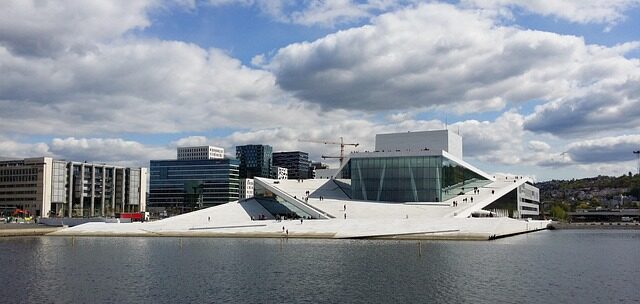
The Oslo Opera House (Operahuset) opened in April 2008. Designed by Norwegian firm Snøhetta, the building presents as an iceberg emerging from the Oslofjord, with a substantial white marble roof that visitors can walk on. The building covers approximately 38,500 square metres, contains three performance venues (the main auditorium with 1,364 seats, the Second Stage with 400 seats, and the Studio with 200 seats), and was constructed for approximately 4.4 billion Norwegian kroner (approximately $500 million at the time). The Opera House won the substantial European Union Prize for Contemporary Architecture (the Mies van der Rohe Award) in 2009. It has become one of Oslo’s most recognisable buildings and one of the most substantial cultural landmarks of contemporary Norway.
The Astrup Fearnley Museum of Modern Art moved to a new Bjørvika building in 2012. Designed by Renzo Piano (the Italian architect whose work includes the Pompidou Centre in Paris and the Shard in London), the building sits on Tjuvholmen (“Thief Island”) at the western edge of the Bjørvika waterfront. The museum houses one of the substantial private modern and contemporary art collections in Scandinavia, including works by Damien Hirst, Jeff Koons, Cindy Sherman, Sigmar Polke, and dozens of substantial international contemporary artists.
The Deichman Bjørvika library opened June 2020 as the new main branch of the Oslo public library system. Designed by Norwegian firms Atelier Oslo and Lund Hagem Arkitekter, the substantial specific building covers approximately 13,500 square metres across six floors and holds approximately 450,000 volumes. It won the substantial International Federation of Library Associations Public Library of the Year Award in 2021 and has substantially transformed Oslo’s public library engagement — visitor numbers have approximately tripled from the previous main library location.
The new Munch Museum (Munchmuseet) opened October 2021. Designed by Spanish architect Juan Herreros, the 13-storey building — sometimes called “Lambda” for its distinctive slanted upper form — covers approximately 26,000 square metres and houses the substantial Munch collection: approximately 26,000 works by Edvard Munch (1863-1944), donated by the artist to Oslo on his death. This is substantially the largest single-artist museum collection anywhere. The building’s construction was substantially controversial — critics argued the design was inappropriate for the sensitive Bjørvika waterfront location — but the substantial museum has been received well internationally since opening, and receives approximately 700,000 visitors per year.
Edvard Munch himself is one of the substantial Norwegian artistic contributions to modern culture. Born 12 December 1863 in Løten (approximately 130 kilometres north of Oslo), Munch grew up substantially in Christiania (as Oslo was then called), and produced his major artistic output there and in specific European cities (Berlin, Paris) across the late 19th and early 20th centuries. His work substantially shaped the development of Expressionism as an artistic movement, and specific paintings — particularly The Scream (four versions produced between 1893 and 1910) — have become substantially universal cultural references beyond the art world. Munch bequeathed his entire artistic estate to Oslo Municipality on his death in 1944, providing the foundation for the substantial Munch collection. The original Munch Museum (opened 1963, closed 2021) at Tøyen east of central Oslo housed the collection for approximately 60 years before the move to Bjørvika. The Scream — specifically the 1910 tempera-on-cardboard version, one of the most valuable paintings in the world — is on permanent display at the new museum.
The Contemporary Oslo
Beyond the Bjørvika transformation, contemporary Oslo contains substantial specific cultural infrastructure across the city. The National Museum (Nasjonalmuseet), opened in its new building June 2022, houses the substantial Norwegian national collections of art, architecture, and design, including the substantial specific Vigeland collection and the substantial specific Norwegian folk art collection. The Vigeland Sculpture Park (Vigelandsparken) at Frogner in western Oslo contains approximately 212 sculptures by Gustav Vigeland (1869-1943), representing one of the substantial single-artist sculpture parks in the world — the Monolith (a 14.12-metre column of intertwined human figures), the Fountain, the Wheel of Life, and dozens of specific figurative sculptures depicting the substantial specific “human condition” theme that shaped Vigeland’s mature work. The park is free and open 24 hours, receives approximately 2 million visitors per year, and is one of Oslo’s substantial most-visited public spaces.
The Viking Ship Museum (Vikingskipshuset) at Bygdøy in western Oslo houses three substantially preserved Viking ships from the 9th-10th centuries — the Oseberg ship (built approximately 820 AD, discovered 1904 in a burial mound), the Gokstad ship (built approximately 890 AD, discovered 1880), and the substantial Tune ship (approximately 900 AD, discovered 1867). These are among the most substantial specific preserved Viking ships anywhere and provide substantial physical evidence of the Viking Age shipbuilding and burial traditions covered at York Ep 64, Orkney Ep 66, Reykjavík Ep 67, and Westfjords Ep 68. The museum closed for major renovation in 2021 and is expected to reopen in 2027 as the substantial new “Museum of the Viking Age.”
The Kon-Tiki Museum (opened 1950) and the Fram Museum (opened 1936), both at Bygdøy, house substantial specific Norwegian exploration heritage. The Kon-Tiki Museum displays the balsa-wood raft on which Norwegian explorer Thor Heyerdahl (1914-2002) sailed from Peru to French Polynesia in 1947 to demonstrate the theoretical possibility of pre-Columbian trans-Pacific contact. The Fram Museum displays the polar exploration ship Fram (built 1892) that Fridtjof Nansen used in his 1893-1896 Arctic expedition and Roald Amundsen used in his 1910-1912 Antarctic expedition (which reached the South Pole 14 December 1911, approximately five weeks before Robert Falcon Scott’s British expedition). The specific Norwegian polar exploration heritage — Nansen, Amundsen, Heyerdahl — represents one of the substantial Norwegian contributions to modern exploration history.
Contemporary Oslo economics extend substantially beyond oil. The city has developed as one of the substantial specific European maritime and shipping centres (Norwegian shipping companies including Wilh. Wilhelmsen, Klaveness, and specific others are substantially based in Oslo). The city has substantial financial services concentration (DNB, Norway’s largest bank, is based in Oslo, along with substantial insurance and asset management companies). Technology sector employment has grown substantially, particularly in specific specialised areas including maritime technology, energy technology, and fintech. Government employment is substantial — Norway is one of the countries with the highest public sector employment share among developed economies (approximately 30% of Norwegian employment is in the public sector), and Oslo houses the substantial specific national government administration. Approximately 33% of Oslo residents have foreign backgrounds (either born abroad or with two foreign-born parents), making Oslo one of the more demographically diverse Nordic capitals — substantial specific communities include Pakistani (approximately 25,000 residents), Polish (approximately 24,000), Swedish (approximately 21,000), Somali (approximately 14,000), and dozens of others.
Housing costs in Oslo are substantially among the highest in Europe. Average apartment prices in central Oslo reached approximately NOK 100,000 per square metre in 2024 (approximately $9,500 per square metre, or approximately $1 million for a modest 100-square-metre apartment). The specific consequence is substantial gentrification of central districts and specific tension between housing affordability and quality of life. Oslo’s substantial oil wealth has produced substantial specific ambivalence about future policy — the substantial Norwegian domestic political debate substantially divides on whether to continue oil and gas production (which contributes substantially to climate change globally while providing substantial specific Norwegian economic benefit) or accelerate the transition away from fossil fuel production. Norway has substantial specific climate policy — approximately 85% of new car sales in Norway are electric vehicles (the highest EV adoption rate in the world), driven by substantial specific tax incentives and infrastructure investment — but continues to substantially produce oil and gas for export.
Oslo is one of the demonstrations of what substantial resource wealth combined with disciplined fiscal policy can produce over 50 years. The North Sea oil discoveries of the late 1960s and early 1970s transformed a modest Nordic country into one of the wealthiest nations in the world. The decision to save rather than spend the revenues — through the substantial Government Pension Fund Global — has produced approximately $1.7 trillion in accumulated wealth that will substantially support Norwegian citizens for generations. The physical evidence of this wealth is substantially visible in Oslo’s Bjørvika waterfront transformation across the past 20 years — the Opera House, the Astrup Fearnley Museum, the Deichman Bjørvika library, the new Munch Museum — one of the most substantial single-city cultural building programmes of 21st-century Europe. The substantial cultural and artistic heritage that preceded the oil wealth — Munch, Vigeland, Ibsen, Grieg, Amundsen, Heyerdahl, Hamsun — has been substantially preserved and expanded through the specific investment. The substantial demographic diversity of the modern city reflects substantial immigration across the past 40 years. And the substantial ongoing negotiations of Norwegian identity — between oil wealth and climate responsibility, between prosperity and immigration, between EU integration and national autonomy — continue to shape the city.
Some capital cities were built on inherited wealth. This one was substantially rebuilt on discovered wealth — North Sea oil that transformed Norway from a modest Nordic fishing-and-shipping economy into one of the wealthiest countries in the world in approximately 50 years, and that the Norwegian state has substantially chosen to save rather than spend, producing the largest sovereign wealth fund on Earth. The specific consequence is visible in Oslo’s Bjørvika waterfront, in the cultural infrastructure that has been substantially built across the past 20 years, and in the substantial specific character of a modern European capital that has been substantially transformed within a single generation by the discovery of hydrocarbons in the sea to the south. Very few European capitals carry this specific accumulated recent inheritance.
Nine regions. One hundred and twenty destinations. Two hundred and ninety-one weeks remaining.
The journey continues west across the Norwegian mountains. The next stop is Norway’s second city — a substantial Hanseatic League port on the western coast, home to seven mountains, the substantial Bryggen medieval wharf (UNESCO World Heritage since 1979), one of the substantial Norwegian fish markets, and the gateway to Norway’s fjord region.
Where are you going?

Beyondia
Trusted Travel CompanionReal digital nomad. I travel. I learn. I grow.
What about you? Where are you going?