🌐 Around the World with Beyondia 🧵 Nordic & Western Europe Region 🪡 Episode 71: Ålesund
Ålesund is a Norwegian coastal city on the western coast of Norway, sitting on three main islands (Aspøya, Nørvøya, and Hessa) and several smaller islands at the mouth of the Storfjord system. The commune population is approximately 66,000, with the Sunnmøre metropolitan region approximately 105,000 — the largest urban centre between Bergen (approximately 300 kilometres south) and Trondheim (approximately 300 kilometres north). Ålesund sits at approximately 62.47 degrees north latitude, roughly 300 kilometres south of the Arctic Circle. The city serves as the administrative, commercial, and cultural centre of the Sunnmøre region and the gateway to the western Norwegian fjord landscape and the Sunnmøre Alps.
Ålesund meaning “eel sound”
The name Ålesund derives from Old Norse Álasund, meaning “eel sound” — the narrow channel between the main islands that has provided harbour infrastructure since Norse settlement. Continuous settlement in the area dates from approximately the 9th century, with Norse-era archaeological evidence at nearby sites. Medieval Ålesund functioned as a fishing and trading community, close to some of the most productive fishing grounds in the North Atlantic (particularly the spring-spawning herring and cod grounds off the Sunnmøre coast). The community remained small through the medieval and early modern periods — approximately 300 residents by 1800 — before 19th-century growth driven by expansion of the Norwegian fishing industry.
Ålesund received municipal town status in 1848. The 19th-century town grew through fishing industry expansion, particularly following 1830s introduction of new fishing techniques and vessels that increased catch capacity. By 1900, Ålesund had reached approximately 12,000 residents, making it one of the mid-sized Norwegian coastal towns of the period. The town was built almost entirely of wood, as most Norwegian coastal towns were, with 18th and 19th-century wooden buildings distributed across the main islands, connected by bridges and harbour infrastructure. Wooden construction reflected Norwegian building tradition but also carried fire risk that had defined Norwegian urban history — major Norwegian towns had experienced catastrophic fires throughout the 18th and 19th centuries (Bergen in 1702, 1855, 1901; Trondheim multiple times; Kristiania/Oslo in 1624, which led to the reconstruction covered at Oslo Ep 70).
The 1904 Ålesund fire began at approximately 2 AM on 23 January 1904. The ignition point was the Aalesunds Preserving Co. factory on Aspøya island, where a kerosene lamp overturned during night operations. The wind was strong — reports indicate approximately 25 metres per second (roughly 90 km/h, storm-force), blowing from the southwest. The combination of wooden construction, wind speed, and cold weather (approximately -10 to -15°C, meaning the fire hoses froze) made the fire uncontrollable within hours. The spread was rapid — the fire jumped between wooden buildings, crossed the narrow streets, and even leapt harbour channels through burning debris carried by the wind. By morning on 24 January, approximately 850 of the town’s 1,000 buildings had been destroyed. Approximately 230 acres (93 hectares) of the central town were burned. Approximately 10,000 of the town’s 12,000 residents were homeless. Remarkably, only one person died — an elderly woman who returned to her burning house to retrieve possessions.
The response was rapid at multiple levels. Immediate emergency response came from surrounding Norwegian communities (particularly Molde and Kristiansund) and from Norwegian government authorities. International response came from Germany. Kaiser Wilhelm II — who had holidayed regularly in the nearby Geirangerfjord and Hjørundfjord regions across the 1890s and 1900s, and had genuine personal affection for the area — was informed by telegraph within hours of the fire. Wilhelm ordered immediate German response: within days, four German ships (including the imperial yacht Hohenzollern and naval vessels) arrived at Ålesund carrying materials including prefabricated barracks for the homeless, food supplies, medical supplies, and construction materials. Wilhelm’s personal intervention was instrumental in ensuring rapid Ålesund reconstruction, and the German-Norwegian connection shaped the reconstruction that followed.
The reconstruction of Ålesund
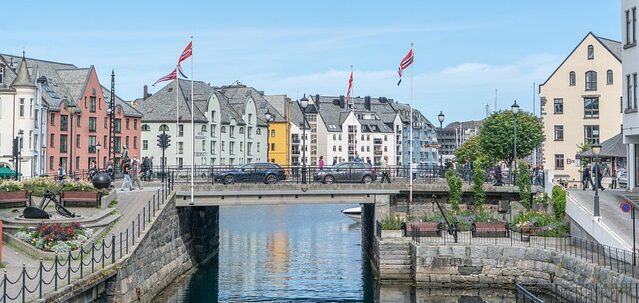
The reconstruction of Ålesund was planned and comprehensively executed across the following three years (1904-1907). The decision was made almost immediately to rebuild not in the traditional Norwegian wooden style, but in stone and brick to eliminate fire risk — a fundamental departure from Norwegian urban building tradition. The architectural language chosen was Jugendstil — the Central European variant of Art Nouveau then dominant across German-speaking Europe (Germany, Austria, Switzerland) in the late 1890s and early 1900s. The choice reflected multiple factors: young Norwegian architects had trained in German architectural schools (particularly the Technische Hochschule Charlottenburg in Berlin and the Technische Hochschule München); German material and construction assistance shaped building methods; and Jugendstil was the international architectural style of the moment for progressive urban planning.
Approximately 20-25 Norwegian architects worked on the Ålesund reconstruction. Key figures included Hagbarth Schytte-Berg (1860-1944, born in Kristiania, trained in Berlin, one of the leading Norwegian Jugendstil architects), Henrik Nissen (1848-1915, one of the senior Norwegian architects of the period), Jens Zetlitz Monrad Kielland (1866-1926, another German-trained Norwegian architect), Sverre Knudsen (1878-1955), Karl Norum (1852-1911), and others. Between them, they designed approximately 320-350 buildings in the Jugendstil style — the standard published range varies slightly by counting methodology, but the total is one of the highest concentrations of Jugendstil buildings anywhere in a single city.
The Ålesund Jugendstil is distinctive within the broader Art Nouveau tradition. Buildings combined German Jugendstil vocabulary (curved lines, floral and organic ornamentation, asymmetric facades, tower and turret elements) with Norwegian references (Norse mythological motifs, dragon-head decorative elements referencing Viking-era art, traditional Norwegian building elements adapted to new stone construction). The result was a “Norwegian Jugendstil” that reflected German influence but also Norwegian identity — one of the successful adaptations of international architectural style to national context. The decorative programme included dragons, Viking ships, Nordic mythological figures (Thor, Odin, the tree Yggdrasil), runic inscriptions on facades, and traditional Norwegian floral motifs (particularly the Norwegian rose).
Key Ålesund Jugendstil buildings include:
The Ålesund Public Library (Ålesund Bibliotek), designed by Sverre Knudsen and Hagbarth Schytte-Berg, completed 1908. Jugendstil facade with tower elements and decorative programme referencing Norwegian literary heritage. The library moved to a new building in 2005, but the original continues in use as a municipal building.
The Ålesund Art Nouveau Centre (Jugendstilsenteret), located in the former Swan Pharmacy (Svaneapoteket) building designed by Hagbarth Schytte-Berg, completed 1907. One of the finest Ålesund Jugendstil interiors, with original pharmacy fittings preserved. Converted to the Jugendstilsenteret in 2003 and serves as the primary museum for the reconstruction and Jugendstil movement.
The Ålesund Church (Ålesund kirke), designed by Sverre Knudsen and consecrated 1909. Jugendstil facade with a tower rising to approximately 65 metres, decorative programme, and stained glass windows by Norwegian artist Enevold Thømt.
Kongens Gate (King’s Street), the main pedestrian street through the reconstructed centre. Almost every building along Kongens Gate is Jugendstil, providing one of the most concentrated Jugendstil street experiences anywhere.
Apotekergata (Pharmacy Street), Løvenvoldgata, and other central streets offer similar concentrated Jugendstil environments.
The Aksla viewpoint — accessible via 418 steps from the town centre (or by road) — provides panoramic views of Ålesund’s unified architectural character. The view demonstrates the consequence of the 1904 reconstruction: an entire city centre in a single architectural style, one of the rare experiences available anywhere in Europe.
Ålesund: the gateway to the western fjord region
Beyond the Jugendstil architectural inheritance, Ålesund serves as the gateway to the western Norwegian fjord region. Geirangerfjord — approximately 120 kilometres east of Ålesund — is one of the most photographed fjords in Norway and was inscribed as UNESCO World Heritage (as part of the “West Norwegian Fjords” inscription including Nærøyfjord) in 2005. The fjord extends approximately 15 kilometres from the village of Geiranger, with mountains rising to 1,500-1,800 metres directly from the fjord waters, waterfalls cascading down the fjord walls (particularly the Seven Sisters, the Bridal Veil, and the Suitor), and dramatic scenery that has attracted tourism since the late 19th century. Kaiser Wilhelm II’s late 19th and early 20th century Geirangerfjord visits — the imperial cruise ship Hohenzollern anchored regularly at Geiranger — established the German-Norwegian tourism connection that shaped the 1904 fire response.
Hjørundfjord — approximately 30 kilometres south of Ålesund — is another dramatic fjord in the Sunnmøre region, extending approximately 35 kilometres into the Sunnmøre Alps. Less visited than Geirangerfjord but considered by many Norwegians to be more beautiful — steeper mountain walls, narrower character, less tourist infrastructure.
The Sunnmøre Alps (Sunnmørsalpene) — the mountain range south and east of Ålesund — contain some of the most dramatic peaks in Norway. Slogen (1,564 metres), Kolåstinden (1,432 metres), Randers Topp (1,434 metres), and others provide mountaineering and hiking terrain. The range has been compared to the Alps in Switzerland or the mountains of Chamonix, though with fjord access at the mountain bases that provides distinctive character.
Trollstigen (“Troll’s Ladder”) — the mountain road approximately 90 kilometres east of Ålesund — is one of the iconic Norwegian tourism drives. The road climbs 11 hairpin turns across approximately 12 kilometres, rising approximately 700 metres, with viewpoints providing panoramic scenery. The road opened in 1936 and closes during winter months (typically mid-October to mid-May) due to snow and avalanche risk.
The Atlantic Ocean Road (Atlanterhavsveien) — approximately 90 kilometres north of Ålesund — is another iconic Norwegian tourism drive. The road connects several small islands via bridges across narrow ocean channels, providing dramatic ocean scenery. The Storseisundet Bridge — the longest bridge on the route — creates an optical illusion of ending in mid-air due to its approach angles.
Contemporary Ålesund combines the Jugendstil architectural inheritance with an active fishing industry (one of the largest Norwegian fishing ports, with a specialised fleet targeting spring-spawning herring, cod, and other North Atlantic species), maritime industry (Ålesund hosts ship design and marine equipment companies including Rolls-Royce Marine, Vard shipbuilding, and others), higher education (Norwegian University of Science and Technology has a campus at Ålesund specialising in marine technology), tourism (approximately 500,000 annual visitors, driven by Jugendstil architectural interest and fjord region access), and ongoing cultural production. Tourism has grown across the past 20 years, with consequences for accommodation supply and city centre character common to European tourism cities.
The Kaiser Wilhelm II connection has been memorialised in Ålesund. A bust of Wilhelm was erected in Ålesund in 1906 as expression of Norwegian gratitude for German fire response, remained in place through World War I and the interwar period, was removed during World War II (during German occupation of Norway, when the German-Norwegian historical connection was compromised by contemporary Nazi occupation), and was restored to public display in 1991. The bust continues to be one of the Ålesund landmarks referencing the 1904 reconstruction. Kaiser Wilhelm II Street (Kaiser Wilhelm gate) is one of the central streets.
The Ålesund architectural inheritance has been recognised as one of the European architectural achievements. The city was awarded the Europa Nostra Award for cultural heritage conservation in 2016 for preservation of the Jugendstil quarter. Ongoing conservation programmes maintain the 1904-1907 buildings, with municipal and national funding supporting restoration work.
Ålesund is one of the demonstrations of what disciplined reconstruction after catastrophe can produce. The city that burned to the ground in one night on 23 January 1904 was comprehensively rebuilt within three years — not as a replica of what had been lost, but as one of the most architecturally coherent Art Nouveau cities anywhere. The decision to rebuild in stone and brick eliminated the fire risk that had defined Norwegian urban history. The decision to rebuild in Jugendstil imported the international architectural style of the moment into a Norwegian context. The German-Norwegian connection that shaped rapid response and architectural transfer reflected cross-border cultural and political relationships in early 20th-century Europe. And the consequence — an entire city centre unified in a single architectural style, one of the rare urban experiences available in Europe — has been preserved for 120 years and continues to define Ålesund’s character.
Some cities have been rebuilt slowly after catastrophe, across decades or centuries. This one was rebuilt fast — three years, comprehensive, unified. Some cities preserve architectural inheritance from multiple historical periods. This one preserves architectural inheritance from a single three-year window in 1904-1907. Some cities have complicated relationships with foreign powers that intervened at critical moments. This one still maintains a bust of a German Kaiser who sent ships. Very few European cities carry this concentrated inheritance. Very few carry the story of complete destruction and complete rebuilding within a single generation.
Nine regions. One hundred and twenty destinations. Two hundred and ninety weeks remaining.
The journey continues south along the Norwegian coast. The next stop is Norway’s second city — a Hanseatic League port established as one of the German trading colonies of the medieval period, home to seven mountains rising directly from the harbour, the Bryggen medieval wharf (UNESCO World Heritage since 1979), and one of the gateways to the Norwegian fjord region.
Where are you going?

Beyondia
Trusted Travel CompanionReal digital nomad. I travel. I learn. I grow.
What about you? Where are you going?