🌐 Around the World with Beyondia 🧵 Nordic & Western Europe Region 🪡 Episode 72: Trondheim
Trondheim is Norway’s third-largest city, sitting at the mouth of the Nidelva river on the Trondheimsfjord, approximately 500 kilometres north of Oslo and 300 kilometres north of Ålesund by road. The commune population is approximately 215,000, with the metropolitan area approximately 285,000. The city sits at approximately 63.43 degrees north latitude — roughly at the same latitude as Anchorage, Alaska, and further north than Reykjavík (though Trondheim’s climate is milder due to the North Atlantic Current). Trondheim serves as the administrative, commercial, and cultural centre of central Norway (Trøndelag region), and one of the primary Norwegian university and research centres.
Trondheim meaning “home of the strong ones”
The name Trondheim derives from Old Norse Þrándheimr, meaning “home of the strong ones” or “home of the Trønder people.” The city was founded in 997 AD by King Olav Tryggvason (King Olav I of Norway), who established a trading post and royal residence at the mouth of the Nidelva river. The location — a defensible peninsula formed by a bend in the river, with access to the fjord and the productive farmland of the Trøndelag region — became one of the primary Norwegian royal seats through the medieval period. The medieval name was Nidaros (“mouth of the Nid”), which remained the city’s name until 1930 when it was formally renamed Trondheim (from an intermediate 16th-century Danish spelling Trondhjem).
King Olav Tryggvason (r. 995-1000) is one of the founding figures of Christian Norway. Born around 963 to Norwegian royal parents, raised partly in exile in Kievan Rus’ and the Baltic, Olav returned to Norway in 995 and claimed the throne. He was Christianised in England (baptised by Bishop Ælfheah of Winchester around 994), and made Christianisation of Norway a central royal project. He founded Trondheim in 997 as a royal capital and Christian centre, and forcibly converted much of coastal Norway before his death at the Battle of Svolder in 1000 AD. His work was substantially completed by his successor Olav Haraldsson (King Olav II, r. 1015-1028), who became one of the central figures in Norwegian medieval history.
Olav Haraldsson was born around 995, participated in Viking raids on England and France as a young warrior, was baptised in Rouen in 1013 or 1014, and returned to Norway to claim the throne in 1015. His reign was a systematic effort to complete Norwegian Christianisation and centralise royal authority. Olav’s methods were often harsh — forced conversions, destruction of pagan sites, execution of resistant nobles — and by 1028 a coalition of Norwegian magnates allied with King Cnut of Denmark and England had driven Olav into exile in Kievan Rus’. He returned in 1030 to reclaim his throne with a small army, and was killed at the Battle of Stiklestad on 29 July 1030.
What happened next transformed Olav from a controversial king into a saint. Within days of his death, reports of miracles at his burial place began to spread — visions, healings, unexplained phenomena. Within a year, Bishop Grimkell of Nidaros formally declared Olav a saint on 3 August 1031 (the traditional dating). This was one of the last formal canonisations before the East-West Schism of 1054, and one of the earliest formal canonisations of a Scandinavian figure. Olav’s body was moved from the initial burial site to a location near the Nidelva river, and a wooden church was built over the grave. Over the following decades, the wooden church was replaced by a stone church, and around 1070 construction began on what would become Nidaros Cathedral.
Trondheim: Romanesque and Gothic Phases
Nidaros Cathedral (Nidarosdomen) was constructed in stages over approximately 250 years. The initial Romanesque phase (approximately 1070-1180) produced the eastern transept and the crossing area. The Gothic phase (approximately 1180-1300) produced the western nave, the ambulatory, the octagon, and the west front. The octagon — built around the original Saint Olav grave site — is one of the distinctive features of the cathedral, an octagonal chapel modelled loosely on the Church of the Holy Sepulchre in Jerusalem and Canterbury Cathedral’s Trinity Chapel (both associated with major medieval pilgrimage cults). The cathedral was largely complete by around 1320, though further construction and modification continued through the medieval period.
The cathedral became one of the northernmost major pilgrimage destinations in medieval Christian Europe. Pilgrims came from across Scandinavia, from the British Isles, from Iceland, from Germany, and from further afield. The St. Olav’s Way (Pilegrimsleden) — the network of pilgrimage routes converging on Nidaros — extended approximately 5,000 kilometres, with the primary Norwegian route running from Oslo through the Gudbrandsdalen valley to Trondheim (approximately 640 kilometres). Secondary routes ran from Sweden (particularly from Sundsvall and further south), from the southern Norwegian coast, and from the north. Estimates of pilgrim numbers vary, but the cathedral was one of the four major medieval pilgrimage destinations in Northern Europe (alongside Canterbury, Cologne, and Aachen), and one of the sites regularly compared to Santiago de Compostela in Spain and Rome itself.
The Norwegian Reformation of 1537 ended the Saint Olav cult and the pilgrimage tradition. King Christian III of Denmark-Norway imposed Lutheranism on Norway as part of the broader Danish Reformation, and Nidaros Cathedral became a Lutheran parish church. The Saint Olav relics were hidden or destroyed. Pilgrimage was banned. The cathedral fell into disrepair through the 17th and 18th centuries, damaged by fires in 1531, 1708, and 1719, and by general neglect. By the mid-19th century, the cathedral was in poor condition, with much of the original Gothic decoration lost.
The restoration of Nidaros Cathedral was a Norwegian national project spanning approximately 150 years. Formal restoration work began in 1869 under architect Heinrich Ernst Schirmer, continued under Christian Christie (1872-1908), Olaf Nordhagen (1908-1925), Helge Thiis (1930-1972), and subsequent architects. The restoration reconstructed the medieval Gothic west front (completed 1969), rebuilt damaged sections of the nave and choir, and produced approximately 100 new sculptures for the west front by Norwegian sculptors including Wilhelm Rasmussen and Kristofer Leirdal. The restoration was one of the largest sustained architectural projects in Norwegian history, and its completion in the mid-20th century coincided with the Norwegian national revival and independence.
The cathedral has served as the coronation and blessing site for Norwegian monarchs across the modern era. King Haakon VII was crowned at Nidaros on 22 June 1906, following Norwegian independence in 1905 — the first Norwegian coronation at Nidaros since the medieval period. King Olav V received his consecration blessing at Nidaros on 22 June 1958. King Harald V received his consecration blessing on 23 June 1991. These modern ceremonies established Nidaros as the continuing royal religious centre of Norway, connecting the medieval Saint Olav tradition to the modern constitutional monarchy.
The St. Olav’s Way pilgrimage tradition has been revived since the 1990s. The Norwegian Pilgrimage Centre (Nasjonalt Pilegrimssenter) was established in 2010 with headquarters in Trondheim, and the pilgrimage routes have been progressively restored and marked. The Gudbrandsdalen route from Oslo to Trondheim received European Cultural Route certification from the Council of Europe in 2010. The pilgrimage has grown from approximately 100 walkers per year in the 1990s to approximately 4,000-5,000 completing sections of the route annually in recent years. This is a fraction of the Camino de Santiago’s approximately 500,000 annual completions, but a meaningful revival of the Norwegian medieval tradition.
Beyond the cathedral, medieval and early modern Trondheim survives in specific locations. The Archbishop’s Palace (Erkebispegården) — adjacent to the cathedral, one of the oldest secular buildings in Scandinavia — was the residence of the Archbishop of Nidaros from the 12th century until the Reformation. The building now houses museum collections including the Norwegian Crown Regalia. Kristiansten Fortress (Kristiansten festning) — the 17th-century fortress on the hill above the city, built after a devastating 1681 fire led King Christian V to commission new defensive fortifications — provides one of the primary Trondheim viewpoints. The Old Town Bridge (Gamle Bybro) — the wooden bridge with distinctive red-painted arches crossing the Nidelva to the Bakklandet district — dates in its current form from 1861, replacing earlier bridges from 1685 onwards.
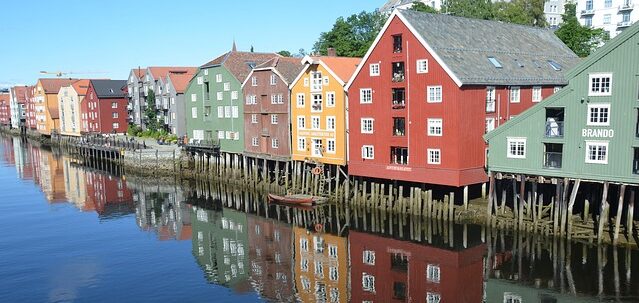
Bakklandet — the traditional working-class district on the east bank of the Nidelva — preserves one of the more coherent 18th-19th century Norwegian wooden urban environments. The district was scheduled for demolition in the 1970s to make way for a motorway, but a citizen preservation campaign saved it, and Bakklandet is now one of the primary Trondheim tourism districts. Nearby, the Kristiansten Fortress hill and the Ilaparken district provide additional preserved wooden architecture.
The Contemporary Trondheim
Contemporary Trondheim is defined substantially by NTNU — Norges teknisk-naturvitenskapelige universitet, the Norwegian University of Science and Technology. NTNU was formed in 1996 through merger of the Norwegian Institute of Technology (established 1910), the University of Trondheim, and other institutions. It is Norway’s largest university, with approximately 42,000 students and 7,000 employees. NTNU is one of the leading Scandinavian technical universities, with particular strength in engineering, marine technology, computer science, and applied natural sciences. The university’s presence gives Trondheim a young, technical character — approximately 20% of the city’s population is students, one of the highest ratios in Norwegian cities. NTNU has produced several Nobel laureates and hosts major research centres including SINTEF (Scandinavia’s largest independent research organisation, established 1950, headquartered in Trondheim).
The technology-university character extends into Trondheim’s economic profile. The city hosts major Norwegian technology companies, particularly in maritime technology (Kongsberg Maritime has significant Trondheim operations), oil and gas technology (Equinor has research operations here), and information technology. The Trondheim start-up ecosystem is one of the more active in Norway, with particular concentration in maritime robotics, ocean sciences, and clean technology. The specific combination of the university, SINTEF, and industry has produced a research-and-development cluster comparable in Norwegian context to those in Oslo or Bergen.
Trondheim’s coastal position gives it access to the productive Trøndelag agricultural region and the Norwegian coastal maritime routes. The city is one of the primary stops on the Hurtigruten coastal steamer route — the historic passenger and cargo service running from Bergen to Kirkenes on the Russian border, established 1893 and continuing today as both a working cargo service and a major tourism route. Trondheim has been a Hurtigruten port since the service began.
The contemporary cultural scene includes the Trøndelag Theatre (Trøndelag Teater, one of Norway’s major regional theatres), the Trondheim Symphony Orchestra (established 1909, one of Norway’s professional orchestras), the Rockheim national museum of popular music (opened 2010, one of the primary Norwegian museums of contemporary music), and the annual Olavsfestdagene festival (established 1962, held around Saint Olav’s feast day on 29 July, one of the major Norwegian church music festivals). The Nidaros Cathedral hosts organ concerts, choral performances, and the annual Olavsfestdagene liturgical programme.
Trondheim’s northern location produces the daylight variation characteristic of subarctic latitudes. Midsummer brings approximately 20 hours of daylight from mid-June to mid-July, with the sun setting briefly around midnight before rising again in the early morning. Midwinter brings approximately 5 hours of usable daylight in late December. The Northern Lights are visible from Trondheim during clear winter nights between approximately September and April, though less reliably than from locations further north. Summer temperatures average approximately 15°C in July, with peak days reaching 25°C. Winter temperatures average approximately -3°C in January, with cold snaps occasionally reaching -20°C or lower.
Trondheim is one of the demonstrations of what medieval religious infrastructure can produce as ongoing urban character. The Saint Olav cult, established 1031, drew pilgrims for approximately 500 years and made Nidaros one of the northern European religious centres. The cathedral built over the saint’s grave — begun around 1070, largely complete by 1320 — is the northernmost Gothic cathedral in the world and one of the three surviving medieval Gothic cathedrals in Scandinavia. The Reformation ended the pilgrimage tradition in 1537, but the cathedral survived, and its restoration across the 19th and 20th centuries reconnected modern Norway to its medieval religious inheritance. Norwegian kings have been crowned or blessed at Nidaros in 1906, 1958, and 1991, maintaining the continuity from the medieval Saint Olav tradition to the constitutional monarchy. The St. Olav’s Way pilgrimage has been revived since the 1990s, with approximately 4,000-5,000 people walking sections annually. And the contemporary university and technology sector — NTNU with approximately 42,000 students, SINTEF as Scandinavia’s largest independent research organisation, the maritime and clean technology cluster — has given Trondheim a distinctive young technical character that balances the medieval religious inheritance.
Some cities carry their medieval history as tourist heritage. This one carries it as living continuity — the cathedral where Norwegian kings are still blessed, the pilgrimage route being walked again, the saint’s day still marked each 29 July. Some cities have universities alongside historical inheritance. This one has approximately 42,000 students within 500 metres of the cathedral of Norway’s national saint. Some cities in the far north are outposts. This one was Norway’s Rome. Very few European cities carry this specific accumulated inheritance across a thousand years and continue to function as both religious centre and technical university city.
Nine regions. One hundred and twenty destinations. Two hundred and eighty-nine weeks remaining.
The journey continues north into the Arctic. The next stop is one of the Norwegian archipelagos above the Arctic Circle — a chain of dramatic mountain islands rising directly from the Norwegian Sea, home to some of the oldest fishing villages in Northern Europe, one of the highest concentrations of Northern Lights viewing anywhere on Earth, and one of the more distinctive rural landscapes in the Nordic region.
Where are you going?

Beyondia
Trusted Travel CompanionReal digital nomad. I travel. I learn. I grow.
What about you? Where are you going?