🌐 Around the World with Beyondia 🧵 Nordic & Western Europe Region 🪡 Episode 55: Lisbon
On the morning of All Saints’ Day, 1 November 1755, at approximately 9:40 in the morning, an earthquake of estimated magnitude 8.5 to 9.0 struck 200 kilometres off the coast of Lisbon in the Atlantic Ocean. The initial shaking lasted between three and six minutes. A tsunami arrived within the following hour, with waves reaching twelve metres. Fires broke out in the collapsed medieval city and burned for five days. By nightfall on 6 November, approximately 40,000 people were dead, and approximately 85% of the city’s buildings were destroyed or made uninhabitable. Voltaire wrote a poem about the disaster the following year. He wrote Candide three years after that. The philosophical concept of theodicy — the problem of how a benevolent God could permit such suffering — was substantially rewritten by European responses to Lisbon. The rebuilt city that stands here today — one of the most beautiful capitals in Europe, and one of the most philosophically consequential — was reconstructed on a systematic grid plan in seventeen years, using earthquake-resistant construction techniques that were among the first in the world.
Lisbon sits on the northern bank of the Tagus estuary
Approximately 15 kilometres upstream from the Atlantic coast, on seven hills that rise from the waterfront through a distinctive stepped topography of terraces, staircases, viaducts, and hillside districts. The commune population is approximately 550,000; the greater metropolitan area is approximately 3 million, making Lisbon the ninth-largest metropolitan area in the European Union and one of the more rapidly changing major European capitals of the 2020s. The city is the political capital of Portugal, the seat of the Portuguese parliament and the presidential residence at the Belém Palace, and one of the oldest continuously inhabited cities in Western Europe — Phoenician traders established a settlement here around 1200 BC, the Romans built Olisipo here from 138 BC, the Visigoths held the city from the 5th to 8th centuries AD, and the Moors ruled al-Ushbuna from 714 to 1147. The Christian Portuguese recapture of the city on 25 October 1147, by King Afonso I with substantial military support from Northern European crusaders passing through on the Second Crusade, established the Portuguese political identity that has continued for nearly nine centuries. Lisbon has been the capital of Portugal since 1255, when King Afonso III moved the court permanently from Coimbra. It has continued in that role through the Aviz dynasty, the Habsburg union (1580–1640), the House of Braganza (1640–1910), the First and Second Portuguese Republics, the Estado Novo dictatorship (1933–1974), and the modern constitutional democracy since 1974. This is the political and historical backbone of the city. But the single fact that most reorganises the reader’s mental model of Lisbon is not any of the political continuities. It is what happened on the morning of 1 November 1755.
The earthquake struck at approximately 9:40 AM Lisbon time on All Saints’ Day. Modern seismological analysis, based on the geographic distribution of the recorded destruction and the tsunami arrival times at various Atlantic coastal locations, estimates the magnitude at between 8.5 and 9.0 on the modern moment-magnitude scale — placing it among the ten largest earthquakes recorded in European history. The epicentre was in the Atlantic Ocean approximately 200 kilometres southwest of the city, on the fault system that separates the Eurasian and African tectonic plates. The initial shaking lasted between three and six minutes according to contemporary accounts, with strong aftershocks continuing throughout the day. In Lisbon, the initial earthquake collapsed a substantial fraction of the city’s medieval buildings — including the royal palace, the customs house, the newly-opened Ópera do Tejo (a lavish opera house that had opened three months earlier for the birthday of the queen), the Patriarchal Cathedral, most of the aristocratic townhouses in the central districts, and the entire commercial waterfront along the Tagus. The queen mother of Portugal — Maria Ana of Austria — died in the collapse of the royal palace. Approximately 15,000 to 25,000 people were killed in the initial shaking. Then the tsunami arrived.
Within approximately 40 minutes of the initial earthquake, the Atlantic waters withdrew from the Tagus estuary — an event witnessed by thousands of Lisbon residents who had fled to the waterfront to escape the collapsing buildings — leaving the harbour bed exposed with stranded ships and marine debris. Approximately 15 minutes later, the first tsunami wave arrived, estimated at six metres height, moving up the Tagus at approximately 30 metres per second. Two additional waves followed within the next hour, some estimated at up to twelve metres. The tsunami inundated the low-lying central districts, the harbour, the Terreiro do Paço (the great riverside square in front of the destroyed royal palace), and the commercial waterfront, killing an additional 10,000 to 15,000 people who had gathered at the water’s edge. In the same window, fires broke out in the collapsed buildings — some from overturned cooking hearths, some from the candles lit for All Saints’ Day masses, some from religious ceremonies interrupted by the earthquake in the collapsed churches. Winds from the Tagus estuary fanned the fires, and they spread through the collapsed medieval city over the following five days, burning what the earthquake and tsunami had spared. When the fires were finally extinguished on 6 November, approximately 40,000 people were dead — between a quarter and a third of Lisbon’s pre-disaster population of approximately 150,000 — and approximately 85% of the city’s buildings were destroyed or made uninhabitable. Portugal, one of the wealthiest European maritime empires of the early modern period, had lost its capital city in six days.
Response to the Lisbon earthquake
The philosophical response to the Lisbon earthquake is one of the more consequential single intellectual responses to any disaster in European history. Voltaire, then living in Switzerland at Les Délices, published Poème sur le désastre de Lisbonne in 1756 — a scathing philosophical challenge to the Leibnizian doctrine of optimism, which held that God had created the best of all possible worlds and that observed suffering was necessary to some larger divine plan. Voltaire’s Poème argued directly and specifically that the Lisbon earthquake — the destruction of a city full of pious All Saints’ Day worshippers in their churches, the mass death of children and the elderly, the drowning of thousands who had fled to the waterfront in search of safety — could not be reconciled with any doctrine of a benevolent providential order. He returned to this argument in Candide, ou l’Optimisme, published in 1759, whose central character Candide (a naive optimist tutored in Leibnizian doctrine by the character Pangloss) is subjected to a series of catastrophes including the Lisbon earthquake, and gradually abandons the doctrine that everything happens for the best. Candide remains one of the most widely-read short novels in Western literature. Its philosophical foundation is a specific rejection of Leibnizian optimism grounded in the specific evidence of the Lisbon disaster. Jean-Jacques Rousseau responded to Voltaire’s Poème in a letter dated 18 August 1756 — Rousseau defended divine providence by arguing that human urban settlement in earthquake-prone locations, not divine failure, was responsible for the scale of the Lisbon disaster. Immanuel Kant, then a young natural philosopher, wrote three essays on the Lisbon earthquake in 1756 (Von den Ursachen der Erderschütterungen, Geschichte und Naturbeschreibung der merkwürdigsten Vorfälle des Erdbebens, and Fortgesetzte Betrachtung der seit einiger Zeit wahrgenommenen Erderschütterungen) that are considered foundational documents in the modern scientific study of seismology — Kant’s essays attempted to explain the earthquake through natural causes (underground gas explosions and thermal chambers) rather than divine intervention, and represent one of the earliest systematic scientific approaches to seismic phenomena in European thought. The concept of theodicy — the philosophical problem of reconciling divine benevolence with observed evil and suffering — was substantially reshaped by the European philosophical responses to Lisbon. Historians of Enlightenment philosophy commonly identify the 1755 earthquake as one of the specific events that shifted European intellectual life from theological toward secular-scientific modes of explaining catastrophic natural phenomena. Lisbon is, in that sense, one of the most philosophically consequential single events in European Enlightenment history — and almost no visitor to the modern city knows this.
The reconstruction of Lisbon was directed by Sebastião José de Carvalho e Melo, the Marquês de Pombal — prime minister to King José I, a former Portuguese ambassador to London and Vienna, and one of the more decisive administrative figures in European Enlightenment government. Pombal was appointed to lead the reconstruction within days of the earthquake, and his response is worth pausing on. He is said to have responded to the immediate crisis with the phrase “Bury the dead and feed the living” — a directive that captures the specifically administrative rather than religious character of his approach. Within a week, Pombal had established a systematic response: emergency food distribution, protection of surviving buildings from looting, systematic recovery of bodies, and the first architectural surveys for reconstruction. Within a year, he had commissioned a comprehensive plan for the rebuilding of the destroyed central Baixa district — designed by the military engineers Manuel da Maia, Eugénio dos Santos, and Carlos Mardel — that would abandon the collapsed medieval street pattern entirely and impose a systematic grid of wide straight streets, uniform building heights, and standardised architectural design. The plan was executed between 1758 and 1775. The rebuilt Baixa Pombalina — approximately 240,000 square metres of central Lisbon, extending from the Terreiro do Paço (renamed Praça do Comércio) at the Tagus waterfront north to the Rossio and Praça da Figueira squares — is one of the earliest systematic grid plans in modern European urban design. It predated Ildefons Cerdà’s Eixample plan for Barcelona (which the Ep 40 article treated) by approximately a century. It predated Haussmann’s Paris reconstruction (1853–1870) by nearly a hundred years. It predated the Manhattan Commissioners’ Plan of 1811 by approximately fifty years. The Baixa Pombalina is a genuine and under-recognised early example of systematic modern urban planning.
Pombal’s plan also incorporated one of the earliest systematic engineered approaches to earthquake resistance. The gaiola pombalina — the “Pombal cage” — is a wooden internal structural frame designed to allow the building to flex under seismic loading rather than to resist it rigidly. The frame consists of interconnected wooden beams arranged as a cage within the masonry walls, allowing the building to deform elastically during ground shaking without catastrophic collapse. Test buildings were subjected to simulated seismic loading before the design was approved — Pombal ordered troops to march in rhythm around test structures to simulate earthquake vibrations, one of the earliest documented empirical earthquake engineering tests in history. The gaiola pombalina was mandated for all new construction in the rebuilt Baixa, and buildings constructed with this system in the 1760s and 1770s remain standing today, having survived numerous subsequent Lisbon earthquakes (including significant events in 1858, 1909, and 1969) without catastrophic damage. This is genuinely one of the earliest systematic engineered earthquake-resistance methods in the world, and its development at Lisbon in the 1750s and 1760s substantially predates the systematic seismic engineering that would develop in California, Japan, and other seismic zones in the 20th century.
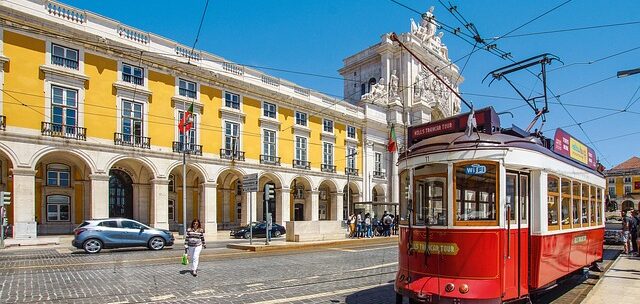
The Baixa Pombalina is worth walking. The visitor entering the district from the Praça do Comércio at the Tagus waterfront passes under the Arco da Rua Augusta — the triumphal arch completed in 1875 that celebrates the reconstruction — and enters Rua Augusta, the pedestrianised central boulevard that runs approximately 500 metres north through the grid to the Rossio square. The parallel streets are named for the trades that were originally concentrated in each — Rua dos Sapateiros (shoemakers), Rua dos Correeiros (harness makers), Rua Áurea (goldsmiths, now the main banking street), Rua da Prata (silversmiths). The cross-streets are numbered rather than named. The building heights are uniform (four to five storeys), the architectural style is a restrained Portuguese-Enlightenment classicism, and the overall urban effect is one of the most coherent early-modern city centres in Europe. The Praça do Comércio at the river end is 175 metres by 175 metres — one of the largest squares in Europe — and contains at its centre the equestrian statue of King José I (1775, by the sculptor Machado de Castro), which faces the Tagus and marks the ceremonial centre of Pombal’s reconstructed Lisbon. On the north side of the Baixa, the Rossio square (Praça de D. Pedro IV) is the traditional heart of civic Lisbon, with the National Theatre D. Maria II (1846) on its northern side and the distinctive wave-patterned mosaic pavement (calçada portuguesa) that characterises the entire district.
But underneath the Pombal reconstruction, Lisbon is still substantially a Moorish city — and this is the article’s second consequential historical claim. Before the earthquake, and continuing today in the districts that survived the destruction, Lisbon retained one of the more substantial and least-recognised urban geographical inheritances from Islamic Iberia. The Moors ruled al-Ushbuna — the Islamic name for the city — from 714 to 1147, approximately 433 years, one of the longest continuous Islamic periods of any Iberian city. When Portuguese Christian forces under King Afonso I recaptured Lisbon on 25 October 1147, they inherited an urban geography, an agricultural system, an irrigation infrastructure, and a district layout that was fundamentally Moorish. The two districts that best preserve this inheritance are Alfama and Mouraria — both on the higher ground east of the Baixa, both surviving the 1755 earthquake substantially intact because their hill positions protected them from the tsunami and from much of the shaking damage, and both still displaying the specific Moorish urban logic that Christian Portuguese inherited in 1147. Alfama itself is named from the Arabic al-hamma — “the hot springs” — referring to the thermal waters that emerged in the district under Moorish rule and were used for public baths (the district still contains functioning traditional public bath facilities, and the Termas dos Cássios are still preserved). The distinctive characteristics of Alfama — the narrow winding streets, the small squares, the whitewashed houses, the small azulejo tile decorations, the specific density of buildings — trace to Moorish urban planning conventions that prioritised shade, ventilation, defensive irregularity, and community-scale enclosure over the wide-street monumental urbanism of the Roman and later Renaissance traditions. Walking Alfama in 2026 is walking a substantially medieval Moorish urban plan preserved through nine centuries of Christian Portuguese occupation.
The Mouraria district — immediately west of Alfama, on the hill below the Castelo de São Jorge — was formally the Moorish quarter under Christian rule after 1147. The name Mouraria means, literally, “the place of the Moors.” Under a specific 1147 treaty between King Afonso I and the surrendering Moorish authorities, the Muslim population of Lisbon was permitted to remain in the city under limited autonomy, occupying a designated quarter that became Mouraria. This arrangement continued through the 12th and 13th centuries until the forced conversions and expulsions of the late 15th and early 16th centuries. Mouraria retains the substantial physical inheritance of this centuries-long Muslim residence — the street pattern, the small mosque foundations (converted to churches), the small courtyards, and the working-class tavern culture that developed in the district and eventually became one of the two main birthplaces of the fado musical tradition. Both Alfama and Mouraria are now UNESCO-adjacent heritage districts (protected under Portuguese national heritage law), receive substantial tourism visitor traffic, and preserve a fundamentally Moorish urban character that most visitors experience without recognising its specific Islamic origin.
The Castelo de São Jorge — the medieval castle that dominates the hilltop above Alfama — is one of the visual signatures of Lisbon. The castle occupies a site that has been continuously fortified since Phoenician times, was substantially rebuilt by the Moors in the 11th century, and was captured by Afonso I in 1147 during the Christian reconquest of Lisbon. The current castle structure dates to the Moorish period with substantial 12th, 13th, and 20th-century Portuguese modifications. The 20th-century modifications include a substantial restoration in the 1930s under the Salazar Estado Novo dictatorship, which reconstructed sections of the medieval walls and towers to project a heroic Portuguese nationalist historical identity. This restoration is now considered by architectural historians as substantially reinterpreted rather than accurately restored — significant elements of the current castle are 20th-century constructions rather than medieval originals. The castle nonetheless commands one of the most spectacular views over Lisbon, the Tagus, and the Alfama district immediately below, and is one of the most-visited monuments in the city.
The fado music tradition emerged in Lisbon in the 19th century, primarily in the taverns and small gathering places of Alfama, Mouraria, and the neighbouring Bairro Alto district. The tradition was substantially working-class and initially performed by women — the fadistas — often in association with the specific tavern culture of these districts. The music is characterised by melancholic vocal performance accompanied by the Portuguese guitar (guitarra portuguesa) and the classical guitar (viola), with lyrics addressing themes of loss, longing, fate, romantic love and its disappointments, class and social frustration, and the specific untranslatable Portuguese emotional register called saudade — a mixed sense of longing for something lost, present-absent nostalgia, and quiet acceptance of the impossibility of complete return. Fado reached national and international recognition through the 20th century, particularly through the singer Amália Rodrigues (1920–1999) whose career made fado an internationally recognised musical form. UNESCO inscribed fado as Intangible Cultural Heritage in November 2011. Fado houses — small performance venues in Alfama, Mouraria, and Bairro Alto — continue to operate today, with live fado performances multiple evenings per week, and the tradition remains genuinely alive as both a heritage form and a contemporary musical practice.
The pastel de nata — the small Portuguese custard tart with a specific caramelised top, flaky puff-pastry base, and warm sweet cream filling — is one of the most distinctive Portuguese food exports of the modern era. The specific recipe traces to the Jerónimos Monastery in the Belém district, where monks in the early 19th century used surplus egg yolks (the whites were used for starching monastic habits) to create a small pastry that was sold to the surrounding neighbourhood. After the 1834 dissolution of the Portuguese monastic orders under Portuguese liberal reforms, the recipe was sold to a nearby sugar refinery, which opened the Pastéis de Belém bakery in 1837 to produce the pastries commercially. The Pastéis de Belém has operated continuously since, produces the pastries to a still-secret recipe (known to only three people at any given time under the terms of the bakery’s operating agreement), and produces approximately 20,000 pastries per day at its main bakery on Rua de Belém. The Pastéis de Belém pastry — distinguished by trademark rules from the more generic pastel de nata produced elsewhere — is one of the most-exported Portuguese food products and one of the most-photographed edible objects in contemporary Lisbon tourism. Whether it is worth queueing 90 minutes to buy at peak Belém tourism hours is a decision every visitor makes for themselves.
The Belém district on the western Tagus waterfront, approximately 6 kilometres downstream from the central Baixa, contains one of the most concentrated cultural-touristic complexes in Portugal. The Mosteiro dos Jerónimos — a large Manueline monastery church begun in 1502 by King Manuel I to commemorate Vasco da Gama’s voyage to India, completed in 1601, and one of the finest examples of the distinctively Portuguese Manueline architectural style — is a UNESCO World Heritage site (inscribed 1983). The Torre de Belém — a small fortified tower on the Tagus waterfront, built between 1514 and 1519 by Francisco de Arruda in the Manueline style as a defensive structure protecting the Lisbon harbour approaches — is one of the most iconic monuments in Portugal and shares the UNESCO inscription. The Padrão dos Descobrimentos — the “Monument to the Discoveries,” a 52-metre limestone monument built in 1960 on the Tagus waterfront to commemorate Prince Henry the Navigator (the operational figure behind the Lagos Ep 53 exploration project) and the Portuguese Atlantic voyages — is a 20th-century monument to the exploration project the series has now covered extensively. The Belém district also contains the Belém Palace (the residence of the President of Portugal since 1911), the Coach Museum (one of the most significant collections of royal coaches in the world), and the MAAT (Museum of Art, Architecture and Technology, opened 2016, a striking contemporary architectural building on the Tagus waterfront). The concentration of Manueline architecture, presidential government, and contemporary cultural infrastructure in a single riverside district is genuinely unusual.
The contemporary Lisbon
The contemporary Lisbon is one of the fastest-changing major European capitals of the 2020s. The population of the commune is approximately 550,000 and the metropolitan area is approximately 3 million. The city has experienced substantial international immigration over the past decade — Brazilian, French, German, British, Ukrainian, and increasing American arrivals, drawn by relatively affordable housing (compared to Paris or Amsterdam), the Portuguese Golden Visa programme (which provided residency in exchange for real estate or business investment from 2012 to 2023), the growing English-language international creative and technology community, and the specific quality of Lisbon urban life that combines Southern European climate and food culture with functional infrastructure and a substantial cultural inheritance. This immigration has produced substantial housing-price inflation — Lisbon housing costs have increased approximately 90% over the past decade, one of the fastest increases in any European capital — and significant tensions between the international arrival population and long-standing Portuguese residents who are increasingly priced out of the city centre. The gentrification of Alfama, Mouraria, Bairro Alto, and Príncipe Real, in particular, has been substantial and controversial. The article names this contemporary reality honestly. Lisbon in 2026 is genuinely changing at a rapid rate, and the visitor who came in 2016 would find the city in 2026 significantly different — more international, more expensive, more contested. Whether these changes are net-positive or net-negative depends on the visitor’s specific perspective; the article does not moralise but names the reality.
This is the deeper character of Lisbon, and the article proposes to close on it. The city sits on seven hills above the Tagus estuary, at one of the more strategically important European locations for Atlantic maritime commerce and, historically, for the coordination of Portuguese overseas exploration and empire. It was catastrophically destroyed by the earthquake of 1 November 1755 — approximately 40,000 people killed, 85% of the built environment destroyed in six days — and rebuilt in a systematic grid pattern under the Marquês de Pombal between 1758 and 1775, using engineered earthquake-resistant construction techniques that were among the first in the world and predating comparable systematic urban planning in Barcelona and Paris by approximately a century. The earthquake produced one of the most consequential single philosophical responses in European Enlightenment history, substantially reshaping the concept of theodicy and moving European intellectual thought toward secular-scientific modes of explaining catastrophic natural phenomena. The districts that survived the earthquake — Alfama, Mouraria, Bairro Alto — preserve a substantial and largely-unrecognised Moorish urban inheritance from the 714–1147 Islamic period, and are the working birthplaces of the fado musical tradition that has been Lisbon’s most distinctive cultural export since the 19th century. The Belém district contains the most concentrated UNESCO-protected cultural complex in Portugal (the Jerónimos Monastery, the Belém Tower, the Padrão dos Descobrimentos monument) and the birthplace of the pastel de nata custard tart. The contemporary city, in 2026, is one of the most rapidly changing major European capitals — substantial international immigration, rapid gentrification, contested housing markets, an expanding technology sector, and a growing English-language international creative community — with all the specific tensions and opportunities that such rapid change produces. Lisbon is not a museum. Lisbon is a living, changing city that carries its extraordinary historical inheritance while continuing to reshape itself in ways that were not visible ten years ago and will continue to be visible in ways that are not yet clear.
Some cities were destroyed and rebuilt as themselves. This one was destroyed in six minutes on the morning of All Saints’ Day, 1755, and rebuilt in seventeen years on a grid plan that predated Barcelona’s by a century — while carrying, underneath the reconstruction, a Moorish urban plan from the 12th century, a fado tradition from the 19th, a pastry recipe from a monastery, and a philosophical inheritance that helped rewrite European thought about God, disaster, and the possibility of divine benevolence in a world where forty thousand people can die in a single morning.
Nine regions. One hundred and twenty destinations. Three hundred and six weeks remaining.
The journey continues west and up. The next stop is the romantic mountain town of palaces where 19th-century Portuguese kings built their fantasy castles above the Atlantic clouds, and where Lord Byron wrote about a landscape he called “the most delightful in Europe.”

Beyondia
Trusted Travel CompanionReal digital nomad. I travel. I learn. I grow.
What about you? Where are you going?