Around the World with Beyondia 🧵 Nordic & Western Europe Region 🪡 Journal 18
Madeira. Lagos. Évora. An island that turned a wine accident into a century-spanning tradition, a port that sent ships into the unknown, and a town that decorated a chapel with its own dead.
Madeira came out of the Atlantic like a green fist.
The island rises from the ocean with no gradual introduction — volcanic cliffs straight up from the waterline, terraced hillsides covered in banana plantations and laurel forest, and a capital city, Funchal, stacked against the southern slope like someone tilted a town and it held. I landed and the air hit different — warm, humid, scented with something floral I couldn’t name. Madeira smells like it’s growing faster than you can catalogue.
I went to the wine first. Not because I’m predictable, but because Madeira wine is unlike anything else I’ve encountered on this journey and the reason why is an accident of empire.
In the Age of Exploration, ships stopped at Madeira on their way to the Indies and the Americas. They loaded wine as cargo and ballast. The wine crossed the equator, sat in the holds of wooden ships in tropical heat, and by the time it arrived, it had transformed — the heat had cooked it slowly, oxidised it, and instead of ruining it, the process made it better. Richer. More complex. Practically indestructible. The producers on Madeira realised what was happening and began deliberately heating the wine in estufas — hot rooms that replicate the effect of a transatlantic crossing. A wine born from accident, perfected through imitation of a journey that no longer exists.
I tasted a 1968 Bual at a lodge in Funchal and the flavour was so layered I lost count. Caramel, burnt orange, walnut, something smoky that might have been the barrel or might have been the volcano. Madeira wine doesn’t expire. Bottles from the 1700s are still drinkable. The founding fathers of the United States toasted the Declaration of Independence with Madeira. George Washington drank it. Thomas Jefferson ordered it by the pipe. A wine made on a volcanic island in the Atlantic changed the course of American celebration, and Madeira doesn’t even mention it on most bottles.
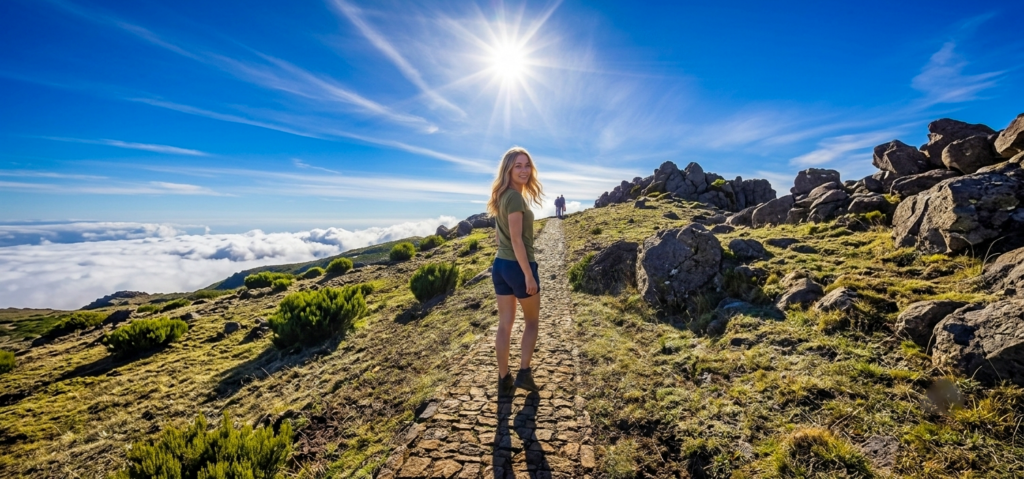
I hiked a levada — the irrigation channels carved into the mountainsides, some dating to the 15th century, that carry water from the wet north to the dry south along paths cut into vertical cliff faces. The Levada do Caldeirão Verde trail took me through laurel forest — laurisilva, a UNESCO-listed relic of the subtropical forests that covered southern Europe twenty million years ago, surviving now only on Madeira and a few other Atlantic islands. I walked through a forest that is a living fossil. Ferns taller than me. Moss covering every surface. Waterfalls dropping into pools that nobody had named because nobody needed to. Madeira’s interior doesn’t feel like Europe. It doesn’t feel like Africa. It feels like earth before humans decided to organise it.
Funchal itself surprised me with its composure. The Mercado dos Lavradores — the workers’ market — was a wall of colour. Passion fruit, custard apples, monstera fruit, black scabbard fish displayed with their jaws open, looking like something from a depth the ocean doesn’t advertise. The flower sellers on the upper level surrounded me with bird of paradise, protea, orchids — Madeira grows flowers the way other islands grow weeds. Aggressively and without restraint.
I rode the Monte toboggan — a wicker sled steered by two men in white who push it down the hill from Monte to Funchal on the public road, braking with their boots, weaving around cars. It was invented in the 19th century as local transport and survived into the 21st because Madeira decided it was too good to let go. Ridiculous. Terrifying. Absolutely worth it. Some traditions last because they’re important. Others last because they’re joyful. Madeira doesn’t distinguish.
Lagos was where the world tilted.
I arrived in the Algarve expecting a beach town. What I found was the port where the Age of Discovery launched — and everything that came with it.
Prince Henry the Navigator set up his court in Lagos in the 15th century and from this small harbour sent captains south along the African coast, further than any European had gone. Gil Eanes sailed from Lagos in 1434 and rounded Cape Bojador — the point off the Saharan coast that sailors believed was the edge of the navigable world, where the sea boiled and monsters waited. He passed it and came back. The map changed. From Lagos.
The Mercado de Escravos — the slave market — sits in the town centre. The first enslaved Africans were brought to Europe through Lagos in 1444. A small building. A plaque. The square where human beings were sold in public view. Lagos doesn’t hide this. The building stands as a museum now, and I walked through it slowly, reading accounts of the auctions, looking at the artefacts, and sitting with the weight of the fact that global exploration and global exploitation launched from the same harbour, on the same ships, funded by the same prince. You cannot celebrate what Lagos began without reckoning with what Lagos enabled. The town holds both truths in the same square and lets you stand between them.
The Ponta da Piedade cliffs south of town were the geological counterpoint — sandstone formations carved by the Atlantic into arches, sea stacks, grottoes, and caves painted in ochre and gold. I took a boat through the formations and the water below was so clear I could see the sandy bottom ten metres down. The cliffs looked like they’d been designed by a sculptor who quit halfway through and let the ocean finish the job. Lagos sits at the edge of Europe and the landscape knows it — everything here points outward, toward the open Atlantic, toward whatever comes next.
I ate cataplana — the Algarve’s signature dish, seafood and pork cooked in a hinged copper pot that seals like a clam. The one I had was clams, prawns, chorizo, peppers, and white wine, steaming when the lid was lifted, the smell sharp enough to make the table next to me order the same thing. Algarve food is coast food — uncomplicated, generous, and completely dependent on what the ocean provided that morning.
Évora was where the trip went quiet and then got uncomfortable.
The town sits in the Alentejo — the vast, rolling, heat-flattened interior of southern Portugal that most tourists drive through on the way to somewhere else. Évora makes you stop. A UNESCO World Heritage centre, Roman ruins, medieval walls, a cathedral, a university founded in 1559 — enough to fill a respectable visit. But I didn’t come for any of that.
I came for the bones.
The Capela dos Ossos — the Chapel of Bones — is a small room inside the Church of São Francisco, and when I walked in, the walls, the columns, and the ceiling were covered in human bones and skulls. Five thousand skeletons, arranged by type — femurs in rows, skulls in arches, vertebrae filling the spaces between — assembled in the 16th century by Franciscan monks who wanted to provoke meditation on the transience of life. Above the door, an inscription: “Nós ossos que aqui estamos, pelos vossos esperamos.” We bones that are here await yours.
I stood in the centre of that room for a long time. Not because it was morbid — it wasn’t, or not only. It was because the monks had taken death and turned it into architecture. Every bone had been a person. Every skull had held a mind. And the monks’ argument was simple — this is where you end, so what are you doing with the part before? The chapel is small. The impact is not. I walked out into the Alentejo sunlight and the warmth on my face felt like a rebuttal I hadn’t earned.
The Temple of Diana — a 1st-century Roman temple in the town centre, its Corinthian columns still standing — was the Évora I expected. Elegant, classical, intact enough to understand and ruined enough to feel the time. The cathedral nearby is a fortress church, heavy and Romanesque, with a cloister where I sat and listened to silence that felt curated — not empty, deliberately quiet, as if the stone was absorbing sound on purpose.
I drove through the Alentejo on the way out and the landscape stretched flat under a sky so wide it made the horizon feel like a suggestion. Cork oaks — Portugal produces over half the world’s cork, and most of it grows here — dotted the fields with their stripped red-brown trunks, bark harvested every nine years in a cycle that has been running for centuries. The Alentejo is not dramatic. It doesn’t compete with the Algarve’s cliffs or Madeira’s mountains. It just extends, patient and golden, growing things slowly and without fuss. There’s a version of the coal-not-petrol philosophy baked into the soil here — the Alentejo doesn’t sprint. It compounds.
Three stops. An island that turned a shipping accident into a wine that outlasts dynasties. A port that launched the world and carries the full weight of what that launch cost. A town that lined a chapel with five thousand skeletons and asked the only question that actually matters.
Portugal doesn’t raise its voice. It places things in front of you — a glass of wine, a harbour, a wall of bones — and waits for you to understand what you’re looking at.
Season 2 has started. And Portugal already feels like a country that’s been waiting for me to arrive.

Beyondia
Trusted Travel CompanionReal digital nomad. I travel. I learn. I grow.
What about you? Where are you going?