
GoBeyondia Atlas 🗺️ North-America Caribbean 🗾
Saint Lucia: Where a volcanic island twenty-seven miles long and fourteen miles wide changed hands between France and Britain fourteen times in one hundred and fifty years — fought over so relentlessly that it was nicknamed the Helen of the West Indies, after the woman whose beauty caused the Trojan War — and where from this island of fewer than one hundred and eighty thousand people came two Nobel laureates, Sir Arthur Lewis in Economics in 1979 and Sir Derek Walcott in Literature in 1992, making Saint Lucia the country with the most Nobel Prize winners per capita on earth — and Walcott wrote an epic poem called Omeros that reimagined the island’s fishermen as Homer’s Achilles and Hector, and the island itself as Helen, her breasts the twin Pitons, fought over by Gaul and Briton the way the original Helen was fought over by Greek and Trojan — because Saint Lucia is the country that was passed back and forth like a possession until it produced a poet who turned the possession into a person and the history into a myth that belongs to the people who actually lived it.
Saint Lucia in 30 Seconds
A volcanic island in the eastern Caribbean, between Martinique to the north and Saint Vincent to the south. The only country in the world named after a woman — Saint Lucy of Syracuse, a Christian martyr. The indigenous Caribs called it Iouanalao, meaning “Land of the Iguanas.” The French settled in 1660, signed a treaty with the Caribs, and broke it. The British came. The French came back. The British returned. Between 1660 and 1814, the island changed hands fourteen times — seven French, seven British — each conquest bringing new laws, new administrators, new names for the same hills and bays. The French left their Catholic faith, their Creole language — Kwéyòl, still spoken across the island — their cuisine, and their place names: Soufrière, Castries, Gros Islet. The British left their governance, their language as official tongue, and their traffic laws — driving on the left. The enslaved Africans, who worked the sugar plantations under both flags, left everything else: the rhythm, the cooking, the oral tradition, the spiritual practices, the resistance that in the 1790s produced a rebellion under the leadership of freed slaves who had absorbed the ideals of the French Revolution. The Pitons — Gros Piton and Petit Piton — are twin volcanic spires that rise from the sea near Soufrière, a UNESCO World Heritage Site, the most recognized silhouette in the Caribbean. Near them, the Sulphur Springs bubble and steam in what is sometimes called the world’s only drive-in volcano — a collapsed crater where the earth’s interior is visible from the road. The island’s national dish is green fig and saltfish — green bananas with salted cod, a combination of African and European food traditions as hybrid as the island itself. Jounen Kwéyòl, or Creole Day, is celebrated every October, an annual assertion that the French-African language that survived every transfer of colonial power is not a relic but a living tongue. Then, from this island — fought over, traded, renamed, exploited, twenty-seven miles long — came Arthur Lewis and Derek Walcott. They share a birthday: January 23. Lewis, born in 1915, was a gifted student who finished school at fourteen, worked as a clerk while waiting for university, earned his doctorate at the London School of Economics, and developed the economic model of labor transfer between traditional and modern sectors in developing countries — a theory that reshaped how the world understood why poor countries stay poor. He won the Nobel Prize in Economics in 1979, sharing it with Theodore Schultz. Walcott, born in 1930, grew up in Castries in a Methodist minority on a Catholic island, the son of a father who painted and wrote poetry and died at thirty-one before the twins Derek and Roderick were born. He trained as a painter, then turned to poetry, and over fifty years produced a body of work that reimagined the Caribbean as a literary landscape equal to any in the Western canon. His epic poem Omeros, published in 1990, takes Homer’s Iliad and transplants it to Saint Lucia: the fisherman Achille and the taxi driver Hector compete for the love of Helen, who is also the island itself — her beauty the Pitons, the war fought over her the fourteen colonial exchanges. The poem traces Achille’s dream journey back to Africa and Walcott’s own journey through the colonial aftermath, weaving myth, history, and the present into a single narrative that insists the Caribbean is not the periphery of someone else’s story but the center of its own. He won the Nobel Prize in Literature in 1992, the first Caribbean writer to receive it. The Nobel committee member who presented the award singled out Omeros as “a major work.” Saint Lucia — population one hundred and eighty thousand — now holds the world record for Nobel laureates per capita. The island that was traded like a commodity produced the minds that redefined how the world values developing economies and Caribbean literature.
Evoke — Why You Visit Saint Lucia
You come to Saint Lucia because someone has been treating you as a thing to be acquired — a resource to be competed for, a position to be filled, a prize to be won — and you need a country that was treated the same way and responded by producing the highest per-capita concentration of genius on earth. Fourteen times, the island was traded. Fourteen times, the flag changed. Fourteen times, the people on the ground — enslaved, freed, working, enduring — remained, watching the administrators come and go like weather. The empire’s gaze passed over them as if they were scenery. Then Walcott wrote the scenery into an epic and won the Nobel Prize. He did not protest the comparison to Helen. He embraced it — and inverted it. In Homer, Helen is an object of desire, a cause of war, a prize. In Omeros, Helen is a Saint Lucian woman who walks through Castries with the confidence of someone who knows she is the reason empires fought and does not owe any of them a thing. Walcott turned the colonial metaphor against itself: yes, the island was fought over like Helen — but Helen was never Troy’s to keep or Greece’s to reclaim. She was always her own. Lewis performed the same inversion in economics. His model of development explained that developing countries are not poor because they lack resources or intelligence — they are poor because the structure of the global economy extracts value from their labor at below-market rates, exactly the way colonial sugar plantations extracted value from enslaved Africans. He won the Nobel Prize for explaining the mechanism by which the world had exploited the island he came from. Both laureates turned the colonial gaze back on itself. Both said: the problem was never the island. The problem was always the price you paid for it. You come because someone has been treating you as a prize. Saint Lucia will remind you that the prize can win the prize.
Explore — How You Experience Saint Lucia
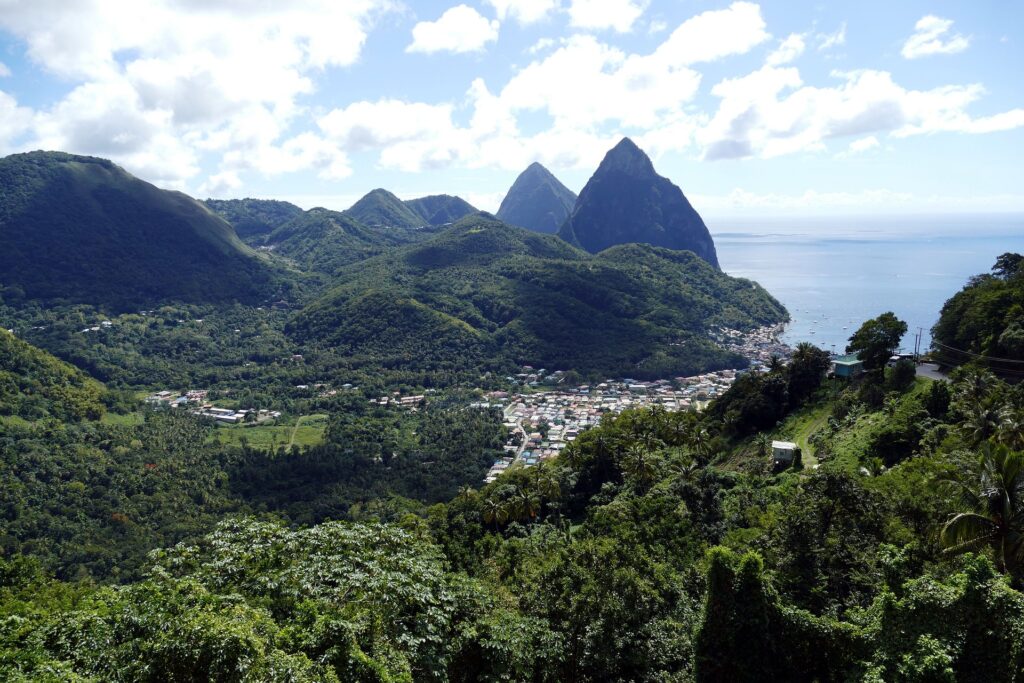
Fly into Hewanorra International Airport in the south and drive north along the coast, past the Pitons — which are more overwhelming in person than any photograph suggests, two volcanic spires erupting from the ocean with a verticality that makes the surrounding hills look polite — and through Soufrière, the oldest town on the island, French-founded, named for the sulphur that still steams from the collapsed volcanic crater nearby. Stop at the Sulphur Springs and see the earth’s interior exposed — boiling mud, mineral pools, the smell of hydrogen sulfide hanging in the tropical air, a landscape that looks like another planet and is accessible by car. Continue to Castries, the capital, and walk through the market where Kwéyòl is the language of transaction, where the spices and produce carry French names and the money carries the Queen’s face, and where the combination of these contradictions is not experienced as contradiction but as identity. Visit the Derek Walcott Square in the center of Castries — renamed from Columbus Square, because the island finally chose to honor the man who wrote it into world literature rather than the man who sailed past it. Sit in a fishing village and watch the pirogue boats come in and understand that these are the descendants of the boats Walcott wrote into Omeros — the working vessels of the Achilles and Hectors who fish the Caribbean the same way their ancestors did, and whose labor was never valued by the empires that fought over the island but was valued, finally, absolutely, by the poem.
Evolve — Who You Become in Saint Lucia
You leave Saint Lucia understanding that the most powerful response to being treated as a prize is to become the one who awards them. Fourteen colonial exchanges. Two Nobel Prizes. The math is not coincidence. The island that was fought over developed the intellectual tools to explain why fighting over islands is how empires work (Lewis) and the literary tools to transform the fought-over island into the center of its own epic (Walcott). Both laureates were born on January 23. Both were products of the colonial education system that the empires built for their own administrative convenience — and both used that education to dismantle the assumptions the system was built on. Lewis explained the economics. Walcott wrote the poetry. Both were from an island of fewer than one hundred and eighty thousand people — smaller than most cities — and both won the world’s highest honors in their fields, honors that had never before been awarded to a Caribbean person. The island that was the prize won the prize. You come home and look at the situation in which you have been treated as a commodity — competed for, acquired, transferred, valued for what can be extracted from you rather than what you produce on your own terms — and you do what Walcott did. You take the metaphor they gave you — the Helen, the prize, the thing fought over — and you write yourself into the center of the story. Not as the object. As the author. The Pitons are still standing. The fishermen are still fishing. The volcano is still steaming. The Kwéyòl is still spoken. The island was traded fourteen times and it has not moved. It is twenty-seven miles long. It contains the highest density of Nobel laureates on earth. The prize was always the island. The island won.
Your practical guide to Saint Lucia starts bellow 👇
🕰️ Saint Lucia Historical Backdrop
Saint Lucia’s history is a captivating narrative of strategic importance and cultural synthesis. Known as the “Helen of the West Indies” because it changed hands between the French and British 14 times, the island is a unique tapestry of European influence and resilient African heritage. Its story is told in the ruins of Rodney Bay’s naval fortifications, the vibrant Kweyol (Creole) language spoken in the villages, and the legacy of its two Nobel laureates—Sir Arthur Lewis and Derek Walcott. Since gaining independence in 1979, Saint Lucia has protected its natural assets with a fierce commitment to sustainable development. Today, it stands as a sophisticated Caribbean hub where the tradition of the cocoa harvest and the elegance of colonial architecture meet a modern, high-end tourism economy that prioritizes the preservation of its breathtaking volcanic landscapes.
🌟 Saint Lucia Local Experiences
Beyond the world-class resorts, discover Saint Lucia’s soul in the ritual of the Friday Night Fish Fry at Anse La Raye or Gros Islet, where the scent of grilled lobster and the sound of island rhythms create a sensory celebration of community. Experience the profound stillness of the Diamond Falls Botanical Gardens, the therapeutic warmth of a mud bath in the Sulphur Springs, or the simple joy of tasting a freshly harvested cocoa pod on a historic estate. Whether it’s trekking the Tet Paul Nature Trail for panoramic views or navigating the hidden mangroves of Savannes Bay by kayak, these moments reveal a nation that finds richness in its soil, its seas, and the infectious warmth of its people.
🌄 Saint Lucia Natural Wonders
- The Pitons: A UNESCO World Heritage site featuring two spectacular volcanic spires that are the most iconic landmarks in the Caribbean.
- Sulphur Springs Park: Known as the “world’s only drive-in volcano,” offering geothermal mud baths and active steam vents.
- Diamond Falls & Botanical Gardens: A stunning waterfall that changes color throughout the year due to mineral deposits, set within a lush tropical garden.
- Marigot Bay: Described by novelist James Michener as the most beautiful bay in the Caribbean, a deep-water harbor surrounded by steep, palm-fringed hills.
- Pigeon Island: A historic landmark and national park connected to the mainland by a causeway, offering panoramic views and military ruins.
- Toraille Waterfall: A powerful 50-foot cascade that falls into a natural pool, perfect for a refreshing tropical shower.
🏙️ Saint Lucia Must-See Towns & Regions
- Soufrière: The original French capital and the heart of the island’s natural wonders, characterized by colonial architecture and proximity to the Pitons. (Historic, Scenic, Volcanic)
- Castries: (Capital) A vibrant port city where the bustling Castries Market and the historic Derek Walcott Square meet the modern cruise terminal. (Urban, Historic, Commercial)
- Rodney Bay & Gros Islet: The island’s entertainment hub, famous for its world-class marina, sandy Reduit Beach, and high-energy nightlife. (Vibrant, Social, Coastal)
- Cap Estate: The northernmost tip of the island, known for its luxury villas, world-class golf courses, and dramatic Atlantic views. (Elegant, Residential, Panoramic)
🏞️ Saint Lucia National Parks & Nature Reserves
Managed with a focus on conservation and environmental education by the Saint Lucia National Trust.
- Pigeon Island National Park: Combining 18th-century British naval history with pristine beaches and hiking trails.
- Maria Islands Nature Reserve: A sanctuary for rare endemic species like the Saint Lucia Racer snake and the Whiptail lizard.
- Mankòtè Mangrove: The island’s largest mangrove forest, vital for coastal protection and birdlife.
🏛️ UNESCO World Heritage Sites
- Pitons Management Area — Recognizing the exceptional natural beauty and geological significance of the two volcanic spires and their surrounding marine and terrestrial ecosystems.
- For more information on the island’s heritage initiatives, visit the UNESCO Saint Lucia Portal.
🖼️ Saint Lucia Museums & Cultural Sites
- Fond Doux Eco Resort & Plantation: A working 19th-century cocoa plantation offering an immersive look into traditional agriculture and heritage.
- Lushan Country Life: An authentic look at traditional Saint Lucian forest life, herbs, and local customs.
- Morne Fortune: A historic hill overlooking Castries, home to Government House and the remains of 18th-century fortifications.
🎉 Saint Lucia Festivals & Celebrations
- Saint Lucia Jazz & Arts Festival: (May) One of the Caribbean’s premier cultural events, attracting international jazz, soul, and R&B legends to the stage at Pigeon Island.
- Saint Lucia Carnival: (July) A vibrant summer celebration featuring high-energy parades, colorful costumes, and Soca monarch competitions.
- Jounen Kwéyòl (Creole Day): (October) A nationwide celebration of the island’s French-African heritage with traditional food, music, and dress.
- Atlantic Rally for Cruisers (ARC): (December) The end-point of the world’s largest trans-oceanic sailing race, culminating in Rodney Bay.
🧽 How to Arrive
- ✈️ By Air
- Hewanorra International (UVF) in the south is the primary gateway for international flights from the US, Canada, and Europe.
- George F.L. Charles (SLU) in the north handles regional flights from neighboring Caribbean islands.
- Airlines: Major carriers (American, Delta, British Airways, Virgin Atlantic, Air Canada) connect Saint Lucia to the world.
- 🚢 By Water
- Castries is a major cruise port, with the Pointe Seraphine and La Place Carenage terminals serving large vessels.
- The L’Express des Îles ferry connects Saint Lucia to Martinique, Dominica, and Guadeloupe.
- 🚗 By Road
- Driving is on the left (British legacy). Car rentals are available, though the island’s winding mountain roads require careful navigation.
📶 Stay Connected
- SIM Cards: The two main providers are Flow and Digicel.
- Where to buy: Kiosks are available at both major airports and in Rodney Bay shopping centers. Registration with a passport is standard.
- eSIM: Supported by major providers and available via global data platforms like Airalo.
🏨 Where to Stay
Saint Lucia offers everything from world-famous “three-walled” luxury retreats to charming boutique inns and eco-lodges.
- Jade Mountain Resort: A masterpiece of organic architecture where suites are open to the Pitons—the ultimate in exclusive luxury.
- Sugar Beach, A Viceroy Resort: Set directly between the two Pitons on a former sugar plantation.
- Ti Kaye Resort & Spa: A secluded, adults-only retreat on the west coast, perfect for diving and privacy.
- Hotel Chocolat (Rabot Estate): A high-end boutique hotel set in a cocoa forest, offering a unique “tree-to-bar” experience.
⛳ Unique Finds
- Saint Lucia Chocolate: Taste world-class chocolate made from the island’s Rabot Estate cocoa beans.
- Tet Paul Nature Trail: Known as the “Stairway to Heaven,” offering the best views of both Pitons without a strenuous climb.
- The Mud Baths: Soak in the mineral-rich waters of the drive-in volcano for a natural skin reset.
- Local Rum: Visit the Saint Lucia Distillers to sample Chairman’s Reserve and Bounty Rum.
🤝 Saint Lucia Cultural Guidance
- Greetings: Manners are paramount. Always greet with a “Good morning” or “Good afternoon” before asking questions.
- Island Pace: While generally efficient, life follows the unhurried rhythm of the tropics. Patience is highly valued.
- Dress Code: Beachwear is for the beach. When in Castries or public buildings, modest attire (covering shoulders and knees) is the respectful standard.
- Basic Phrases (Kweyol/Creole):
- Hello: “Bonjou”
- Thank you: “Mèsi”
- How are you?: “Sa ou fê?”
- Everything is good: “Tout bagay byen”
🛂 Saint Lucia Entry & Visa Requirements
- Visa-Free: Citizens of the UK, US, Canada, EU, and many GCC nations generally do not require a visa for tourism stays up to 90 days.
- Official Source: Consult the Saint Lucia Department of Immigration.
💰 Practical Essentials
- Currency: Eastern Caribbean Dollar (XCD). It is pegged to the USD at a 2.7:1 ratio. US Dollars are widely accepted, but change is usually given in XCD.
- Electricity: Type G (Three rectangular pins—same as the UK and Middle East). Voltage is 230V.
- Safety: Generally safe for travelers. Standard urban vigilance is advised in Castries and Gros Islet at night.
- Climate: Tropical. Best visited December to May (Dry Season) to avoid the humid rainy window.
✨ Bonus Tip: The Vertical Recalibration
To truly embrace Saint Lucia, you must experience its “Verticality.” Most travelers focus on the shoreline, but the island’s true soul is found in the ascent. Whether you are climbing the Gros Piton or simply driving the winding roads of the interior rainforest, allow the scale of the volcanic peaks to recalibrate your sense of perspective. It is in the transition from the turquoise sea level to the mist-shrouded cloud forest—where the air is cooler and the world feels ancient—that your own sense of internal clarity and long-term vision will finally reveal itself.
🔗 Featured Links
- Official Tourism: Visit Saint Lucia.
- National Trust: Saint Lucia National Trust.

Beyondia
Trusted Travel CompanionReal digital nomad. I travel. I learn. I grow.
What about you? Where are you going?