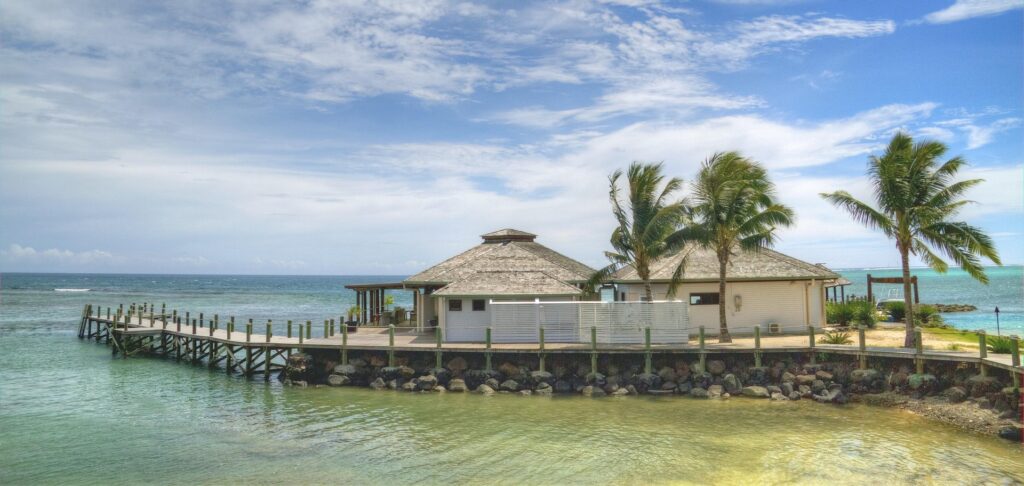
GoBeyondia Atlas 🗺️ East-Asia Oceania 🗾
Samoa: Where the oldest continuous culture in Polynesia — three thousand years and counting — designed its houses as oval domed roofs held up by wooden posts with no walls, lashed together with tens of thousands of feet of hand-plaited coconut fiber rope and not a single nail, and the absence of walls was not a limitation of materials or engineering but a design decision encoding an entire philosophy of social existence — that privacy is not a right but a choice exercised through behavior, that accountability is maintained through visibility, that community is not something you opt into but something you live inside, literally, with the breeze and the neighbors and the chief’s gaze passing through the same open space — and eighty-one percent of the country’s land remains under communal family ownership governed by a chiefly system that predates European contact by millennia — because Samoa understood before anyone else that what you leave out of the structure is the structure.
Samoa in 30 Seconds
An archipelago in the central South Pacific — two main islands, Upolu and Savai’i, and several smaller ones — settled by Lapita seafarers around 1000 BC, making it one of the oldest continuously inhabited sites in Polynesia and a launchpad for the later settlement of Tonga, Fiji, Hawai’i, and New Zealand. The culture that developed here — fa’a Samoa, the Samoan Way — is a comprehensive social operating system governing every aspect of life: how families are organized, how land is held, how chiefs are selected, how food is shared, how disputes are resolved, how houses are built. The word “comprehensive” is not metaphorical. Fa’a Samoa is holistic in the way an operating system is holistic — it does not run alongside life; it is the platform on which life runs. At its core is the aiga — the extended family — headed by a matai, a chief selected by consensus for the ability to serve, not for bloodline alone. Roughly eighteen thousand matai titles represent three hundred and sixty villages across the country. Every member of parliament is a matai. Eighty-one percent of the land is held communally under customary ownership — not by individuals, not by the state, but by families, managed by chiefs who can be removed if they fail to serve. The fale — the traditional Samoan house — is the physical expression of this philosophy. It is an oval or circular domed roof supported by wooden posts. There are no walls. The entire structure is lashed together with afa — plaited coconut fiber rope — using no metal, no nails, no adhesive. A single fale requires thirty thousand to fifty thousand feet of afa, each length hand-made from dried coconut husk. The construction is performed by tufuga fau fale — master builders belonging to an ancient guild whose knowledge is passed down through generations, the same way navigational knowledge was transmitted in the rest of Polynesia. The absence of walls is not incidental. It is the architecture. Without walls, there is no private space. Without private space, behavior is governed by visibility. You cannot abuse your family in a house the entire village can see into. You cannot hoard when your possessions are in plain sight. You cannot withdraw from community obligations when your absence is physically observable. The fale enforces the values of fa’a Samoa through its structure — or more precisely, through what it refuses to include. When blinds are needed — for rain, for sleep, for ceremony — they are woven from coconut or pandanus leaves and lowered temporarily. The default state is open. And the concept that makes this architecture possible is va — the space between. In Samoan philosophy, va is not empty space. It is relational space. The space between people, between families, between a chief and a community. Va is what connects, not what separates. A wall would interrupt va. The fale preserves it. Then, on December 29, 2011, Samoa skipped an entire day. The country moved from the east side of the International Date Line to the west side, jumping from Thursday directly to Saturday — Friday, December 30, 2011, never happened in Samoa. The reason was pragmatic: Samoa’s main trading partners, Australia and New Zealand, were on the other side of the line, and the mismatch meant that when Samoans were at church on Sunday, Sydney was already conducting Monday business. A country that has maintained the same social system for three thousand years looked at the calendar, decided it was misaligned with reality, and deleted a day. No referendum. No debate that lasted years. A decision was made and a day was removed. This was not the first time. In 1892, Samoa had added a day — celebrating July 4th twice — when it shifted to align with American trading partners. A hundred and nineteen years later, it shifted back. The country that builds houses without walls also builds calendars without certain Fridays. What you leave out is the architecture.
Evoke — Why You Visit Samoa
You come to Samoa because you have been adding walls — to your schedule, your relationships, your organization — and the walls are not protecting you, they are isolating you, and you need a civilization that has spent three thousand years proving that the most sophisticated social structure does not require separation. The fale is not primitive. It is the result of a design philosophy so advanced that modern architects study it: the domed roof disperses cyclone winds; the absence of walls allows cross-ventilation in tropical heat without mechanical cooling; the lashing system permits disassembly and reassembly without structural degradation; the spatial layout encodes an entire governance hierarchy — the position of every person in a formal gathering is determined by rank, direction, and relationship to the posts. The fale is more architecturally sophisticated than a Western house with four walls and a locked door. It just achieves its sophistication through subtraction rather than addition. Fa’a Samoa operates the same way. The matai system is not a primitive chieftaincy. It is a distributed governance network — eighteen thousand chiefs across three hundred and sixty villages, each selected by family consensus, each removable for failure to serve — that has maintained social cohesion across a population now split between the islands and a diaspora larger than the homeland population. Samoans in Auckland, Los Angeles, and Sydney still hold matai titles, still send remittances, still return for ceremonies, still recognize the authority of a system that has no enforcement mechanism other than the social pressure of being visible to your community — the same pressure the fale creates by having no walls. You come because you have been building walls between yourself and the people you serve, and the walls have become the problem. Samoa will show you that the most enduring governance system in Polynesia was built on a structure that anyone can see through.
Explore — How You Experience Samoa
Fly into Apia on Upolu — a capital small enough that you can walk it in an afternoon — and visit the parliament building, the Fale Fono, whose roof is designed in the shape of a traditional fale, because even the national legislature acknowledges that the form of governance it houses is older than the building. Then leave Apia and drive the coastal road around either island — and understand that every village you pass through is governed by its own fono a matai, a council of chiefs that meets in the fale tele, the big house at the front of the village, where the seating positions are determined by rank and direction and the space in the center is kept open for the presentation of fine mats and the ava ceremony that precedes every significant decision. Stay in a beach fale on Savai’i — the largest island, the least developed, the most traditional — and sleep in an open-sided structure with the ocean ten meters away, the breeze uninterrupted, the stars visible through the gap between roof edge and sand. Understand that you are not “roughing it.” You are experiencing the architectural philosophy that sustained the oldest Polynesian civilization: the default state is open; closure is temporary and reversible. Watch a traditional ava ceremony — the preparation and drinking of the kava-like beverage in a sequence determined by chiefly rank, served in a polished coconut shell by a designated server, every gesture codified, every phrase ritualized — and understand that this is the same ceremony that has preceded important decisions in this archipelago for three thousand years. Visit the Papase’ea Sliding Rocks — a natural water slide on volcanic rock — and watch Samoan children launch themselves down the same smooth stone their ancestors used, and notice that no one is supervising, no one is charging admission, and no one is worried, because the community is the supervision, the visibility is the safety net, and the va between the children and the adults present is not empty space but relational space that holds them both.
Evolve — Who You Become in Samoa
You leave Samoa understanding that the most radical architectural decision is not what you build but what you refuse to build. The fale has no walls because walls would contradict the purpose of the structure — which is not to shelter individuals from each other but to shelter a community from the weather while keeping it visible to itself. The matai system has no enforcement apparatus because the enforcement is the visibility — a chief who fails is seen failing, by a family that lives in houses you can see through. The calendar has no December 30, 2011, because that day was in the way. Every design decision in Samoa is a subtraction. What do we not need? Walls. Nails. Metal. Privacy as a default. A Friday that doesn’t align with our trading partners. The Western instinct is to add — more walls, more features, more structure, more privacy, more days. Samoa’s instinct is to remove — until what remains is the minimum architecture required to sustain a community in open air for three thousand years. Thirty thousand feet of coconut rope. A domed roof. Posts. The sky. The va between people, which is not empty, which holds everything. You come home and look at the walls you’ve built — the organizational silos, the closed-door meetings, the private channels, the structures that were supposed to protect but instead isolated — and you ask the Samoan question: what would happen if I took the walls down? Not the roof. Not the posts. Not the rope that holds the thing together. Just the walls. What would the breeze carry in? What would the village see? What behavior would change if it could be observed? The fale has stood for three thousand years. The walls you built last quarter are already causing problems. The architecture was never the wall. The architecture was always the space between.
Your practical guide to Samoa starts bellow 👇
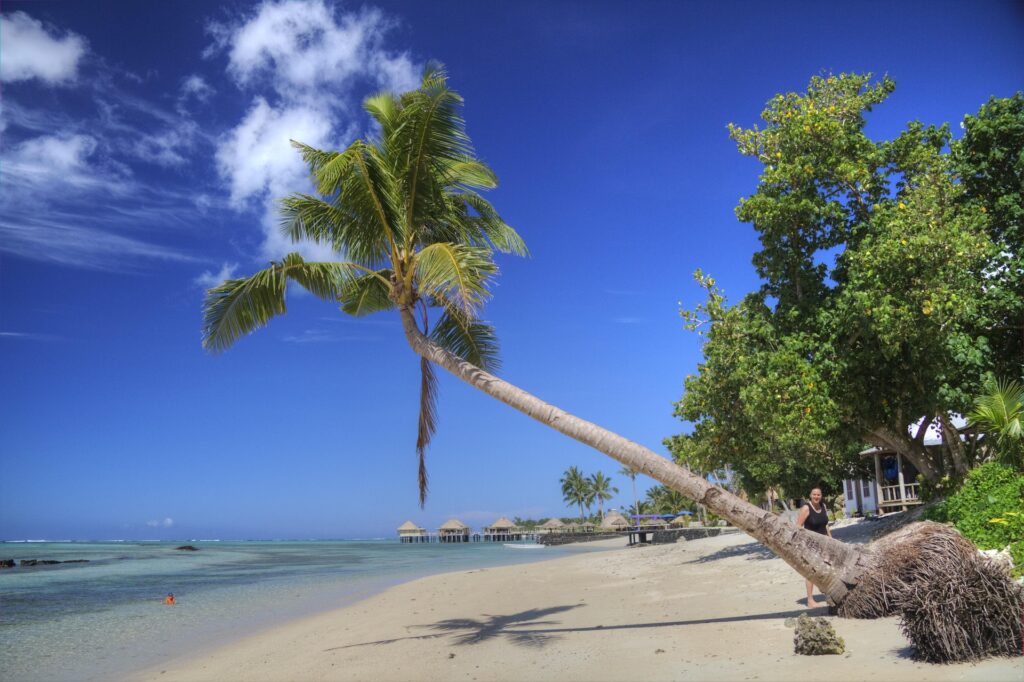
🕰️ Samoa Historical Backdrop
Samoa’s history is a 3,000-year narrative of maritime mastery and cultural endurance. Settled by Lapita explorers, the islands became the cradle of Polynesian culture, from which voyagers eventually settled Hawaii, Tahiti, and New Zealand. Its story is told in the ancient Pulemelei Mound—the largest prehistoric structure in the Pacific—and the resilient spirit of the Mau movement, which led to Samoa becoming the first small island nation in the Pacific to regain its independence in 1962. Following periods of German and New Zealand administration, Samoa has remained a fierce guardian of its traditional chiefly system (matai) and communal land ownership. Today, it stands as a vibrant parliamentary democracy that meticulously balances modern development with the “Fa’a Samoa” (The Samoan Way), preserving a society where family, faith, and the environment are inextricably linked.
🌟 Samoa Local Experiences
Beyond the pristine beaches, discover Samoa’s soul in the ritual of the Ava Ceremony, where the sharing of a sacred root drink marks the beginning of all significant social bonds. Experience the profound stillness of a Sunday morning in a village, where the air is filled with the harmonious sounds of choral singing, the intoxicating aroma of an “Umu” (earth oven) feast, or the simple joy of staying in a traditional “Fale”—an open-air thatched dwelling that removes the boundaries between you and nature. Whether it’s witnessing the high-intensity energy of a “Siva Afi” fire knife dance or learning the symbolic language of the “Pe’a” (traditional tattoo), these moments reveal a nation that finds richness in respect, community, and the slow rhythm of island life.
🌄 Samoa Natural Wonders
- To Sua Ocean Trench: An iconic 30-meter deep natural swimming hole formed by a collapsed lava tube, accessible by a wooden ladder.
- Lalomanu Beach: Consistently ranked among the world’s best, offering vibrant coral sands and views of the uninhabited Aleipata Islands.
- Alofaaga Blowholes: Powerful natural jets of water that blast hundreds of feet into the air through volcanic rock tubes on the island of Savai’i.
- Afu Aau Waterfalls: A spectacular cascade that plunges into a deep, crystal-clear swimming hole surrounded by a lush tropical rainforest.
- Lake Lanoto’o: A rare, high-altitude volcanic crater lake home to thousands of gold-colored wild goldfish.
- Mount Matavanu: An accessible volcanic crater on Savai’i, offering a glimpse into the 1905 eruption that shaped the island’s unique lava fields.
🏙️ Samoa Must-See Towns & Regions
- Apia (Upolu): (Capital) A charming waterfront city blending colonial-era architecture with vibrant local markets (Flea Market) and the scenic Mulinu’u Peninsula. (Urban, Historic, Gateway)
- Savai’i: The larger, more traditional island known as “The Soul of Samoa,” famous for its rugged volcanic landscapes and unhurried pace. (Authentic, Wild, Natural)
- Lalomanu & Aleipata: The southeastern tip of Upolu, offering the most iconic beaches and island-hopping opportunities. (Picturesque, Coastal, Relaxed)
- Manono Island: A car-free, dog-free sanctuary between the two main islands, offering a look at ancient Samoan life and the 12-pointed Star Mound. (Quiet, Traditional, Historic)
🏞️ Samoa National Parks & Nature Reserves
Managed with a focus on community-led conservation and biodiversity by theMinistry of Natural Resources and Environment (MNRE).
- O Le Pupu-Pu’e National Park: Samoa’s first national park, stretching from the highest peaks to the rugged southern basalt cliffs.
- Palolo Deep Marine Reserve: A spectacular blue hole and coral garden located just steps from downtown Apia.
- Falealupo Rainforest Preserve: Featuring a canopy walkway and the legendary “Gateway to the Underworld.”
🏛️ UNESCO World Heritage Sites
Samoa currently has several sites on the Tentative List, reflecting its commitment to cultural preservation:
- Fagaloa Bay – Uafato Tiavea Conservation Zone: A unique landscape where steep mountains meet the ocean, preserving traditional lifestyles.
- Manono, Apolima and Nuulopa Cultural Landscape
- For more information on heritage initiatives, visit the UNESCO Samoa Portal.
🖼️ Samoa Museums & Cultural Sites
- Robert Louis Stevenson Museum (Villa Vailima): The beautifully restored home and final resting place of the “Treasure Island” author.
- Museum of Samoa (Apia): Housed in a historic colonial building, detailing the archaeology and ethnographic history of the islands.
- Samoa Cultural Village (Apia): An essential interactive space to witness traditional tattooing, wood carving, and “Siapo” (bark cloth) making.
🎉 Samoa Festivals & Celebrations
- Teuila Festival: (September) The premier national cultural event featuring traditional dancing, choir competitions, and “Fautasi” longboat races.
- Independence Day: (June 1) A vibrant celebration of national sovereignty with parades, traditional games, and festivals.
- Siva Afi Festival: (Occasional) Celebrating the modern and ancient art of fire knife dancing.
- Miss Samoa Pageant: (September) A major cultural event that showcases the “Samoan Woman” and traditional values.
🧽 How to Arrive
- ✈️ By Air
- Faleolo International (APW) on Upolu is the primary gateway, located about 45 minutes from Apia.
- Airlines: Samoa Airways (National Carrier), Fiji Airways, Air New Zealand, and Qantas connect Samoa to major hubs in the Pacific and beyond.
- 🚢 By Water
- Inter-island ferries (Samoa Shipping Corporation) provide regular transport between Upolu (Mulifanua Wharf) and Savai’i (Salelologa Wharf).
- 🚗 By Road
- Driving is on the left. Car rental is highly recommended for Savai’i. Local buses are colorful, wooden, and an essential part of the Samoan travel experience.
📶 Stay Connected
- SIM Cards: The two main providers are Digicel and Vodafone Samoa.
- Where to buy: Kiosks are available at Faleolo Airport and in Apia town center. Registration with a passport is standard.
- eSIM: Supported by Vodafone Samoa; also available via international data platforms like Airalo.
- Digital Infrastructure: High-speed 4G is standard in Apia and coastal resorts, though signal can be limited in the Savai’i interior.
🏨 Where to Stay
Samoa offers everything from luxury tropical resorts to authentic beach “Fales” (traditional open-air bungalows).
- Sheraton Samoa Beach Resort: A world-class resort located near the airport and ferry wharf.
- Taumeasina Island Resort (Apia): A premiere luxury resort built on its own island just outside the capital.
- Sinalei Reef Resort & Spa: An elegant, adults-only eco-retreat on the southern coast of Upolu.
- Beach Fales: For a transformative experience, stay with local families in beach fales (like those at Lalomanu), providing an authentic, unplugged island immersion.
⛳ Unique Finds
- Coconut Crab Tasting: Try the world’s largest land crab, a local delicacy on Savai’i.
- Traditional Tattoos (Tatau): Witness the “Pe’a” (for men) and “Malu” (for women) being applied using traditional hand-tapping tools.
- Piula Cave Pool: A beautiful freshwater pool located directly beneath a historic Methodist chapel.
- Saleaula Lava Fields: Walk over the rippled landscape of the 1905 eruption where a stone church was partially buried in molten rock.
🤝 Samoa Cultural Guidance
- Fa’a Samoa: Respect the local social code. Village elders (Matai) hold authority; follow their lead.
- Evening Prayer (Sa): Many villages observe a quiet prayer time between 6:00 PM and 7:00 PM (indicated by a bell or shell). Please remain still and quiet if you are walking through a village.
- Sunday Protocol: Sunday is a day of rest and family. Most businesses are closed, and it is polite to avoid loud activities or swimming near villages during church hours.
- Basic Phrases:
- Hello: “Talofa”
- Thank you: “Fa’afetai” (Fah-ah-feh-tye)
- How are you?: “O a mai oe?”
- Everything is good: “Manaia” (Mah-nye-ah)
🛂 Samoa Entry & Visa Requirements
- Visa-Free: Citizens of most countries (including UK, US, Canada, EU, and Gulf nations) are granted a 60-day Visitor Permit on arrival for free.
- Official Source: Consult the Samoa Ministry of the Prime Minister and Cabinet (Immigration).
💰 Practical Essentials
- Currency: Samoan Tala (WST). ATMs are available in Apia and Salelologa. Cash is essential for village fees and local markets.
- Electricity: Type I (Three flat pins—same as Australia/NZ). Voltage is 230V.
- Safety: One of the safest and most welcoming destinations in the South Pacific. Standard water safety precautions apply.
- Climate: Tropical. Best visited May to October (Dry Season) to avoid the humid rainy window.
✨ Bonus Tip: The Open Fale Perspective
To truly embrace Samoa, you must spend at least one night in a traditional Open Fale. Most travelers seek the “protection” of four walls. In Samoa, the open fale is a philosophy—it represents a lack of secrets and a total connection to the community and the ocean. It is in the absolute vulnerability of sleeping with only the breeze and the sound of the waves between you and the world—where the stars are your only ceiling—that your own sense of perspective and internal peace will finally reveal themselves.
🔗 Featured Links
- Official Tourism: Samoa.travel.
- Heritage Trust: Samoa Conservation Society.

Beyondia
Trusted Travel CompanionReal digital nomad. I travel. I learn. I grow.
What about you? Where are you going?