🌐 Around the World with Beyondia 🧵 Mediterranean Region 🪡 Episode 44: Seville
Seville is the Andalusian capital that ran the legal monopoly on Spanish trade with the Americas for 214 years, completed Spain’s expulsion of its Moorish-descended population in 1609–1614, and contains the largest Gothic cathedral in the world built on top of an Almohad mosque.
The bell tower of Seville’s cathedral is 95 metres tall
The bell tower of Seville’s cathedral is 95 metres tall. The lower 76 metres of it were built between 1184 and 1198 as the minaret of the Great Mosque of Seville, by the architects of the Almohad Caliphate — the Berber-Arab Islamic dynasty that ruled most of Iberia and the western Maghreb from the mid-twelfth to the mid-thirteenth centuries. From the top, five times a day for three hundred and twenty-eight years, the muezzin called the city to prayer. The mosque below was one of the largest in the Western Mediterranean. The Almohads had made Seville — which they called Ishbiliya — the capital of their Iberian territory in 1147, and over the next century they built the mosque, the city walls, the original Alcázar palace, and the infrastructure that turned the Roman city of Hispalis into one of the great medieval Islamic capitals of Mediterranean Europe. In 1248, after a sixteen-month siege, King Ferdinand III of Castile took the city. The Muslim population was given the choice of leaving or converting; the great majority left, moving south to the surviving Nasrid kingdom of Granada or across the Strait of Gibraltar to Morocco. The mosque was converted to a Christian cathedral. The minaret was kept as the bell tower. For one hundred and fifty years, Christian worship continued inside what had been a Muslim building.
Then, in 1401, the cathedral chapter decided to demolish the converted mosque and build something larger on its foundations. The decision was recorded in the chapter-house minutes in a sentence that has since become one of the most famous medieval architectural quotations: “Hagamos una iglesia tan hermosa y tan grandiosa que los que la vieren labrada nos tengan por locos” — “Let us build a church so beautiful and so grand that those who see it built will think we are mad.” Construction began in 1402. The cathedral was substantially complete by 1506. The result is the largest Gothic cathedral in the world by area: five naves, eighty side chapels, total interior floor area of approximately 11,500 square metres, total interior volume of approximately 132,000 cubic metres. The central nave rises to 42 metres. The total length is 135 metres. The chapter that ordered the building did not, in the event, get to see it completed; the construction took five generations. But the cathedral was finished as they had imagined it, and they had been right about what people would think. The minaret of the mosque the cathedral replaced was retained as the bell tower. In 1568, the Spanish architect Hernán Ruiz the Younger added the upper Renaissance bell-chamber, carefully matching the Almohad brickwork pattern, and topped the entire structure with a four-metre bronze weathervane representing Faith holding a palm-frond banner — the Giraldillo, the spinning one, from which the tower takes its modern name. The Almohad architects who built the minaret in 1198 could not have anticipated that their tower would, four centuries later, be crowned with a Christian allegorical figure spinning in the wind. The tower kept doing what towers do. The civilisation underneath it changed.
The tomb of Christopher Columbus is inside the cathedral. It sits in the south transept, held aloft by four large bronze figures representing the kingdoms of Castile, Aragón, Navarre, and León — the components of the Spain that Columbus had sailed for. The bones inside the tomb are, with reasonable certainty, his — though the question has been disputed for centuries, given the number of times Columbus’s remains were moved (Valladolid, where he died in 1506; then Seville; then Santo Domingo in 1542; then Havana in 1795 when Spain lost Santo Domingo to France; then back to Seville in 1898 when Spain lost Cuba to the United States). A DNA analysis conducted in 2006 confirmed the bones in Seville’s cathedral are consistent with Columbus’s documented family lineage. The Dominican Republic continues to claim that the real bones remain in Santo Domingo. The article will not resolve the question. What is certain is that the man whose 1492 voyage opened the Americas to European colonisation is commemorated in the cathedral of the city that subsequently administered, for two and a quarter centuries, the entire imperial system his voyage initiated.
The administrative system was the Casa de Contratación de Indias — the House of Trade of the Indies — established in Seville in 1503 by Queen Isabella, and given the legal monopoly on all Spanish maritime trade with the Americas. From 1503 until 1717, every ship sailing from Spain to the Americas, and every ship returning, was legally required to depart from and arrive at Seville’s quaysides on the Guadalquivir. The river — al-wadi al-kabir in the Arabic of its Moorish renamers, “the great river,” the name that has survived in modern Spanish as Guadalquivir and that is the most durable Arabic toponym in European geography — was navigable by ocean-going ships from the Atlantic at Sanlúcar de Barrameda, 95 kilometres downstream, all the way up to Seville’s port at the heart of the city. The Casa de Contratación licensed every voyage, collected the quinto real (the royal fifth, the 20% tax on all colonial production, principally on the silver mined at Potosí and Zacatecas), trained the navigators, maintained the padrón real (the master map of the world, the central cartographic document of the Spanish empire, updated continuously from the reports of returning pilots), administered the colonial postal system, and adjudicated commercial disputes. The Casa was, in functional terms, a financial regulator at imperial scale — the Wall Street of the early modern world, the institutional engine through which Atlantic colonial wealth flowed into and out of Spain. For two centuries, Seville was the wealthiest single port city in Europe. The architecture of the city’s golden age — the Lonja de Mercaderes (the Merchants’ Exchange, completed in 1598, now the home of the Archive of the Indies), the Mudéjar palaces of the noble merchant families, the great religious foundations (the Casa de Pilatos, the Palacio de las Dueñas), the Triana ceramic industry that supplied the tilework to all of these — was paid for by the trade the Casa administered. The Archive of the Indies, established in the Lonja in 1785 by King Charles III to centralise the documentary record of three centuries of empire, contains approximately 43,000 individual document collections and an estimated 80 million pages of original colonial administration. It is the single most important documentary archive for the history of Spanish colonisation of the Americas, and it has been a UNESCO World Heritage Site (alongside the Cathedral and the Alcázar) since 1987.
And in 1609, in the same city, by the order of the same crown, an entire civilisation began to depart. The Moriscos were the Muslim-descended Spaniards who had been forcibly converted to Christianity after the Reconquista, particularly after the fall of Granada in 1492. They had remained, for over a century, a substantial demographic and cultural presence in Spain — perhaps 300,000 people across the country in 1609, with the largest concentrations in Valencia, Aragón, and Andalusia (including the agricultural hinterland of Seville). Their assimilation had been partial, contested, and politically increasingly suspect. The Inquisition had pursued them as crypto-Muslims. The crown had debated their status for generations. In September 1609, King Philip III issued the formal decree of expulsion. Over the following five years, the entire Morisco population of Spain was forcibly removed from the country, transported to North Africa (principally to Morocco and to the Ottoman territories of Algiers and Tunis), with the small minority that escaped expulsion absorbed into the surrounding Christian population through sometimes-forced conversion. In the Kingdom of Valencia, where the Morisco population had been the largest, the expulsion removed approximately one third of the total population and caused immediate agricultural collapse. In Andalusia, the demographic transformation was profound. The Moorish agricultural inheritance — the irrigation systems (the acequias) that had supported Seville’s hinterland for eight centuries, the specific knowledge of citrus, rice, olive, and silk cultivation, the small-scale family farming that had been the rural economy of Moorish al-Andalus — was substantially destroyed by the removal of the people who knew how to maintain it. The cultural transformation was equally profound. Eight hundred years of Moorish presence in Iberia — beginning with the Berber-Arab conquest of 711 and continuing in some form through the fall of Granada in 1492 and the post-Reconquista Morisco century — ended, in administrative terms, between 1609 and 1614. The river that the Moors had named al-wadi al-kabir continued to flow through Seville to the Atlantic. The name did not change. The people did.
This is the deepest paradox of seventeenth-century Seville and one of the most consequential single contradictions of early modern European history. The city that was administering the largest territorial empire in the world, that was the entry point and exit point of the wealth flowing between Spain and its American colonies, that was at the absolute peak of its economic and demographic significance — was, simultaneously, the city through which the crown that ruled it was conducting the largest single act of religious-cultural cleansing in early modern Europe. The wealth of the Americas was funding the political project of religious uniformity. The same year that Seville received the silver fleets returning from Veracruz and Portobelo, the same year that the Casa de Contratación was registering record trade volumes, the same year that the cathedral chapter was commissioning new chapels and the merchant families were building palaces in the Mudéjar style their Moorish predecessors had taught them — that same year, the Morisco families of the Andalusian countryside were being marched to the Atlantic coast for deportation. The two facts cannot be separated. They are the same imperial moment. The article does not propose to resolve the moral question. The article proposes only that the visitor to Seville in 2026 should know that both events happened, in the same city, under the same crown, within the same century, and that the architecture and the wealth and the demographic composition of the contemporary city are the joint inheritance of both.
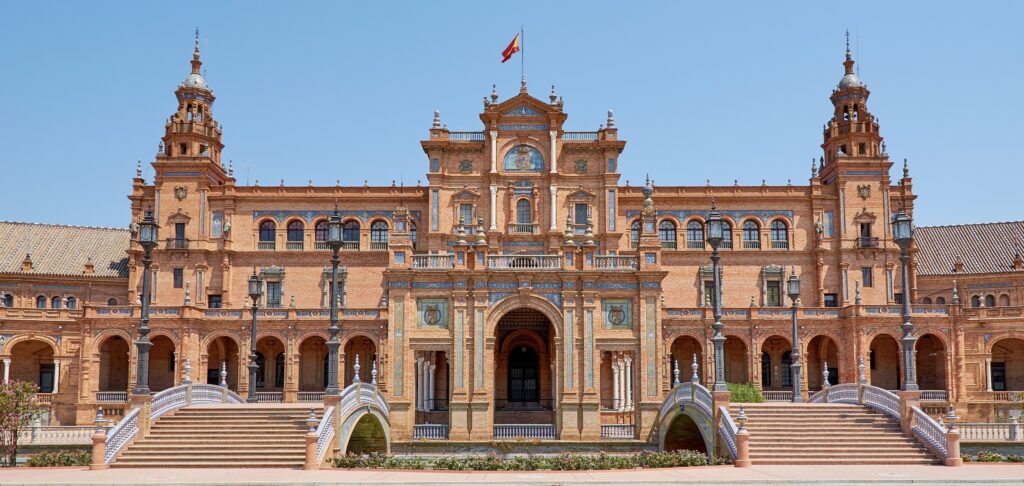
The city’s decline came in the eighteenth century, when the Guadalquivir’s silting could no longer be managed and ocean-going ships became too large to navigate up the river to Seville’s port. In 1717, King Philip V transferred the Casa de Contratación to Cádiz, the larger Atlantic port at the mouth of the Bay of Cádiz, eighty kilometres south. Seville’s economic position collapsed almost immediately. The city went into a long decline that lasted until the early twentieth century — a decline that, paradoxically, preserved much of the historic architectural fabric, because there was insufficient economic activity to demolish and rebuild it on the scale that was happening simultaneously in Madrid, Barcelona, and Bilbao. The Seville of 1900 was poor, small, peripheral, with a tenth of Madrid’s population and a fraction of Barcelona’s industrial capacity. The 1929 Ibero-American Exposition, organised partly to revive the city’s economic position and partly to reassert Spain’s relationship with its former American colonies, produced the architectural infrastructure that defines much of the contemporary visitor’s experience: the Plaza de España (designed by Aníbal González, opened in 1928, a semicircular brick-and-tile complex with niches representing the 48 Spanish provinces), the Plaza de América, the María Luisa Park, and the substantial rebuilding of the city centre to receive international visitors. The 1992 Universal Exposition, organised for the five-hundredth anniversary of Columbus’s first voyage, brought the AVE high-speed rail link to Madrid (Spain’s first high-speed line, opened that year, reducing travel time from over six hours to two and a half), the modernisation of the city’s infrastructure, and the redevelopment of the Isla de la Cartuja (the riverside island where Columbus had prepared his second voyage in 1493, by then a near-abandoned former Carthusian monastery) as a technology park and exhibition site. The two Expositions, sixty-three years apart, both restructured the city. Both also positioned Seville in international consciousness as something other than a former imperial capital — as a city of festivals, oranges, flamenco, and Andalusian warmth.
Flamenco is the cultural product of all of these processes. The art form is genuinely from Andalusia — and more specifically from the Romani communities of Seville, Cádiz, Jerez de la Frontera, and the Triana neighbourhood across the Guadalquivir from the cathedral. The codification of flamenco as a recognised art form dates from the mid-nineteenth century, when the cafés cantantes of Seville and Cádiz first began to stage public performances of what had previously been a private community music. The deeper musical synthesis is older: Romani vocal traditions (the Roma migrated into Spain from the Indian subcontinent through the fifteenth and sixteenth centuries, arriving in significant numbers in Andalusia by the late sixteenth century), Andalusian folk music (with its substantial Moorish musical inheritance), and very probably elements of Sephardic Jewish liturgical music (carried into the Roma communities by Spanish-Jewish musicians after the 1492 expulsion). The art form developed in the marginalised communities of Triana and the working-class quarters of Seville and Cádiz for two centuries before its public emergence. The four components — the cante (vocal song), the toque (guitar accompaniment), the baile (dance), and the palmas (rhythmic handclapping) — developed together. The cante jondo (the deep song) — the most serious, slow, vocally demanding form, dealing with themes of grief, exile, love, and death — is widely considered the artistic core of the tradition. UNESCO inscribed flamenco as Intangible Cultural Heritage of Humanity in 2010, with the inscription explicitly noting its origins in the Roma communities of Andalusia and its broader Andalusian cultural context. The Triana neighbourhood remains one of the principal centres of flamenco performance and instruction, though the tradition has spread across the city and across Spain. Flamenco is, in many ways, the Andalusian equivalent of what the blues was in the American South: an art form developed by a marginalised community, carrying historical pain into virtuosic musical form, and eventually adopted by the broader national and international culture. Both took roughly a hundred years between codification and international recognition. Both remain rooted in the communities that created them.
The bitter orange trees of Seville — Citrus aurantium, the naranjo amargo — line the streets and the central patio of the cathedral and the Alcázar gardens. The trees were brought to Spain by the Moors in the tenth century from the Middle East, where they had originated as a cross between the pomelo and the mandarin somewhere in southeast Asia. Seville has approximately 25,000 bitter orange trees in its public spaces. They flower between mid-February and mid-March, filling the city with the scent of azahar — orange blossom — that is, for many Sevillanos, the single most distinctive sensory experience of their city’s spring. The fruit ripens in winter and is harvested between December and February. It is too bitter to eat raw, but is essentially the world’s principal source of marmalade oranges. Approximately ninety per cent of Seville’s bitter orange harvest is exported to the United Kingdom, where Dundee marmalade has been made from Seville oranges continuously since 1797 (when, according to the family legend, the Keiller family of Dundee bought a cargo of Seville oranges from a Spanish ship that had taken shelter in Dundee harbour, found the fruit too bitter to sell, and turned it into preserve). The oranges that British breakfasts spread on toast every morning grew on trees planted by the Moors a thousand years ago, in the streets of the city that the same Moors had built and that the Christian crown subsequently emptied of their descendants. The continuities are quiet. The continuities are also real.
This is the deeper character of Seville. The city is the architectural compression of Spain’s Moorish-Christian-imperial layering, with the largest Gothic cathedral in the world built on the foundations of an Almohad mosque, with the bell tower that used to be the minaret, with the oldest royal palace in continuous use in Europe a few hundred metres away, with the bones of Christopher Columbus in the south transept, with the documentary archive of three hundred years of Spanish colonisation in the former merchants’ exchange across the plaza. The city was the legal and financial centre of the largest territorial empire of the early modern world for two hundred and fourteen years. The city was also where the crown that ran that empire completed its demographic-cultural ending of Spain’s eight-century Moorish presence between 1609 and 1614. The city declined when the river silted, was preserved by the decline, was revived by two international expositions sixty-three years apart, and produced — out of the marginalised communities that the empire and the expulsions and the long decline had left to themselves — one of the most consequential art forms of nineteenth-century Europe. The bitter oranges flower every February. The Guadalquivir still carries the Arabic name the Moors gave it. The cathedral still rings the same bells from the same tower the Almohads built. The contradictions are real. The continuities are also real. The city contains both.
Some cities were on the edge of history. This one was on the absolute centre of it for two centuries, and contains, in the same square mile, the architecture of expansion, the documentary record of empire, the demographic ending of a civilisation, and the art form that grew from what was left behind.
Nine regions. One hundred and twenty destinations. Three hundred and seventeen weeks remaining.
The journey continues south-east. The next stop is the city where Moorish Spain had its last and most beautiful capital — and where, in January 1492, it finally ended.

Beyondia
Trusted Travel CompanionReal digital nomad. I travel. I learn. I grow.
What about you? Where are you going?