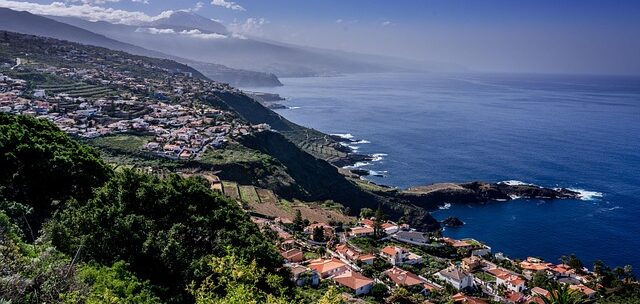
🌐 Around the World with Beyondia 🧵 Mediterranean Region 🪡 Episode 47: Tenerife
Tenerife is the largest of the seven Canary Islands — 2,034 square kilometres, roughly the size of the state of Luxembourg — and sits approximately three hundred kilometres off the southern Moroccan coast at the same latitude as the Sahara. It has a permanent population of approximately 950,000 residents (making it the most populous of the Canaries, ahead of Gran Canaria) and receives approximately six million tourists per year, the largest single visitor share of any Spanish island. It is dominated, geographically and psychologically, by the volcanic peak at its centre.
Tenerife has the highest point in Spain
El Teide (or Pico del Teide, “the Teide peak,” from the Guanche Echeyde, meaning approximately “hell” — the Guanches believed the volcano was the entrance to a subterranean realm of demons) rises to 3,715 metres above sea level, making it the highest point in Spain, the highest point anywhere in the Atlantic Ocean, and — measured from its base on the ocean floor at roughly 7,500 metres below sea level — one of the three largest single volcanoes on Earth by total elevation. Only Mauna Loa and Mauna Kea in Hawaii exceed it. If you were to drain the Atlantic and measure El Teide from base to summit, it would be 11,200 metres tall, or approximately 26% taller than Everest measured from sea level. The mountain is the reason the island exists — Tenerife rose from the seabed in a series of eruptions beginning approximately 12 million years ago, with El Teide itself in its current form being roughly 170,000 years old. The mountain last erupted in November 1909 from the Chinyero vent on the western flank; the last summit eruption was in 1798 from the Narices del Teide vents; the volcano is currently classified as active but dormant, monitored continuously by the Instituto Volcanológico de Canarias. The Guanches were right about the entrance. The demons have been quiet for a while.
The mountain is also, and increasingly, the reason astronomers come to Tenerife. Since the mid-1960s, the summit region of the island — specifically the Izaña plateau at 2,390 metres, well above the daily mar de nubes (the sea of clouds that forms around 1,500 metres and blankets the lower island in white below) — has hosted the Observatorio del Teide, one of the most productive optical and solar observatories in the northern hemisphere. The atmosphere at the observatory is exceptional for astronomy: high altitude, extremely low humidity, minimal light pollution (the Canary Islands enforce some of the strictest anti-light-pollution regulations in Europe, dating from the Ley del Cielo of 1988), and stable air produced by the interaction of the northeast trade winds with the volcanic mass. The observatory operates telescopes for solar observation (including the world’s largest currently-operating vacuum-tower solar telescope, GREGOR, aperture 1.5 metres), for exoplanet detection, for gamma-ray astronomy, and for cosmological research. It is operated by the Instituto de Astrofísica de Canarias (IAC), founded in 1975, which also operates the larger Observatorio del Roque de los Muchachos on the neighbouring island of La Palma — home of the Gran Telescopio Canarias, at 10.4 metres of aperture the largest single-mirror optical telescope in the world. Between the two Canary observatories, Spanish-hosted astronomy has produced a substantial share of major exoplanet discoveries of the past twenty-five years, has contributed to solar physics research that has fundamentally revised our understanding of the sun’s magnetic-field dynamics, and hosts telescopes for research consortia that include institutions from more than 60 countries. Most foreign readers who go to Tenerife for the beach never realise that Europe’s premier optical astronomy programme runs from the mountain visible on every clear morning above their hotel. The sky is what Europe comes to Tenerife to see, at the exact altitude that puts the observers above the clouds the beach visitors are avoiding.
Tenerife was inhabited by the Guanches.
Before all of this — before the astronomy, before the tourism, before the Spanish empire, before the volcanic peak became the postcard — Tenerife was inhabited by a people the historical record calls the Guanches. The Guanches were, according to the genetic and linguistic evidence now firmly established, of Berber origin — related to the Amazigh peoples of North Africa — who had settled the Canary Islands approximately 2,500 years ago, probably from what is now southern Morocco and Algeria, and had been isolated on the archipelago for roughly two millennia by the time Europeans arrived. They lived in Neolithic-era pastoral societies, herded goats and sheep, cultivated barley and figs, wove wool and reed, lived in caves and stone huts, mummified their dead with techniques comparable in sophistication to (though independently developed from) those of Pharaonic Egypt, and had no writing system, no metallurgy, no boats capable of inter-island travel, and no knowledge of the sea beyond fishing from shore. They spoke Guanche, a language related to Amazigh Berber but largely lost, preserved only in place names, personal names, and a small vocabulary of documented terms. They believed in a supreme god called Achamán, worshipped at the summit of El Teide, and used the mountain as a spiritual centre in ways that have left rock inscriptions and ritual sites still being catalogued by archaeologists today. Their political organisation on Tenerife was decentralised: the island was divided into nine independent kingdoms (menceyatos), each ruled by a mencey who held approximately absolute authority over his territory.
Between 1402 and 1493, the Kingdom of Castile conquered the other six Canary Islands one by one — Lanzarote (1402), Fuerteventura (1405), El Hierro (1405), La Gomera (1445), Gran Canaria (1483), La Palma (1493). Tenerife held out longest, primarily because of the mountainous terrain and the political skill of the menceys who coordinated resistance across the nine kingdoms. In April 1494, the Castilian conquistador Alonso Fernández de Lugo landed at what is now Santa Cruz de Tenerife with an army of approximately 2,000 soldiers, and marched inland to attack the menceyato of Taoro (roughly the modern Orotava valley on the northern coast), whose mencey Bencomo led the united Guanche resistance. On the 31st of May 1494, at a ravine called Acentejo, the Guanches ambushed the Castilian column and killed approximately 900 of the invaders. Fernández de Lugo escaped with heavy casualties. This was the First Battle of Acentejo, and it remains one of the largest military defeats of a Castilian force during the entire fifteenth-century Reconquista and Atlantic-conquest period. The Castilians retreated to Gran Canaria to regroup. They returned in November 1494 with reinforcements from the Kingdom of Castile and from mercenaries recruited across Andalusia. On the 25th of December 1494, at a place called La Victoria de Acentejo (the town named for the Castilian victory, and still bearing that name today), Fernández de Lugo’s second force defeated the Guanches in a pitched battle in which Bencomo’s brother Tinguaro died and Guanche military coordination broke down. The remaining menceys surrendered progressively over the following two years. The formal conquest of Tenerife was completed in July 1496. It was the last territory conquered as part of the fifteenth-century Castilian expansion, four years after Granada and Columbus’s first voyage in the same year, 1492.
What happened to the Guanches after the conquest is complicated and contested, and the article should be honest about the complications. Direct combat casualties were significant. A smallpox epidemic swept the island in 1495–1496 and killed a large portion of the surviving Guanche population — the same continental European diseases that were about to devastate the Americas were rehearsed here first, on populations that had been isolated for two thousand years and had no acquired immunity. Enslavement was substantial: Guanches who had resisted after formal surrender were legally enslavable under Castilian law, and thousands were sold in Cádiz, Seville, and Valencia between 1496 and 1510. The remaining Guanche population — perhaps 15,000 to 25,000 people at the time of full conquest, down from an estimated 30,000 to 40,000 pre-conquest — was gradually assimilated into the Castilian colonial society through baptism, intermarriage, and language shift over the following century. By 1600, the Guanche language was substantially extinct as a living community language. By 1650, no monolingual Guanche speaker is documented. By 1700, Guanche as a spoken language was gone. The kingdoms were gone, the religion was gone, the writing that never existed was still not there, the political organisation had been replaced entirely with Castilian municipal governance.
And yet. Recent genetic studies conducted by researchers at the University of La Laguna (on Tenerife itself) and by international collaborators have found that Guanche genetic ancestry — specifically, North African Berber mitochondrial haplogroups — is present in approximately 55–60% of the modern Canary Islander population, and in significant fractions of the mainland Spanish population, the Cuban population, and the Venezuelan population. The Guanche disappearance was administrative and linguistic; the biological survival was substantial. Guanche place names persist across Tenerife: Anaga (from Guanche Anaga), Adeje (from Adjaha), Taganana, Chinyero, Igueste, Guimar, and dozens more. Guanche agricultural terraces on the northern slopes are still cultivated. The silbo gomero — the whistled language of La Gomera, which allowed shepherds to communicate across valleys by whistling encoded Spanish, and which was inscribed as UNESCO Intangible Cultural Heritage in 2009 — is generally considered to be a hispanicised descendant of a similar Guanche whistled communication system used across the pre-conquest archipelago. Guanche mummification techniques, once dismissed as folkloric, have been demonstrated by archaeological and chemical analysis to have been genuinely sophisticated preservation methods that produced mummies comparable in quality to some Egyptian examples. The Guanche religion left rock carvings that are still being catalogued. The Guanche presence in modern Tenerife is not extinct. It is embedded — in the DNA of the people, in the names of the villages, in the terraces of the northern slopes, in the whistling shepherds of the neighbouring island, in the mummies preserved in the Museo de Naturaleza y Arqueología in Santa Cruz. The conquest completed its administrative work. The people it conquered survived by not being visible.
Immediately after the conquest, Tenerife assumed a new role. Santa Cruz de Tenerife — the port on the eastern coast where Fernández de Lugo had first landed — became one of the principal Atlantic staging ports of the Spanish empire, alongside Cádiz on the Iberian mainland. The Canaries were the last European stopover before the transatlantic crossing to the Americas: Columbus rested at La Gomera in 1492 on his first voyage, at Gran Canaria on his second in 1493, and continued to use the Canaries as the standard departure point for Spanish transatlantic shipping. For three centuries, from 1500 to 1800, a substantial share of all Spanish maritime activity to the Americas passed through Tenerife’s harbour: colonial administrators outbound to Mexico, Peru, and Cuba; silver-fleet ships inbound from Veracruz and Portobelo; wine and agricultural exports from Tenerife itself (Tenerife’s Malvasía wine was one of the most-exported wines in the early modern Atlantic economy); slave-trade ships routing through the Canaries between West Africa and the Caribbean; and — crucially — the Canarian emigrants themselves, who left for the Americas in some of the largest per-capita migration streams within the Spanish empire. Between 1670 and 1810, approximately 40,000 Canarians emigrated to the Americas, concentrated in Cuba, Venezuela, Puerto Rico, and the northern Rio Grande valley of what is now Texas and Louisiana. Between 1885 and 1936, another 30,000 to 40,000 Canarians emigrated to Cuba alone, with substantial additional flows to Venezuela and the Dominican Republic. San Antonio, Texas, was founded in 1731 by fifteen Canarian families sent by the Spanish crown to establish a settlement in Nueva España. The Isleños of Louisiana are descendants of Canarians recruited by Bernardo de Gálvez in 1778 to settle the delta lands south of New Orleans; their descendants still speak an eighteenth-century Canarian-accented Spanish in parts of St Bernard Parish today, and their community is documented in linguistic studies as one of the most conservative surviving varieties of the historical Canarian dialect.
The consequence, for Latin American Spanish, is enormous and mostly unrecognised outside specialist sociolinguistics. The distinctive features of Cuban, Venezuelan, and Dominican Spanish — the aspiration of syllable-final /s/, certain vowel realisations, specific lexical items (guagua for “bus,” fósforo for “match,” papa for “father”), certain pronoun uses — are not primarily inherited from Castilian Spanish. They are inherited from Canarian Spanish, brought to the Caribbean by the successive waves of Canarian emigrants who made up a disproportionately large fraction of Spanish-speaking settlers in these regions in the seventeenth, eighteenth, and nineteenth centuries. A Cuban visitor to Tenerife will hear a Spanish that sounds startlingly like their own, and this is not coincidence. This is inheritance. The Canary Islands are, in linguistic terms, the mother region of most Caribbean Spanish. Tenerife specifically, as the largest and most populous of the Canaries during the emigration centuries, contributed the largest share of that maternal accent. This is one of the most consequential single facts about the modern Spanish-speaking world, and it is essentially invisible in mainstream historical and travel literature. The article installs it here because the article can.
Tenerife Sur airport was originally planned as a military facility
The contemporary island is genuinely two islands, in tourism terms, occupying the same 2,034 square kilometres of volcanic rock. The southern coast — from Los Cristianos through Playa de las Américas, Costa Adeje, and westward to Los Gigantes — is the mass-tourism strip. Developed rapidly between 1959 (when Tenerife Sur airport was originally planned as a military facility, later converted for civilian use) and 1980, this coastline hosts approximately 70% of all Tenerife tourism accommodation. High-rise hotels, chain resorts, British and German charter flights, package holidays, all-inclusive complexes, and the standard mid-latitude beach-tourism infrastructure. The southern coast has been the target of substantial criticism from environmental and cultural preservation groups for decades. It also generates the majority of the Canary Islands’ tourism revenue and provides much of the island’s contemporary employment. The northern coast — from Santa Cruz de Tenerife and San Cristóbal de La Laguna (the historic colonial capital, UNESCO World Heritage since 1999) through Tacoronte, La Orotava, Puerto de la Cruz, Icod de los Vinos, and Garachico — is a fundamentally different landscape. Puerto de la Cruz was Europe’s first winter health resort, developed from the 1880s onwards when British doctors began prescribing the temperate winter climate for tuberculosis patients (the same reasoning that populated Nice, Menton, and Madeira with English winter colonies). The 19th-century Grand Hotel Taoro was one of the earliest purpose-built winter tourist hotels in Europe. The Jardín de Aclimatación de La Orotava, founded in 1788 by King Carlos III as a botanical garden to acclimatise tropical plants for potential introduction to the Iberian peninsula, is one of the oldest continuously operating botanical gardens in Spain. Alexander von Humboldt visited Tenerife in 1799 en route to South America and described the view from Puerto de la Cruz in Reise in die Äquinoktial-Gegenden des Neuen Kontinents as one of the most beautiful landscapes he had seen anywhere. The interior of the island — the Anaga peninsula (UNESCO Biosphere Reserve since 2015), the Teno mountains in the northwest, the Orotava valley with its terraced vineyards, the Cañadas del Teide caldera — is one of the most biodiverse subtropical mountain ecosystems in Europe.
The wine of Tenerife deserves its own paragraph, briefly. The volcanic soils of the northern and southern slopes have supported viticulture continuously since the fifteenth century. Tenerife’s Malvasía wine was famous in Elizabethan England — the “sack” that Falstaff drinks in Shakespeare’s Henry IV Part 1 and Part 2 was substantially Canary Malvasía, imported in large quantities into English ports through the sixteenth and seventeenth centuries. The trade collapsed in the late eighteenth century when Madeira surpassed the Canaries as the preferred fortified-wine source for the British market. Tenerife’s wine industry survived at reduced scale through the nineteenth and twentieth centuries and has been recovering since the 1980s. The island now has five separate Denominación de Origen wine designations — Tacoronte-Acentejo, Valle de la Orotava, Ycoden-Daute-Isora, Valle de Güímar, and Abona — reflecting the extraordinary microclimatic variety across the island’s volcanic slopes. The indigenous grape varieties (Listán Blanco, Listán Negro, Negramoll, Malvasía Volcánica) are cultivated on terraced slopes at altitudes up to 1,600 metres — some of the highest-altitude commercial vineyards in Europe. The wines are increasingly recognised internationally for their distinctive volcanic mineral character.
The Carnival of Santa Cruz de Tenerife — held in February each year, in the two weeks preceding Ash Wednesday — is the second-largest carnival in the world by attendance and scale, exceeded only by Rio de Janeiro’s. Approximately 250,000 people participate in the Coso street parade on the final Tuesday. The Carnival Queen contest, held in the Recinto Ferial two weeks before the parade, features gowns weighing up to 200 kilograms that require internal support structures on wheels to allow the wearers to move on stage. The tradition dates in continuous form from the late eighteenth century and has been declared a Fiesta de Interés Turístico Internacional by the Spanish government. It is the largest single tourism event in the Canaries and one of the largest annual gatherings in Spain.
This is the deeper character of Tenerife. The island is dominated by a volcano that is, by some measurements, the third-largest on Earth — a mountain that the pre-Hispanic Guanches worshipped as the entrance to hell and that European astronomers have made into one of the most productive observatories in the world. The island was the last free territory of the Guanche people, whose administrative extinction between 1496 and 1600 preceded the demographic and linguistic disappearance that the article has spent a paragraph honestly recording, and whose biological, toponymic, and cultural survival in the modern island is also documented and real. The island served as one of the two principal Atlantic staging ports of the Spanish empire for three centuries, sending Canarian emigrants to Cuba, Venezuela, Louisiana, and Texas in migration streams whose linguistic and demographic influence on modern Caribbean Spanish is enormous and mostly unrecognised. The island contains, today, two fundamentally different tourism landscapes — the 1970s mass-tourism south and the 1880s health-resort north — running simultaneously on the same volcanic rock. The wine industry that supplied Elizabethan England with Falstaff’s sack is recovering under five DO designations. The Carnival that fills Santa Cruz every February is second only to Rio’s. And above all of it, on clear mornings, the volcano that gave the island its shape and its name floats above a sea of clouds, visible from the beach hotels of the south and the botanical gardens of the north and the shepherd villages of the interior. The mountain has been there for 170,000 years. The observatory has been there for sixty. The Guanches were there for two and a half thousand. The tourists have been there for sixty-five. The island holds all of it.
Some islands are one thing. This one is a volcano, an observatory, a lost kingdom, a transatlantic bridge, two tourism models, five wine regions, and the second-largest carnival on Earth — all at once, all on the same rock, all visible if you know where to look.
Nine regions. One hundred and twenty destinations. Three hundred and fourteen weeks remaining.
The journey continues. The next stop is the sister island of dunes, where an African desert crossed the Atlantic and settled twenty-four kilometres from a European city.

Beyondia
Trusted Travel CompanionReal digital nomad. I travel. I learn. I grow.
What about you? Where are you going?