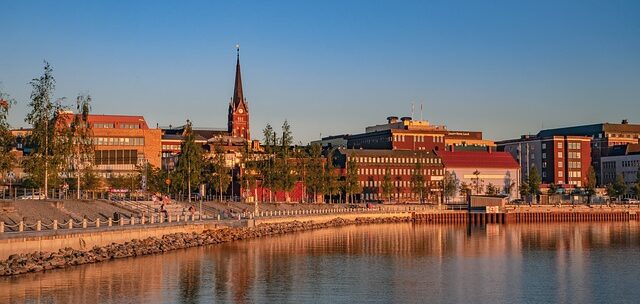
🌐 Around the World with Beyondia 🧵 Nordic & Western Europe Region 🪡 Episode 78: Luleå
Luleå is a Swedish coastal city in Norrbotten County, sitting at the head of the Bothnian Bay (the specific northern arm of the Baltic Sea) at the mouth of the Lule River. The municipal population is approximately 79,000, with the city itself containing approximately 50,000 — one of the largest urban centres in Northern Sweden and the specific administrative capital of Norrbotten County. Luleå sits at approximately 65.58 degrees north latitude, just below the Arctic Circle (66°33′N), and functions as one of the primary transport, administrative, industrial, and educational centres of Swedish Arctic Sweden. The specific city is approximately 900 kilometres north of Stockholm by road, connected by regular rail service (approximately 14 hours by overnight train) and daily flights.
Luleå Climate
The specific latitude produces substantial daylight variation but not the extreme continuous midnight sun and polar night documented at higher-latitude locations like Alta Ep 74, Nordkapp Ep 75, or Abisko Ep 76. Midsummer at Luleå brings approximately 22 hours of daylight from mid-June to mid-July, with a brief period of civil twilight around midnight rather than true darkness — the sun does not technically stay above the horizon continuously (as it does above the Arctic Circle), but the specific twilight is bright enough that darkness is minimal. Midwinter brings approximately 4 hours of usable daylight in late December, with the sun rising around 10:30 AM and setting around 1:30 PM. The Northern Lights are visible from Luleå during clear winter nights between approximately September and April, though less reliably than at higher-latitude locations.
The specific climate at Luleå is subarctic maritime — moderated by the proximity to the Bothnian Bay but with substantial continental winter conditions. Winter temperatures average approximately -10°C in January, with cold snaps reaching -30°C or lower during specific weather patterns. Summer temperatures average approximately 15°C in July, with peak days reaching 25-30°C during specific warm periods. Annual precipitation is approximately 500 millimetres. The specific Bothnian Bay freezes during winter months, typically from December through April, providing specific ice road connections to smaller coastal communities and specific winter transport across the frozen sea surface.
Luleå Human Presence
Human presence in the Luleå region dates from approximately 6,000-7,000 years ago, following the post-glacial ice retreat that opened the Bothnian Bay coast to human settlement. The specific archaeological record includes coastal settlement sites, tool-making sites, and specific hunting sites documenting continuous occupation across approximately 8,000 years. The specific Sámi population traditionally used the coastal and inland regions around Luleå for reindeer herding, fishing, and hunting, and specific Sámi place names remain in use across the region. The specific Lule Sámi language variant takes its name from the Lule River, reflecting the specific historical Sámi cultural presence in the region.
Swedish settlement of the Luleå region developed from approximately the 12th-13th centuries as part of the specific Swedish colonisation of northern Sweden. The specific process involved gradual expansion of Swedish agricultural settlement northward, church-establishment (as part of specific Catholic Christianisation of Sápmi), and specific commercial development around trading posts. The specific Nederluleå Church (Nederluleå kyrka) — the stone church at the centre of Gammelstad Church Town — was constructed between approximately 1492-1517, replacing an earlier wooden church that had served the specific parish since approximately 1339. The specific stone church is one of the largest medieval churches in Northern Sweden, with a nave approximately 30 metres long and 15 metres wide, and specific late-Gothic architectural features including specific ribbed vaults and specific medieval altar sculpture.
The specific church town tradition developed alongside the stone church construction. The specific practical problem — mandatory Sunday church attendance for parishioners living substantial distances from the church — was addressed by building small wooden cottages near the church for overnight stays. The specific pattern was formalised through specific parish regulations that allocated specific plots of land to individual farms or family groups, allowing them to construct and maintain their own church cottages. The specific cottages were typically small (approximately 15-25 square metres of floor area), built of horizontally laid logs in the specific Northern Swedish rural construction tradition, painted red with specific white trim in the specific Swedish Falu red style, and included basic accommodation for sleeping, cooking, and specific storage of church-related items.
At the peak of the church town tradition in the specific 18th-19th centuries, approximately 71 church towns existed across northern Sweden, most in Norrbotten, Västerbotten, and specific inland Norrland regions. The specific tradition also existed in Finland (which was part of Sweden until 1809, then part of Russia until 1917) with similar church towns established there. Individual church towns ranged in size from approximately 30-50 cottages at smaller parishes to approximately 400-500 cottages at the largest parishes. Gammelstad at its peak in the specific 18th century contained approximately 400-450 cottages — making it one of the largest church towns in Sweden and one of the primary religious centres of Northern Sweden.
The specific decline of the church town tradition began in the 19th century as improved transportation (better roads, eventually railways) reduced the specific practical need for overnight accommodation near churches. The specific 1858 abolition of mandatory church attendance in Sweden (though church attendance remained socially expected for much longer) reduced the specific legal requirement that had driven the tradition. Many church towns were abandoned during the 19th and early 20th centuries, with specific cottages either demolished, moved to other locations for reuse, or allowed to decay. By the mid-20th century, only a handful of substantial church towns remained in Sweden — Gammelstad being the largest and most complete surviving example.
Gammelstad Church Town today contains 424 wooden cottages arranged around the specific Nederluleå Church. The specific cottages are distributed across specific streets and specific plots that reflect the specific medieval and early modern parish structure — specific family groups traditionally had specific cottage locations based on their specific farm and community affiliations. The specific cottages are individually owned by contemporary families, many of whom trace descent from the specific original parish families that owned the cottages centuries ago. The cottages are used approximately 15-20 times per year for specific religious festivals, weddings, funerals, confirmations, and specific community gatherings — maintaining the specific traditional function even as the specific practical necessity has ended. The specific Nederluleå Church remains an active parish church with regular Sunday services and specific ongoing religious use.
The specific UNESCO inscription of Gammelstad Church Town in 1996 recognised the specific “outstanding universal value” of the site as documenting the church town tradition. The specific inscription criteria emphasised the specific completeness of preservation (all 424 cottages remaining in place around the specific historic church), the specific ongoing traditional use (rather than the site becoming a museum), and the specific unique documentation of the Northern European religious practice. The specific site includes the specific main cottage area, the specific church building itself with its specific medieval interior, the specific parsonage (parson’s residence), specific administrative buildings, and specific surrounding cultural landscape. The specific inscription area covers approximately 21 hectares.
The specific management of Gammelstad Church Town combines specific national heritage protection (through Riksantikvarieämbetet, the Swedish National Heritage Board), specific municipal administration, specific parish administration (the specific cottages and church remain in parish and private ownership), and specific tourism development. Visitor infrastructure includes the specific Gammelstad Visitor Centre (opened 2007), specific guided tours during summer months, specific historical exhibitions, and specific programmes documenting the church town tradition. Approximately 150,000-200,000 annual visitors experience the site.
Beyond Gammelstad, the specific medieval Luleå settlement itself has an unusual history. The specific original town of Luleå (which contained the specific church that later became Nederluleå at Gammelstad) was originally located at the specific present-day Gammelstad site, approximately 10 kilometres inland from the current Luleå city centre. In 1649, the specific town was moved to the current coastal location because the specific ongoing post-glacial isostatic rebound (documented also at Alta Ep 74 and Nordkapp Ep 75, occurring at approximately 8-10 millimetres per year in the Luleå region) had caused the specific inland location to become too shallow for shipping — the specific harbour at Gammelstad had become unusable as the specific land continued to rise from the sea. The specific move to the coastal location preserved the specific church at Gammelstad as the parish church, while the specific commercial town of Luleå relocated to the deeper coastal harbour. The specific pattern of moving towns due to isostatic rebound is unusual in European urban history — only in the specific northern Baltic region does the specific post-glacial land uplift occur at rates that force this specific kind of geographic adaptation.
Contemporary Luleå
Contemporary Luleå combines specific elements. The specific Luleå University of Technology (Luleå tekniska universitet, established 1971 as one of Sweden’s northernmost universities) has approximately 17,000 students and specific specialisations in mining, materials science, computer science, and specific Arctic sciences. The specific SSAB steel works at Luleå produces approximately 2.4 million tonnes of steel annually — one of the primary Swedish steel production facilities, with specific specialisation in high-strength steel for automotive and construction applications. The specific SSAB Luleå works is undergoing specific transformation as part of the HYBRIT project (a collaboration between SSAB, LKAB, and Vattenfall) developing fossil-free steel production using hydrogen-based direct reduction rather than traditional coal-based processes — the specific project aims to produce commercial fossil-free steel by 2026, one of the substantial European industrial decarbonisation initiatives.
The specific Facebook (Meta) data centre at Luleå — opened 2013 as Meta’s first data centre outside the United States — represents one of the specific technology sector developments that have shaped contemporary Luleå. The specific facility was located at Luleå for specific practical reasons: the specific cold Northern Swedish climate substantially reduces cooling costs for the specific data centre servers, the specific access to cheap renewable hydroelectric power (Norrbotten produces substantial specific hydroelectric power from specific rivers including the Lule River, providing approximately 60% of Swedish hydroelectric production), and the specific proximity to the university providing technical workforce. The specific Facebook facility covers approximately 84,000 square metres and represents one of the substantial European data centre investments. Additional data centre developments have followed, with specific companies including Amazon and specific others establishing operations in the region.
The specific commercial harbour at Luleå is Sweden’s largest port by tonnage handled — approximately 8 million tonnes annually — primarily serving the specific iron ore export from the LKAB mines at Kiruna and Malmberget. The specific iron ore is transported by rail on the Malmbanan (referenced at Abisko Ep 76) to Luleå during summer months when the specific Bothnian Bay is ice-free, then exported by ship to specific European steel producers. During winter months when the Bothnian Bay freezes, iron ore transport shifts to the Malmbanan’s western section to the specific ice-free port at Narvik in Norway. The specific dual-port arrangement — Luleå in summer, Narvik in winter — represents one of the specific practical adaptations to Arctic geography that has shaped Swedish industrial infrastructure for over a century.
The specific cultural infrastructure of contemporary Luleå includes the specific Norrbottens Museum (documenting regional history), the specific Kulturens Hus (opened 2007, the primary cultural centre containing library, art gallery, and specific concert facilities), the specific Norrbotten Chamber Orchestra, the specific Luleå Cathedral (Luleå domkyrka, completed 1893 as the specific bishop’s church of the specific Luleå diocese established 1904), and specific ongoing cultural production. The specific Luleå Cathedral is one of the specific larger Neo-Gothic churches in Northern Sweden, replacing the specific role that Nederluleå at Gammelstad played before the diocese reorganisation.
The specific ongoing negotiations of contemporary Luleå life include the tensions common to specific Northern Swedish cities — the specific balance between industrial development and environmental protection (with the specific HYBRIT decarbonisation project representing one substantial industrial adaptation), the specific ongoing population pressures affecting housing supply, the specific tensions between Sámi rights and industrial development in the surrounding Sápmi region, and the specific climate change impacts affecting both the specific frozen Bothnian Bay (with documented reduction in specific ice cover duration) and the specific broader regional ecosystem.
Luleå is one of the demonstrations of how specific Northern European practical solutions to religious, geographical, and industrial challenges have shaped a specific Arctic Swedish city across approximately 700 years. The specific Nederluleå Church constructed 1492-1517 established the specific religious centre. The specific church town tradition that developed around the church produced the specific 424 wooden cottages that remain today as one of the largest preserved church towns in Northern Europe, inscribed as UNESCO World Heritage in 1996. The specific 1649 relocation of the commercial town from Gammelstad to the current coastal location reflected the specific ongoing post-glacial isostatic rebound that continues to raise the Northern Swedish coast at approximately 8-10 millimetres per year — one of the specific European geographical phenomena that has directly shaped urban development patterns. The specific 20th-century industrial development around the SSAB steel works and the specific commercial harbour has made Luleå one of the primary Swedish Arctic industrial centres. The specific 21st-century transformation includes the specific HYBRIT fossil-free steel project (one of the substantial European industrial decarbonisation initiatives), the specific Facebook data centre and broader technology sector development (utilising the specific cold climate and cheap renewable hydroelectric power), and the specific ongoing Luleå University of Technology development. And the specific Sámi cultural presence in the region reflects the broader Sápmi cultural continuity documented across the previous Arctic articles.
Some cities preserve specific medieval religious infrastructure as museum heritage. This one preserves 424 wooden cottages built for practical religious purposes across approximately 400 years, still owned by families whose ancestors built them, still used for specific religious festivals and community gatherings. Some coastal towns have unusual origins. This one was relocated from its original inland site because the specific land was rising out of the sea. Some Arctic cities are peripheral outposts. This one produces 2.4 million tonnes of steel annually, hosts one of Meta’s global data centres, and functions as one of the specific Swedish industrial capitals of the Arctic region. Very few European cities carry this specific accumulated combination of medieval religious heritage, geographical adaptation, and contemporary industrial transformation.
Nine regions. One hundred and twenty destinations. Two hundred and eighty-three weeks remaining.
The journey continues south along the Swedish coast. The next stop is one of the primary Swedish cultural centres in the north — a coastal city of approximately 130,000 residents at the mouth of a specific major river, home to a substantial university that has shaped the specific city’s cultural character across the past 60 years, one of the specific Swedish coastal industrial ports, and the specific European Capital of Culture designated for 2014 that transformed the specific city’s contemporary cultural profile.
Where are you going?

Beyondia
Trusted Travel CompanionReal digital nomad. I travel. I learn. I grow.
What about you? Where are you going?