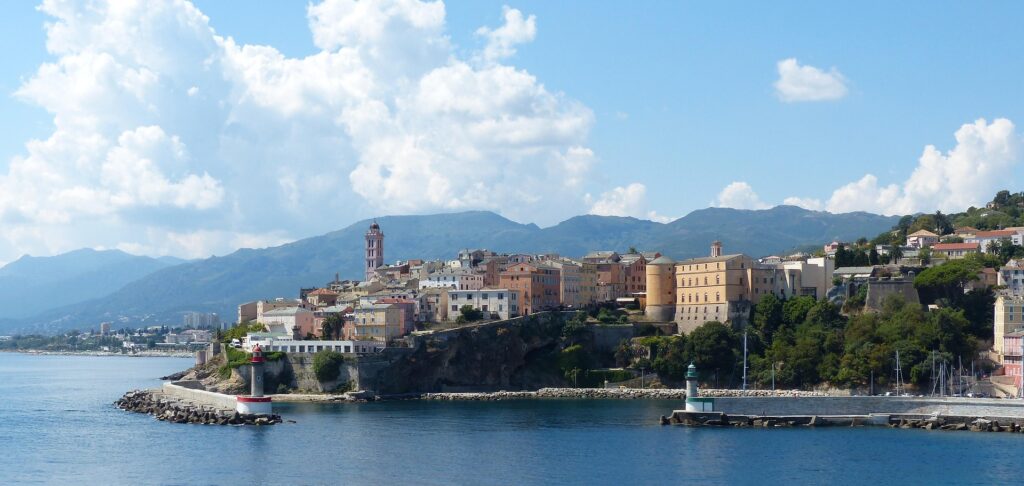
France Route: Corsica (Bastia → Calanques de Piana → Bonifacio) → overnight ferry → Nice (Vieux Nice, Grande Corniche) → Provence (Luberon Valley — Gordes, Roussillon) Total distance: approximately 600 km (driving sections combined, plus ferry crossing) Recommended duration: 7–10 days Best months: June (lavender bloom in Provence), September (warm Corsican waters, thinner crowds) Currency: Euro (€) Driving side: Right
The Shape of This France Route
This route crosses from the wildest island in the Mediterranean to the most refined coast in France and Europe, then turns inland to a valley where the earth itself changes colour. It is a route of contrasts held together by one continuous thing: the light.
Corsica is red granite and maquis scrub and mountains that rise to 2,700 metres from a coastline so jagged it measures over 1,000 kilometres. Nice is white limestone and the Promenade des Anglais and a city that turned itself into the winter destination for European aristocracy, then stayed open when they left. Provence is golden sandstone and lavender fields and hilltop villages where the pace of life slows until the loudest sound is the cicadas in the afternoon heat.
Three landscapes. Three colours of stone. One route heading from the sea to the interior, following the light the painters came for.
Corsica — The Wild Anchor of France
Corsica is France’s most vertical landscape. The island sits 170 km south of Nice and 90 km west of the Italian coast, closer to Italy than to mainland France — and this proximity shows in the food, the language, and the temperament. Napoleon was born here. So was a stubbornness the rest of France has learned to respect without entirely understanding.
Arrive in Bastia by air or ferry. The port faces Italy across the narrow Tyrrhenian Sea. From Bastia, the route runs south and west along the island’s mountainous spine.
The Calanques de Piana are the visual centrepiece of Corsican coastline. These are red granite cliffs — not the ochre of Provence or the golden limestone of Malta but a deep, mineral red — dropping vertically into turquoise water on the west coast between Porto and Piana. The road (D81) winds through the formations at cliff height, and the combination of red rock, green maquis, and blue sea below is one of the most dramatic coastal drives in the Mediterranean. UNESCO lists the Calanques as a World Heritage Site. Drive it slowly. There are pullover points but no guardrails in places.
The maquis is Corsica’s signature scent — a dense scrubland of wild myrtle, rosemary, thyme, lavender, and cistus that covers the island’s hillsides. Sailors approaching Corsica by sea claim they can smell the maquis before they see the island. This is not legend. The essential oils in the scrub carry across open water, particularly in the warm months. When you drive with the windows down on Corsica’s mountain roads, the air smells like something between a herb garden and a pharmacy that has been left open to the sun.
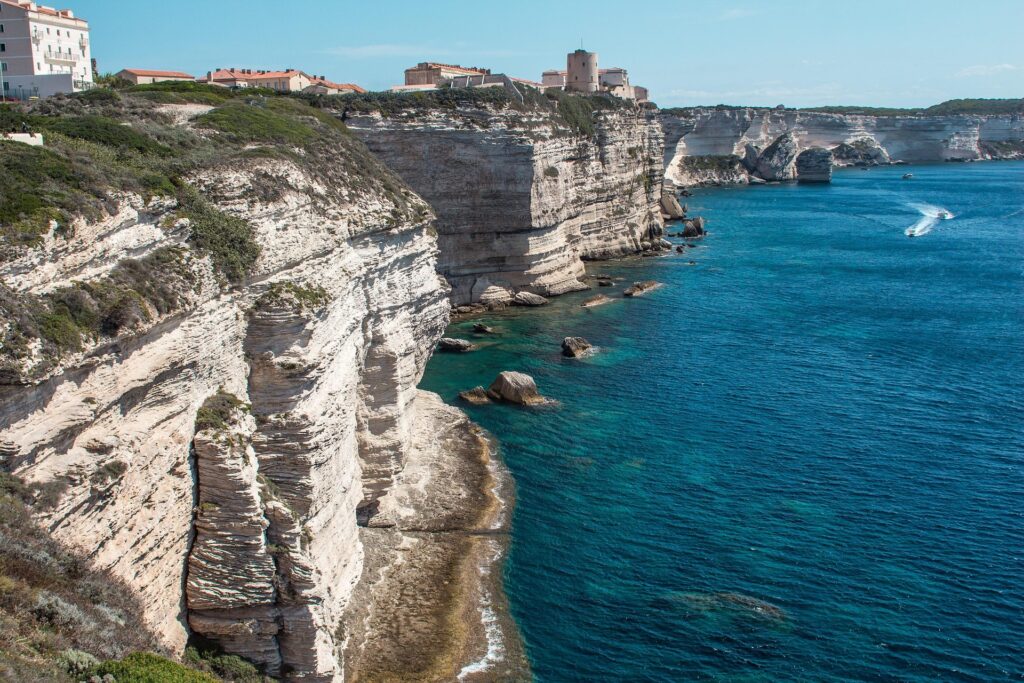
Bonifacio sits at the southern tip of the island — a medieval citadel perched on 70-metre-high white limestone cliffs above a deep natural harbour. The old town occupies the cliff top, reached by a steep stone staircase from the marina below. The view from the ramparts looks south across the Strait of Bonifacio to Sardinia, visible on clear days just 12 km away. Eat in the marina. The seafood here is Corsican — simpler, rougher, and less decorated than what you will find in Nice.
Corsican food runs on charcuterie (wild boar is the island’s speciality), Brocciu cheese (a fresh sheep’s milk cheese used in everything from omelettes to pastry), and chestnut flour. It is mountain food adapted to an island, and it tastes like the landscape — dense, aromatic, and not trying to impress anyone from Paris.
The Crossing — Corsica to Nice
The overnight car ferry from Bastia or Ajaccio to Nice is the literal bridge between the wild island and the refined coast. Corsica Ferries and La Méridionale operate the route. The crossing takes approximately 6–8 hours overnight from Bastia, or 10–11 hours from Ajaccio. Departures are typically in the evening, arriving in Nice the following morning.
Book a cabin for the overnight crossing — deck passage exists but sleeping in a seat for seven hours is a decision you will regret. Prices vary by season; budget approximately €50–120 per person with a cabin, plus €30–60 for a vehicle. Book early for summer crossings, particularly July and August when the route fills with French holidaymakers heading to and from the island.
You leave Corsica in red granite darkness and arrive in Nice in white limestone morning light. The contrast is immediate.
Nice — The Refined Coast of France
Nice is not the Riviera’s prettiest town — that would be Villefranche or Èze — but it is the most alive. A city of 350,000 people that functions as a real city while also being one of the most visited places on the Mediterranean coast.
Vieux Nice (Old Town) is where the city keeps its soul. A grid of narrow streets between the Cours Saleya market and the hill of the Château, filled with Baroque churches, family-run restaurants, and laundry hanging between buildings in a way that should look shabby and instead looks like an argument for living well in small spaces. The Cours Saleya flower market operates Tuesday through Sunday mornings — cut flowers, produce, olives, soap, and spices arranged in the kind of chromatic abundance that explains why Matisse moved here and stayed for thirty-seven years.
Eat socca — a chickpea flour pancake cooked on a wood-fired copper plate, sold from street stalls and specialist shops in the old town. It is Nice’s defining street food: simple, cheap, and impossible to replicate properly anywhere else because the water and the flour and the heat are specific to this place. Eat it standing. Eat it hot. The salade Niçoise in its authentic form uses raw vegetables, hard-boiled eggs, tuna, anchovies, and olives — no cooked green beans, no potatoes, no lettuce. Order it in Vieux Nice and you will understand why the Niçois are particular about this.
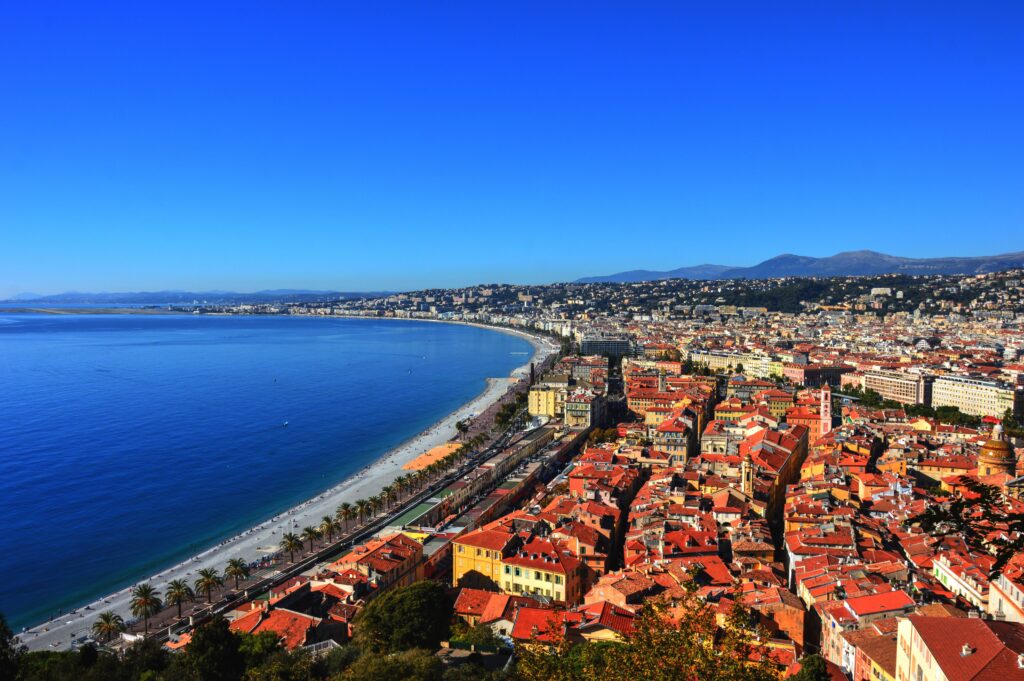
The Grande Corniche is the drive that defines the Riviera. Three parallel roads — the Basse, the Moyenne, and the Grande — run between Nice and Monaco along the cliffs above the sea, each at a different altitude. The Grande Corniche is the highest, built by Napoleon along the route of the Roman Via Julia Augusta, averaging 500 metres above sea level. It is the most cinematic road in France — Hitchcock filmed To Catch a Thief here. The views from the road down to Monaco, Cap Ferrat, and the open Mediterranean are vertiginous and constant. The drive from Nice to La Turbie and back takes less than an hour. Do it in the late afternoon when the light comes from the west and the sea below turns from blue to gold.
The hilltop village of Èze, accessed from the Moyenne Corniche, is the single stop between Nice and Monaco that justifies pulling over. Medieval stone lanes, the Jardin Exotique with its cactus garden and panoramic views, and a quietness that feels improbable given that Monaco is directly below.
Provence — The Rural Heart
From Nice, drive west on the A8 autoroute toward Aix-en-Provence, then north into the Luberon Valley. The drive takes approximately 2.5–3 hours. The moment you leave the coast and enter the interior, the landscape changes. The Riviera’s glamour gives way to something older, quieter, and more fundamentally French.
The Luberon Valley contains several villages classified among the “Most Beautiful Villages of France” — a designation that sounds like marketing but functions as quality control. Gordes is the most photographed: a village of pale golden stone cascading down a hillside, visible from a distance as a single architectural organism that seems to have grown from the rock rather than been built on it.
Roussillon is Gordes’ chromatic opposite. Where Gordes is pale gold, Roussillon is deep orange and red — an entire village tinted by the ochre deposits it sits upon. The Sentier des Ocres (Ochre Trail) is a short walk — 35 or 50 minutes depending on the route chosen — through former ochre quarries where the cliffs glow in shades that belong more to the American Southwest than to France. Entry is approximately €3.50 for adults. The trail is well-maintained with steps and railings. Do not wear white shoes. The ochre soil sticks to everything and does not negotiate.
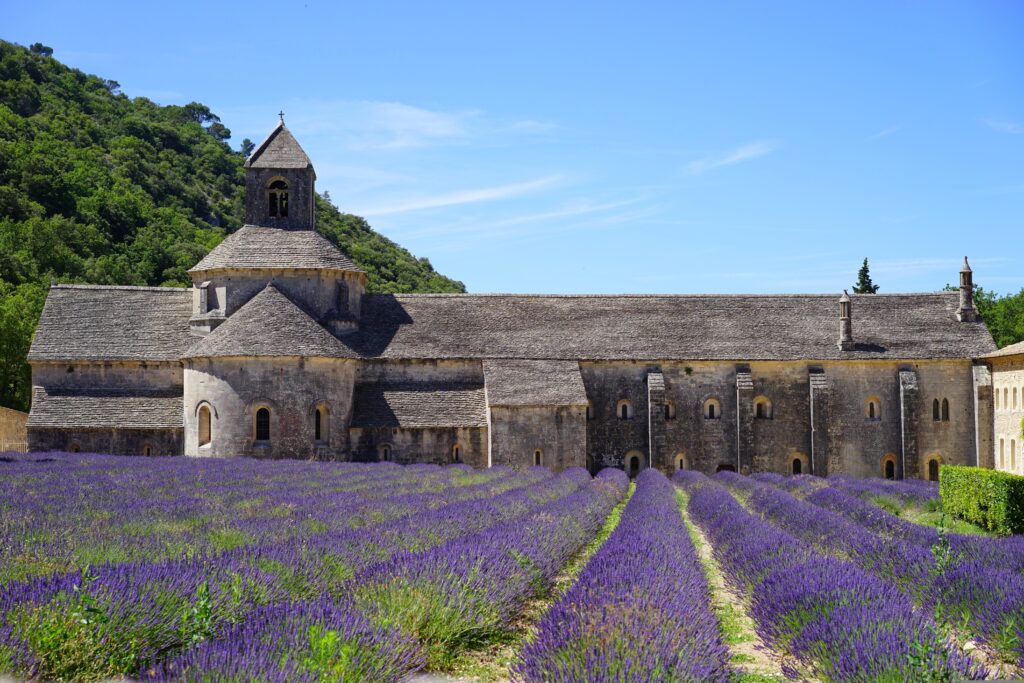
The Plateau de Valensole, east of the Luberon, is where Provence becomes the postcard. Row upon row of lavender stretching to the horizon, blooming from mid-June through July, the colour so saturated it looks artificial and is not. If you are here in June, drive the Route de la Lavande. If you are here in September, the lavender is gone but the light remains — the same light Cézanne spent decades trying to pin to canvas at nearby Mont Sainte-Victoire.
Bonnieux and Ménerbes complete the Luberon circuit — perched stone villages with views across the valley, slower pace, and the particular Provençal quality the French call l’art de vivre — the art of living. It is not a philosophy anyone can teach you. It is the sound of cicadas in the afternoon, a glass of Côtes de Provence rosé, and the understanding that nothing you need to do is more important than the fact of being here.
Practical Notes
Getting to Corsica: Fly into Bastia (BIA), Ajaccio (AJA), Calvi (CLY), or Figari (FSC) from Paris, Nice, Marseille, or other European cities. Alternatively, take the ferry from Nice, Marseille, or Toulon. In summer, ferry crossings are frequent but must be booked well in advance.
Driving in Corsica: Roads are narrow, mountainous, and often bordered by nothing more than a low stone wall and a steep drop. The interior roads (D roads) require confidence and patience — you will meet oncoming traffic on single-lane curves. Allow more time than mapping software suggests. The D81 along the west coast through the Calanques de Piana is spectacular but slow.
Driving on the Riviera: The A8 autoroute between Nice and Provence is fast, tolled, and efficient. The Corniche roads between Nice and Monaco are narrow, winding, and not for rushed drivers. The Grande Corniche has limited pullover points — stopping for photographs requires planning. Traffic on the Basse Corniche (the coastal road) is heavy in summer.
Provence by car: Essential. The Luberon villages are connected by small departmental roads that buses serve infrequently. Rent a car in Nice and return in Aix-en-Provence or Marseille. Skip the autoroute between villages — the local roads through the valley are the point.
Season: June is the crossover month — warm enough for Corsican swimming, early enough for Provençal lavender. September offers warm Corsican waters and calm seas plus the harvest season in Provence. July and August are peak — Corsica fills with French holidaymakers, the Riviera is shoulder-to-shoulder, and Provence’s village car parks overflow.
Food: Corsica runs on charcuterie and Brocciu. Nice runs on socca, pan bagnat (a pressed sandwich of Niçoise ingredients), and fresh seafood from the Cours Saleya. Provence runs on tapenade, truffles (November through March), and rosé that is better than its reputation. The entire route is a GoBeyondia Food episode waiting to happen.
Cost: Corsica is moderately priced by French standards. Nice and the Riviera are expensive — accommodation, parking, and restaurant prices reflect international demand. Provence varies: the Luberon villages charge tourist premiums in season but remain more affordable than the coast.
What This Route Is Really About
Every route in this series has been defined by what it crosses — a sea, a desert, an island. This one is defined by what it follows: light.
Corsica gives you light filtered through red granite — warm, mineral, heavy. Nice gives you light reflected off white limestone and blue water — sharp, clear, the light Matisse needed to see colour as it actually was. Provence gives you light absorbed into golden sandstone — soft, slow, the light that taught Cézanne that the same mountain could be painted a thousand times and never be the same painting twice.
The painters came here because the light changed what they made. They stayed because it changed what they saw.
The Mediterranean Season of this journey is approaching its end. The coast curves west from Provence toward Spain, the last stretch of this sea before the Atlantic. The light continues.
🔍 Related GoBeyondia Journeys in France
- 🇫🇷 France — Lavender, Long Lunches & a Country That Perfected the Art of Living
- What the Mediterranean Light Does
- The Mediterranean Light They Came For

Beyondia
Trusted Travel CompanionReal digital nomad. I travel. I learn. I grow.
What about you? Where are you going?