Around the World with Beyondia 🧵 Mediterranean Region 🪡 Journal 12
Paris. Brest. La Rochelle. The city that invented being a city, a port at the end of the continent, and a harbour that chose starvation over surrender.
Paris doesn’t care that you’ve arrived.
That’s the first thing I felt walking out of Gare du Nord. Not hostility — indifference. Rome grabs you. Naples shouts at you. Paris glances at you and returns to its conversation. The city has been the centre of something — art, revolution, philosophy, fashion, food, arrogance — for so long that your presence is simply not remarkable. Twelve million people in the metropolitan area and the city still behaves like a private club that never bothered putting up a sign.
I walked to Notre-Dame first. The scaffolding was down. The cathedral reopened after the 2019 fire and seeing it standing — cleaned, restored, its twin towers and rose windows catching the morning light over the Seine — felt like watching someone get back up after being knocked flat in front of the whole world. Eight hundred years of history nearly erased in a single night, and Paris rebuilt it because Paris doesn’t accept loss. The spire is new. The stone is old. The argument between the two is what makes it Notre-Dame again.
The Seine carried me west. I walked the Left Bank because that’s what the city demands — Notre-Dame to the Musée d’Orsay, past the bouquinistes with their green boxes of secondhand books bolted to the river wall, a tradition running since the 16th century. Paris invented the idea of the public intellectual, the café as an office, the bookshop as a political act. Shakespeare and Company still operates across from Notre-Dame, and I walked in knowing it was a tourist stop and walked out with a book I didn’t plan to buy because the room smelled like paper and ambition and I’m not immune.
The Louvre I entered with a plan and abandoned it within twenty minutes. You cannot see the Louvre. You can only survive it. 380,000 objects. 72,735 square metres. I stood in front of the Winged Victory of Samothrace at the top of the staircase and forgot the plan entirely. A headless, armless sculpture from 190 BC mounted on a stone ship prow, and it is the most powerful thing in the building — more powerful than the Mona Lisa three rooms away, which hangs behind bulletproof glass surrounded by two hundred phone screens. The Victory doesn’t need a face. The wind is in the marble. The movement is in the stone. Whoever carved it understood that sometimes what’s missing is the whole point.
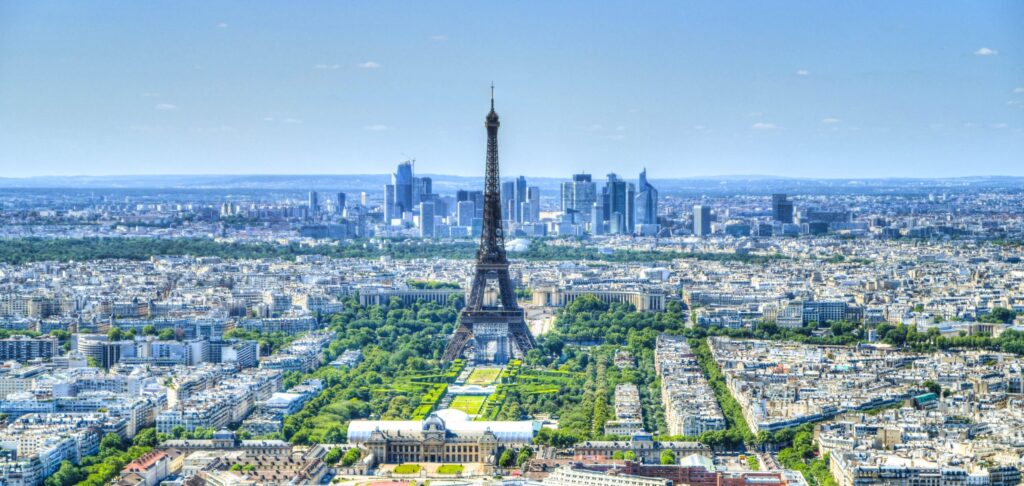
Montmartre in the evening. The Sacré-Cœur glowing white above the city. I climbed the steps and sat at the top and Paris spread below me — rooftops in zinc grey, the Eiffel Tower in the distance doing exactly what it’s been doing since 1889, which is standing there being the Eiffel Tower, the most visited paid monument in the world, built as a temporary structure for the World’s Fair and too beloved to tear down. Paris is full of things that were never supposed to last and became permanent. That might be the city’s entire philosophy.
I ate a croque-monsieur at a zinc-top bar in the 11th arrondissement. Not a restaurant. A bar. The kind of place where the menu is on a chalkboard and the waiter doesn’t write anything down because there are four things and he’s been doing this for thirty years. Paris food culture doesn’t live in Michelin stars — it lives in the ten-thousand ordinary places that refuse to serve anything below a standard that the rest of the world would call excellent and Paris calls Tuesday.
Then I went to Brest. And France ended.
Not metaphorically. Geographically. Brest sits at the western tip of Brittany, at the end of the continent, where the land runs out of reasons to continue and the Atlantic begins. The city is not beautiful in the way most French cities are beautiful. Allied bombing in 1944 levelled nearly everything — Brest was one of the most heavily damaged cities in France during World War II because the Germans used it as a submarine base and the Allies needed it gone. What was rebuilt is functional, concrete, honest. Brest doesn’t charm. It endures.
I walked to the Château de Brest — one of the few structures that survived, a fortress that has been in continuous military use for seventeen centuries. Roman foundations. Medieval walls. The French naval museum inside. Brest has been a strategic port since before France existed as a concept, because whoever controls this harbour controls access to the Atlantic. The city’s identity is the sea, and the sea here is not the gentle Mediterranean I’d been swimming in for months. The Atlantic off Brest is grey, cold, muscular. The waves argue with the coastline. The wind has opinions.
I drove to the Pointe de Saint-Mathieu — the westernmost point of mainland Brittany — and stood next to the ruins of a Benedictine abbey and a working lighthouse, both perched on a cliff above the Atlantic. Behind me, the continent. Ahead of me, nothing until North America. The feeling was physical. Not romantic loneliness, not poetic solitude — just the blunt fact that the land had stopped and I was standing on its last word.
Brittany itself is not quite France and will tell you so. The language — Breton — is Celtic, closer to Welsh and Cornish than to French. Road signs are bilingual. The food is buckwheat galettes, salted butter, cider instead of wine. The culture is maritime, stubborn, independent. Brittany joined France in 1532, and parts of it are still thinking it over.
I ate a galette complète in a crêperie near the port — buckwheat crêpe, ham, cheese, egg — and drank a bowl of cider, because in Brittany cider comes in bowls, not glasses, and you don’t question it. The woman who served me spoke French with an accent that sounded like the sea had gotten into the vowels.
La Rochelle was the stop I wasn’t prepared to feel as much as I did.
I arrived by train and the twin towers of the old harbour appeared like sentinels — the Tour Saint-Nicolas and the Tour de la Chaîne, medieval fortifications that once held a chain between them to close the port to enemy ships. The harbour is still the centre of the city, still active, and walking along the quay past fishing boats and yachts and restaurants built into arcaded limestone buildings, La Rochelle felt like a city that has always understood one thing: the harbour is the argument. Everything else is commentary.
But the story that defines La Rochelle is the siege of 1627-1628. The city was a Huguenot stronghold — Protestant in a Catholic kingdom — and Cardinal Richelieu decided to end its independence. He built a sea wall across the entire harbour entrance — over 1,400 metres of stone and sunken ships — to cut the city off from English resupply. The siege lasted fourteen months. The population of La Rochelle dropped from 27,000 to 5,000. They chose starvation over surrender. When Richelieu’s forces finally entered the city, what they found was not a defeated population but the remains of one that had decided its principles were worth more than its survival.
I stood on the sea wall — what’s left of it — and looked back at the harbour. The towers still standing. The city rebuilt, thriving, full of students and cyclists and the particular light that the Atlantic coast produces in late afternoon when the sun hits limestone and everything turns gold. La Rochelle doesn’t wear its history like a wound. It wears it like a decision that was made and doesn’t need to be explained.
I walked through the old town under covered arcades that have been sheltering market traders since the Middle Ages. I ate oysters from the Île de Ré — the island connected to La Rochelle by a bridge — fresh, cold, tasting like the Atlantic had been concentrated into a shell. I drank Pineau des Charentes, the regional aperitif that mixes grape juice with cognac and tastes like autumn sunlight. La Rochelle is generous in that quiet Atlantic way — not performative, not curated, just good food in an old place that knows what it has.
Three stops. The capital that doesn’t need you but rewards you for showing up. A port at the end of the continent where the land gives up and the ocean takes over. A harbour town that starved for fourteen months rather than give up who it was.
France doesn’t do anything halfway. Not the beauty, not the stubbornness, not the food, and definitely not the history.
Next week — further into France. But La Rochelle’s harbour is still the image behind my eyes when I close them.

Beyondia
Trusted Travel CompanionReal digital nomad. I travel. I learn. I grow.
What about you? Where are you going?