Route: Lisbon → Coimbra → Porto Total distance: approximately 315 km by road Driving time: 3–3.5 hours on the A1 (Autoestrada do Norte) Alternative: Train — Lisbon to Porto in approximately 2h 45min (Alfa Pendular) or 3h 15min (Intercidades) Currency: Euro (€) Driving side: Right Best months: April–June, September–October
The Shape of This Route
Portugal is a narrow country. The entire western edge is Atlantic coastline, and the A1 motorway that connects its two largest cities runs roughly north-south through the interior, parallel to the ocean, never more than an hour from the sea at any point.
This route follows the spine. Lisbon at the mouth of the Tagus, where the ships departed. Coimbra in the middle, where the minds that planned the departures were educated. Porto at the mouth of the Douro, where the port wine was loaded onto the ships and the merchants waited for them to return. Three cities connected by a motorway, a railway, and the same Atlantic-facing identity: Portugal is the country that looked west and decided the horizon was an invitation rather than a boundary.
The light here is different from anything on the Mediterranean. The Atlantic light is softer, greyer, more diffuse. It enters through cloud cover and reflects off white limestone and blue azulejo tiles with a quality that Portuguese painters have been trying to describe for centuries and that the fado singers gave up trying to describe and just sang about instead.
Lisbon — The Departure Point
Lisbon is built on seven hills above the Tagus estuary, which is not a river at this point but a bay — wide enough to hold an entire fleet, which is exactly what it did during the Age of Discoveries when Portuguese ships departed from here toward Africa, India, Brazil, and the edges of the known world.
Belém is the district where the departures happened and where Portugal built its monuments to commemorate them. The Jerónimos Monastery was commissioned by King Manuel I in 1501 to honour Vasco da Gama’s voyage to India. It was built on the exact site where da Gama and his crew prayed the night before they sailed. The architecture is Manueline — a Portuguese late Gothic style that decorates every surface with maritime rope, coral, shells, and armillary spheres, as if the stone itself remembers the sea. Da Gama’s tomb is inside the church. The church entry is free. The cloisters — the real reason to visit — require a ticket: approximately €18 for adults. Book online. Summer queues stretch for hours. Free entry on Sundays until 2 PM, but the crowds know this.
The Belém Tower stands in the Tagus at the point where the estuary meets the open Atlantic — a small Manueline fortress built to guard the harbour mouth and to be the last thing departing sailors saw as they left Lisbon. Note: the tower has been undergoing restoration work — check current access status before planning a visit.
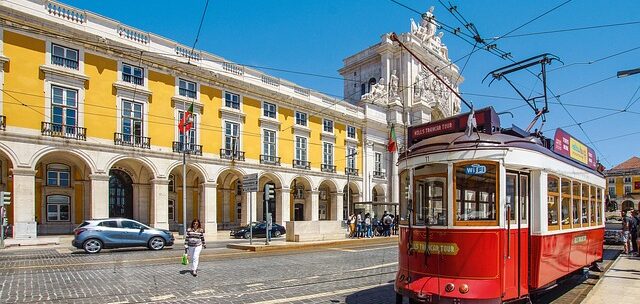
Walk from Belém to the Pastéis de Belém bakery — five minutes on foot from the monastery. The monks of Jerónimos created the original recipe for the custard tart (pastel de nata) over three hundred years ago, and this bakery has been producing them from the same recipe since 1837. The queue is permanent. The tarts are warm. The experience is not optional.
The Alfama — Lisbon’s oldest neighbourhood, cascading downhill from the Castle of São Jorge to the Tagus waterfront — is where fado lives. Fado is the music of saudade, and it is performed nightly in small restaurants and casas de fado throughout the Alfama and Bairro Alto. It sounds like what the sea sounds like to the person standing onshore watching a ship disappear. It is Portugal’s most important cultural export after the language itself.
Stage One — Lisbon to Coimbra
Distance: approximately 200 km Driving time: 2–2.5 hours on the A1 Train: approximately 2 hours (Alfa Pendular from Lisbon Oriente or Santa Apolónia to Coimbra-B)
The A1, the Autoestrada do Norte, is Portugal’s primary north-south motorway. It is well-maintained, tolled, and fast. Tolls are collected at traditional booths — take a ticket at the entrance, pay by cash or card at the exit. The full Lisbon-to-Porto toll is approximately €22–25 for a standard car. The Via Verde electronic system is available for frequent users.
The road passes through the Ribatejo — Portugal’s agricultural heartland, flat river plains along the Tagus — before climbing into the hillier terrain around Coimbra. The landscape is cork oaks, olive groves, and vineyards. It is quiet, green, and looks nothing like the Lisbon most tourists imagine when they think of Portugal.
Coimbra — The Mind of the Country
Coimbra is the pause between the two Atlantic cities. Quieter than both, steeper than both, older in function if not in stone. The University of Coimbra, founded in 1290, is one of the oldest continuously operating universities in the world. It sits at the top of the hill, on the site of a former royal palace, overlooking the Mondego river. The entire old university precinct — courtyards, chapel, ceremonial halls — is a UNESCO World Heritage site.
The Biblioteca Joanina is the reason to come to Coimbra. Built between 1717 and 1728 under King John V, it is among the most beautiful Baroque libraries in the world. Three connected halls — gold on green, gold on red, gold on black — lined with gilded bookshelves holding over 60,000 volumes from the sixteenth to the eighteenth century. The walls are 2.1 metres thick to regulate temperature and humidity. The shelves are oak to deter insects. A colony of bats lives inside the library and emerges at night to eat the insects that threaten the books — a fact so specific that it sounds invented, but it is not. The bats have been doing this for centuries, and the staff lays leather sheets over the tables each evening to protect the furniture.
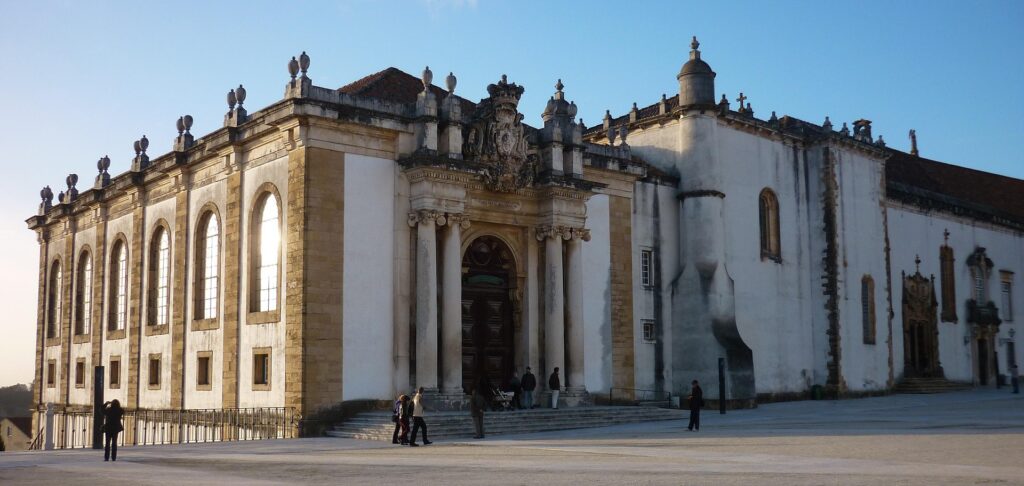
Entry to the Joanina Library is by timed ticket as part of the University Circuit — approximately €13–16.50 for adults, covering the library, Royal Palace, Chapel of São Miguel, and Academic Prison. Book in advance — the library operates on strict timed slots and fills quickly. Photography is not permitted on the Noble Floor.
Coimbra also has its own fado tradition — the fado de Coimbra — which is different from Lisbon’s fado. It is sung only by men, traditionally in black academic capes, and the mood is more lyrical than mournful. It is the fado of students rather than sailors. Listen to it in the old town in the evening.
Stage Two — Coimbra to Porto
Distance: approximately 120 km Driving time: 1–1.5 hours on the A1 Train: approximately 1 hour (Alfa Pendular from Coimbra-B to Porto Campanhã)
The final leg runs north through increasingly hilly terrain. The landscape greens as you approach the Douro valley. The air cools. Porto announces itself from a distance — you see the river gorge and the bridges before you see the city, and the bridges are the first sign that Porto is a different kind of place. Lisbon spreads. Porto stacks.
Porto — The City That Waited for the Ships to Return
Porto is built on the steep granite banks of the Douro river, a few kilometres from where the Douro meets the Atlantic. The city is vertical — houses, churches, and warehouses clinging to the hillside in layers, connected by staircases, bridges, and narrow streets that were designed for donkeys and have never been widened.
São Bento Station is a railway station that functions as a monument. The main hall is covered in approximately 20,000 azulejo tiles — hand-painted blue and white ceramic panels depicting scenes from Portuguese history: battles, royal processions, the history of transport. It was completed in 1916 by artist Jorge Colaço and is one of the most photographed interiors in Portugal. You do not need a ticket to enter the hall. It is a working station. Walk in, look up, and understand that in Portugal, even the infrastructure is art.
Livraria Lello — a bookshop on Rua das Carmelitas, near the university — is regularly cited as one of the most beautiful bookshops in the world. The interior features a carved wooden staircase that splits and curves upward like a double helix, stained glass ceiling, and neo-Gothic carved wood shelving. J.K. Rowling lived in Porto in the early 1990s and is said to have drawn inspiration from the shop for parts of the Harry Potter universe. Entry requires a voucher (approximately €8), redeemable against any book purchase. The queue wraps around the block in summer. Go early on a weekday.
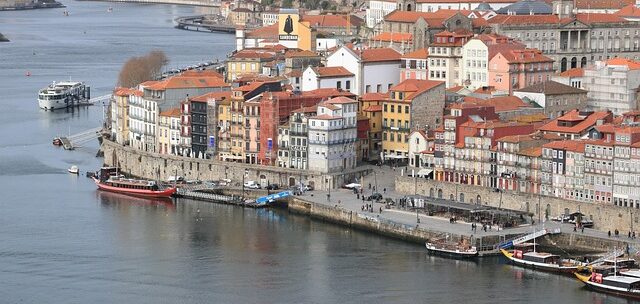
The Ribeira waterfront — the UNESCO-listed riverside district where colourful houses stack above the Douro — is Porto’s visual signature. Cross the Dom Luís I Bridge (designed by a student of Gustave Eiffel) on the upper deck for the defining view: Porto on one side, Vila Nova de Gaia and the port wine lodges on the other, the river between them carrying tour boats and the occasional rabelo, the flat-bottomed boats that once transported wine barrels downriver from the Douro valley.
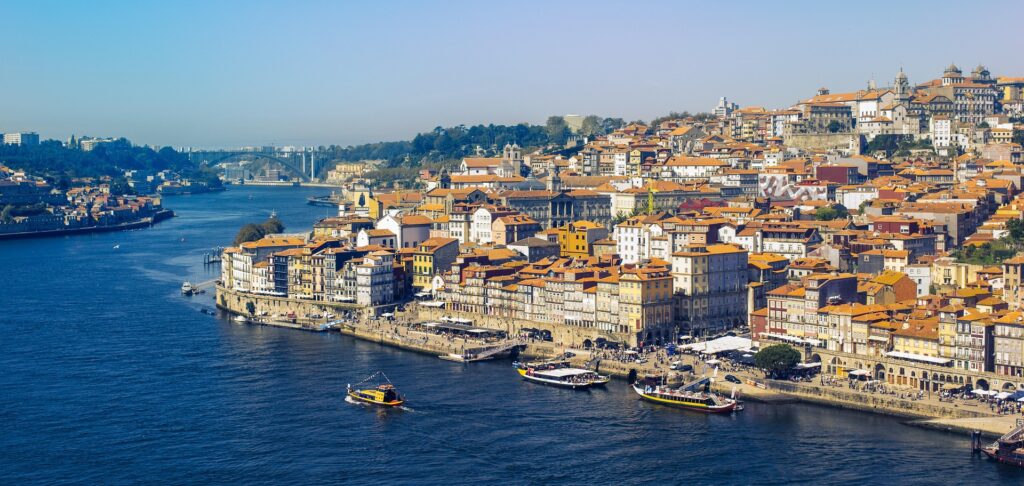
The port wine lodges in Vila Nova de Gaia — the south bank, technically a separate municipality — are where port wine is aged and tasted. Taylor’s, Graham’s, Sandeman, and dozens more offer tours and tastings. A basic tasting starts at €15–20. The cellars are cool, dark, and smell of oak and decades of evaporation. Port wine was invented because Portuguese merchants needed their wine to survive the sea journey to England — they added brandy to stabilise it, and the result became one of the world’s great fortified wines. It exists because of the Atlantic. Like everything else in Portugal.
Eat francesinha — Porto’s signature sandwich: layers of cured ham, fresh sausage, steak, and cheese, covered in melted cheese and a thick, spiced tomato-beer sauce, usually served with chips. It is excessive, unapologetic, and exactly what the city tastes like.
Practical Notes
Tolls: The A1 is a conventional tolled motorway — take a ticket at the entry, pay at the exit by cash or card. Lisbon to Porto: approximately €22–25. Some other motorways in Portugal use electronic-only tolling — rental cars may come equipped with a Via Verde device, or you can register your licence plate at a Welcome Point near the border. Confirm with your rental company.
Trains: CP (Comboios de Portugal) operates three tiers: Alfa Pendular (fastest, ~2h 45min Lisbon–Porto, ~€30–45), Intercidades (slightly slower, cheaper), and Regional (slow, scenic, cheap). Lisbon departures from Oriente or Santa Apolónia. Porto arrivals at Campanhã (connect to São Bento for the city centre). Book at cp.pt.
Driving: Portugal drives on the right. Motorway speed limit is 120 km/h. Portuguese driving is assertive. Low Emission Zones exist in Lisbon — rental cars are typically compliant but confirm. Parking in Lisbon and Porto historic centres is limited and expensive; park outside and use public transport.
Fado: In Lisbon, the Alfama and Bairro Alto neighbourhoods have the highest concentration of fado houses. Expect a cover charge or minimum spend (typically €25–40 including a drink). In Coimbra, fado is performed less formally, often outdoors or in small venues, especially during academic festivals. Quality varies — ask locals for recommendations rather than following tourist signs.
Pastel de Nata vs. Pastel de Belém: Every bakery in Portugal sells pastéis de nata (custard tarts). Only the Pastéis de Belém bakery in Lisbon sells pastéis de Belém, made from the original monastery recipe. The difference is debatable. The argument is Portuguese national sport.
Season: April through June is ideal — warm, dry, fewer crowds. July and August are hot in Lisbon (35°C+), and Porto fills with summer tourists. September and October are warm, golden, and quieter. Winter is mild and rainy — Porto gets significantly more rain than Lisbon.
Budget: Portugal remains one of Western Europe’s most affordable destinations. A quality meal in Porto or Coimbra costs €12–20 per person. Lisbon is slightly more expensive but still accessible. Port wine tastings, museum entries, and the Joanina Library are all under €20.
What This Route Is Really About
Portugal is the only European country that turned entirely toward the Atlantic and made the ocean its identity. Spain looked both ways — Mediterranean and Atlantic. France looked inward toward Paris. Italy looked east toward the trade routes. Portugal looked west, into open water with no visible far shore, and built an empire on the assumption that the horizon was not an edge but a door.
This route follows the three stages of that assumption. Lisbon is where the door opened — the monastery, the tower, the harbour from which the ships departed. Coimbra is where the knowledge lived — the university that educated the navigators, the library that held the maps. Porto is where the commerce flowed — the wine that travelled on the ships, the merchants who waited at the Douro mouth for the ships to return.
Between the three cities, the A1 runs through the country’s green interior — the Portugal that did not go to sea, that stayed behind and farmed and raised families and sang fado about the ones who left. That Portugal is still there, visible from the motorway, unchanged in the way that the places people leave from are always slower to change than the places people arrive at.
The Atlantic light holds all of it together — the departure, the knowledge, the waiting, the return. It is the light of a country that made absence its art form and called it saudade, and built an entire culture around the understanding that the most important journeys are the ones where you do not know if the ship will come back.

Beyondia
Trusted Travel CompanionReal digital nomad. I travel. I learn. I grow.
What about you? Where are you going?