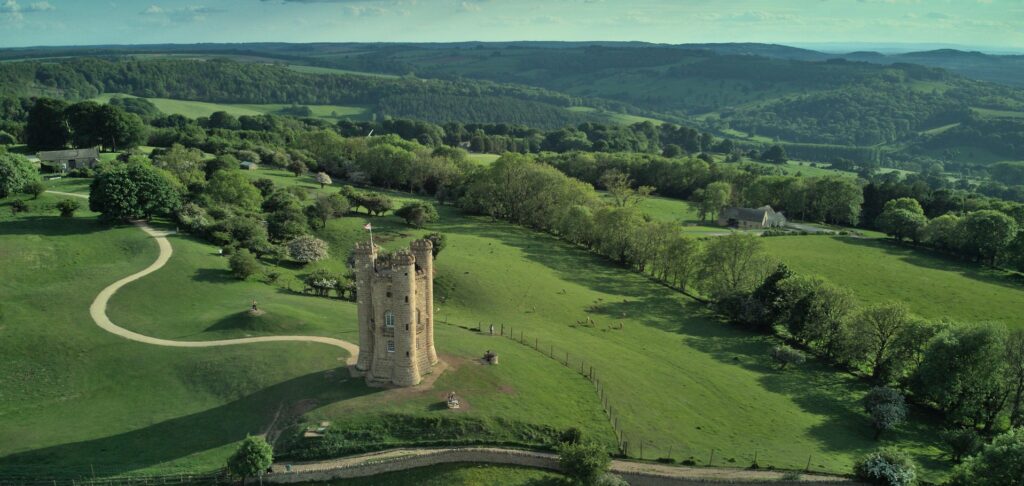
🌐 Around the World with Beyondia 🧵 Nordic & Western Europe Region 🪡 Episode 59: The Cotswolds
The Cotswolds is a rural region in central-southern England, covering approximately 2,038 square kilometres across parts of six English counties (Gloucestershire, Oxfordshire, Warwickshire, Wiltshire, Worcestershire, and Somerset). The region is characterised by a specific geological formation — the Cotswold Hills, a limestone escarpment approximately 100 kilometres long from Bath in the south to Chipping Campden in the north, rising to a maximum height of 330 metres at Cleeve Cloud near Cheltenham. The specific geology — Jurassic-era oolitic limestone laid down between approximately 165 and 180 million years ago, when the region was covered by a shallow tropical sea — produces the distinctive honey-coloured stone that has been quarried throughout the region for approximately 2,000 years. The Romans quarried Cotswold limestone for the construction of Corinium Dobunnorum (modern Cirencester), which was one of the largest cities of Roman Britain (population approximately 15,000-20,000 in the 2nd century AD, making it the second-largest Roman city in Britain after Londinium). The medieval Cotswold villages that developed from approximately 1000 AD onwards used the same locally-quarried limestone. The distinctive village architectural language — steep-pitched roofs of stone tiles (specifically called Stonesfield slate or Collyweston slate depending on the source quarry), thick walls of locally-quarried limestone rubble faced with dressed stone, small mullioned windows, gabled fronts, and the specific pattern of clustered village houses around a central church or green — has been substantially continuous for approximately 800 years, and is one of the most integrated regional architectural languages in Europe.
The Cotswolds Geographical Shape
The geographical shape of the Cotswolds is worth naming carefully. The region is not administratively defined as a single unit — it crosses six English county boundaries and contains no single unified political authority. The specific designation that gives the Cotswolds its modern institutional identity is the Cotswolds Area of Outstanding Natural Beauty (AONB), established under the 1949 National Parks and Access to the Countryside Act and formally designated for the Cotswolds on 3 August 1966. The AONB covers 2,038 square kilometres, making it the largest AONB in England and one of the largest protected rural landscapes in Europe. AONB designation provides substantial legal protection for the region’s specific character — planning restrictions on new construction, requirements for local materials and traditional building techniques, restrictions on major infrastructure projects that would compromise the landscape character, and various additional conservation frameworks. The system predates most similar European rural heritage protection frameworks — the French Parc Naturel Régional system was established in 1967, the Italian parchi regionali system developed through the 1970s and 1980s, and various other European systems followed. In the specifically English context, AONB designation for the Cotswolds preceded the full development of the English heritage protection framework by several decades. The consequence is that the Cotswolds has been legally protected as a specific rural landscape character for approximately 60 years, and the specific architectural and agricultural landscape that visitors experience today is substantially the product of this protection combined with the earlier historical circumstances that produced the original character.
The historical circumstances that produced the distinctive Cotswold character are worth naming substantively, because they explain why this specific region has this specific architectural inheritance. The Cotswold Hills’ geology produces a specific ecological environment — thin limestone-based soils, grassland vegetation (rather than dense forest cover), and specific micro-climates that support particular agricultural patterns. From at least the Roman period, the region supported large sheep flocks — the Roman writer Pliny the Elder mentioned “British wool” in the 1st century AD, and archaeological evidence suggests substantial sheep pasturage in Roman Britain. In the medieval period, from approximately 1000 AD onwards, the Cotswolds became one of the most productive wool-producing regions in England. The specific sheep breed — the Cotswold Lion, a long-wool breed producing a thick, high-quality fleece particularly suited to the coarse-cloth weaving traditions of continental Europe — was developed in the region during the medieval period, and the long-wool from Cotswold Lion sheep became one of the most sought-after wool varieties in medieval European textile production.
The Cotswolds Commercial Mechanism
The commercial mechanism that connected Cotswold wool production to continental European weaving was substantial. From approximately 1200 to 1500, the raw wool from Cotswold pastures was gathered at annual wool fairs held at specific Cotswold market towns — Cirencester, Cheltenham, Stow-on-the-Wold, Chipping Campden (the specific “Chipping” element in the name means “market” in Old English), Chipping Norton (the “Norton” chipping, north of the central Cotswolds), and others. The wool was purchased at these fairs by specific merchant traders — often Flemish, Italian, or later German — who then transported the raw wool through London and Southampton to the continental weaving centres. The Flemish weaving cities (Bruges, Ghent, Ypres, Antwerp) were the largest single destination for English wool in the 13th-14th centuries. The Italian weaving centres (Florence, Venice, and other cities of the Italian textile industry) also absorbed substantial quantities. The manufactured cloth was then re-exported across Europe — some of it back to England — completing a commercial cycle that generated substantial wealth for the merchants and landowners at each stage. The specific wealth generated by the Cotswold wool trade at the English producer end was substantial. Individual medieval wool merchants — men like William Grevel (the “flower of the wool merchants of all England” as his tomb brass calls him, died 1401 in Chipping Campden), John Fortey (Northleach, died 1458), and Thomas Bushop (Cirencester, died 1493) — accumulated fortunes that were substantial by medieval English standards, and their wealth was reinvested in the construction of the specific religious and civic buildings that define the Cotswold villages today.
The medieval wool merchants of the Cotswolds funded the construction of what are now called the “wool churches” — the substantial Perpendicular Gothic parish churches built in Cotswold villages between approximately 1350 and 1520, in the specific late medieval English architectural style that combines large stained-glass windows, elaborate stone tracery, high vaulted ceilings, and substantial exterior stone construction. The wool churches are one of the most concentrated groups of late medieval English parish churches anywhere in England, and they represent the specific late-medieval European pattern of commercial wealth funding religious architecture at village scale rather than only at cathedral or metropolitan scale. The most substantial of the Cotswold wool churches include:
St John the Baptist at Cirencester — one of the largest parish churches in England, with a substantial tower rising 49 metres, built primarily between 1490 and 1530 with earlier medieval work. The church contains substantial preserved medieval woodwork, brass memorial plates commemorating specific Cirencester wool merchants, and stained glass. The specific “wool pew” carved with sheep imagery is a specific example of medieval commercial-religious iconography.
St Peter and St Paul at Northleach — a smaller church than Cirencester but with one of the most complete sets of medieval merchant brass memorials in England. The brasses depict specific wool merchants (John Fortey d. 1458 among the most substantial) with their wool marks — the specific traders’ marks that identified individual merchant bales in the medieval commercial cycle — carved on their brass memorial plates. The specific commercial-religious integration is unusually explicit at Northleach.
St Mary at Fairford — built between 1490 and 1510, this church contains 28 complete medieval stained glass windows, which is one of the most complete sets of medieval English stained glass anywhere in the country. The specific commissioning of the stained glass by the wool merchant John Tame and completed by his son Sir Edmund Tame is documented, and the specific narrative sequences of the glass (Old Testament, New Testament, and Apocalypse) represent one of the most substantial medieval English glass-glazing programmes surviving today.
St Mary at Chipping Campden — a substantial wool church funded by William Grevel and other 14th-15th century wool merchants, with substantial preserved medieval brass memorials.
St Andrew at Chedworth — a smaller village wool church with specific preserved medieval features.
The Cotswolds Wool Churches
Approximately 30-40 specific “wool churches” have been identified across the Cotswold region by architectural historians, and most of them are still functioning as active parish churches today. The specific concentration of late medieval religious architecture funded by commercial wealth is one of the most distinctive characteristics of the region, and the specific pattern — village-scale rather than cathedral-scale, commercial-mercantile rather than aristocratic or royal, English Perpendicular rather than continental Gothic — represents a specific late medieval English commercial-religious culture that developed in the region and has left substantial physical inheritance.
The wool trade collapsed in the specific ways that all commercial systems collapse — competition, changing preferences, technological change. By the 16th century, English wool exports had declined substantially as English weaving industries (particularly in Yorkshire and East Anglia) developed to manufacture cloth domestically rather than exporting raw wool to Flanders and Italy. The Cotswold region shifted from raw wool export to domestic cloth manufacturing during the 17th-18th centuries, and specific Cotswold cloth manufactures developed in the market towns. The Industrial Revolution of the late 18th-19th centuries then substantially bypassed the Cotswolds — the specific water-power infrastructure and coal deposits required by industrial-scale textile manufacturing were concentrated in Yorkshire and Lancashire, not in the Cotswolds. The consequence is that the Cotswold market towns and villages did not experience the substantial industrial expansion that transformed other English regions during the 19th century, and the specific medieval and early-modern character of the region was substantially preserved — not because of deliberate preservation policy but because there was no economic pressure for substantial redevelopment. The Cotswolds went from being one of the most economically dynamic regions in medieval England to being one of the more economically peripheral regions in industrial England, and the physical preservation of the region’s specific medieval and early-modern character is substantially a consequence of this economic peripherality.
The 20th century added the specific dimension of deliberate conservation. Throughout the late 19th and early 20th centuries, specific individuals and groups had campaigned for the preservation of the Cotswolds’ rural character — William Morris (who lived at Kelmscott Manor in the Cotswolds from 1871 until his death in 1896 and made the region a specific inspiration for his Arts and Crafts movement), the Cotswolds Society (founded 1929), and various local heritage groups. The 1949 National Parks and Access to the Countryside Act provided the legal framework for systematic rural landscape protection, and the Cotswolds AONB designation followed in 1966. The specific consequence — that the visual character of the Cotswold villages and rural landscape is substantially preserved from the medieval and early-modern periods, with 20th-century additions carefully controlled — is one of the more successful cases of European rural heritage protection.
Walking through the Cotswolds is an experience worth some specific naming. The specific character of the villages — the honey-coloured stone (which changes character depending on the light, appearing pale golden in morning light, deeper amber at midday, and almost pink in evening light), the specific pattern of village layout (typically clustered around a central church or green with specific defensive medieval origins), the specific field boundaries (dry stone walls covering approximately 6,900 kilometres of the region, mostly built between 1750 and 1850 during the specific parliamentary enclosure of previously open sheep pastures), and the specific rural landscape (small enclosed fields, ancient hedgerows, and scattered woodland patches) — has been substantially maintained across centuries. The Cotswold Way — the 164-kilometre long-distance walking path from Chipping Campden in the north to Bath in the south, established as a National Trail in 2007 — passes through many of the most distinctive villages and provides one of the most-walked long-distance paths in England. Along the Cotswold Way, walkers experience the specific integrated landscape character that has made the region a substantial destination for both British and international walkers.
The specific villages worth naming for their architectural or historical character include Bourton-on-the-Water (with its distinctive low bridges across the River Windrush, one of the most-visited villages in the region), the Slaughters (Upper and Lower Slaughter — small villages with picturesque water-mills that survived because they were not commercially significant), Bibury (with Arlington Row — a row of 17th-century weaver’s cottages that is one of the most-photographed street scenes in England, and where the writer William Morris described as “the most beautiful village in England” during his visit in the 1880s), Chipping Campden (the substantial medieval wool-market town with a preserved High Street including the Grevel House, home of William Grevel the wool merchant), Broadway (an 18th-century coaching-inn town on the historic Fosse Way Roman road), Stow-on-the-Wold (a market town at 244 metres above sea level, the highest town in the Cotswolds, historically an important sheep-market centre), Burford (a market town on the River Windrush), and Cirencester (the Roman-era regional capital, now a substantial market town with the largest wool church in the region). Each village has specific historical and architectural character worth investigating, and the substantial dispersal of significant villages across the region means that experiencing the Cotswolds substantively requires multiple days of walking or driving rather than a single day-trip.
The specific pub culture of the Cotswolds is one of the most preserved rural pub cultures in England, and worth substantive treatment. The traditional country pub — the specific institutional form of the small village pub, often operating in a building of medieval or early-modern origin, functioning as a neighbourhood gathering place with specific hours, food traditions, and social patterns — has been substantially preserved throughout the Cotswolds. Many Cotswold pubs occupy buildings that date to the 15th-17th centuries, with specific historical continuities of licensing and operation that are unusual in modern England. The Fleece at Bretforton (13th-century medieval hall converted to inn in the 15th century, one of the oldest continuously operating pubs in England). The Lygon Arms at Broadway (16th-century coaching inn with substantial Elizabethan character, historically significant as a gathering place during the English Civil War of the 1640s). The Fox at Broadwell. The Old Volunteer at Chipping Campden. The Kingsbridge Inn at Bishops Cleeve. These pubs are not tourist creations but genuinely working village institutions, and the specific integration of pub culture into the Cotswold village life is one of the defining social patterns of the region.
The contemporary Cotswolds is a substantial tourist region — approximately 38 million visitor days per year, most of it UK domestic tourism, with substantial international visitor traffic particularly from the United States, Japan, and continental Europe. The specific tension between the region’s preservation and its commercial exploitation is one of the ongoing negotiations of contemporary Cotswold life. Housing prices in the specific villages have increased substantially over the past three decades, particularly in the most-visited villages (Bourton-on-the-Water, Bibury, Chipping Campden), driven by London-based professionals purchasing second homes and by international buyers investing in specific properties. The consequence has been substantial gentrification of certain villages, with long-established rural communities partially displaced by wealthier incoming residents. Specific tensions between preservation objectives (which favour maintaining traditional buildings and prohibiting new construction) and affordability objectives (which favour allowing new housing construction to accommodate local workers) have produced substantial ongoing planning debates. The Cotswolds AONB Board — the specific administrative body responsible for the AONB — has to negotiate these tensions substantially. The consequence is that contemporary Cotswold life combines preserved rural character with substantial contemporary wealth concentration in specific patterns that would have been unrecognisable to the medieval wool merchants who originally funded the region’s specific architecture.
The literary and cultural inheritance of the Cotswolds is worth naming. William Morris (1834-1896) — the Victorian poet, textile designer, and founder of the English Arts and Crafts movement — lived at Kelmscott Manor near Lechlade from 1871 until his death, and made the Cotswolds one of the specific inspirations for the Arts and Crafts movement’s return to traditional craftsmanship and rural aesthetic ideals. Kelmscott Manor is preserved and open to public visits. Laurie Lee (1914-1997) — the Gloucestershire-born writer whose memoir Cider with Rosie (1959) is one of the most beloved English pastoral memoirs — grew up in the small Cotswold village of Slad and returned to live there in his later life. His grave is in the churchyard at Holy Trinity, Slad. The specific Cotswold rural life documented in Cider with Rosie is a substantial part of British cultural memory. Various films and television productions have used the Cotswolds as a specific rural English setting — Downton Abbey (though the fictional Downton is set in Yorkshire, some filming takes place in Cotswold locations), Bridget Jones’s Diary, and various period dramas. The specific J.K. Rowling connection is worth mentioning — while the Harry Potter films substantially used Alnwick Castle in Northumberland for exterior Hogwarts shots, various Cotswold locations were used for other scenes.
This is the deeper character of the Cotswolds, and the article proposes to close on it. The region is a 2,038 square kilometre rural landscape in central-southern England, containing approximately 100 villages and market towns built substantially of the same honey-coloured Jurassic limestone across approximately 800 years. The specific architectural and landscape character was funded originally by the medieval English wool trade of the 13th-16th centuries, which generated substantial wealth for specific Cotswold merchants and landowners who reinvested the wealth in the construction of the specific “wool churches” and the specific market-town infrastructure that defines the region today. The Industrial Revolution largely bypassed the Cotswolds, and the specific medieval and early-modern character was substantially preserved through economic peripherality rather than deliberate policy. The 20th century added deliberate conservation — the 1949 National Parks Act, the 1966 AONB designation, and the specific William Morris Arts and Crafts inheritance — which provided legal and cultural frameworks for preserving the region’s specific character. The Cotswold Way long-distance path, the specific pub culture, the specific village architectural language, and the specific rolling limestone landscape provide the substantive experience for contemporary visitors. The tensions of contemporary Cotswold life — preservation versus affordability, tourism versus rural community, wealth concentration versus long-established village life — are ongoing negotiations that the article names honestly. Underneath all of it, the specific medieval circumstances that produced the region continue to shape it — the specific stone, the specific villages, the specific wool churches that still stand in every substantial village, and the specific integrated aesthetic identity that most foreign visitors carry as “picturesque English villages” without recognising the specific commercial and geological history that produced them.
Some rural regions are just rural regions. This one was built by medieval wool merchants who wanted to prove their commercial success to God — and the villages they funded, in the same honey-coloured stone, are still standing eight hundred years later, still functioning as parish churches, and still legally protected as a specific rural landscape character that has been substantially unchanged since the medieval wealth that created it collapsed with the end of the wool trade five hundred years ago.
Nine regions. One hundred and twenty destinations. Three hundred and two weeks remaining.
The journey continues south. The next stop is one of the most architecturally distinctive small cities in England — a city built around natural hot springs that the Romans used for two thousand years, redeveloped in the 18th century as one of the most systematically planned Georgian urban districts anywhere in Britain, and where Jane Austen set two of her novels.
Where are you going?

Beyondia
Trusted Travel CompanionReal digital nomad. I travel. I learn. I grow.
What about you? Where are you going?