Around the World with Beyondia 🧵 Nordic & Western Europe Region 🪡 Journal 20
London. The Cotswolds. Bath. A city that has been the centre of something for two thousand years and still hasn’t decided what, a landscape so gentle it feels like an apology for the rest of England, and a town built on the only hot spring in Britain because the Romans needed a bath and stayed four hundred years.
London doesn’t begin. It’s already happening.
I came out of St Pancras and the city was mid-sentence. Eight million people in a metropolitan area that speaks over three hundred languages, and every single one of them was in a hurry except the pigeons. London has been a capital since the Romans founded Londinium in 43 AD, and in the two thousand years since, it has been invaded, burned, bombed, rebuilt, reinvented, and expanded until it became something that no single word can describe. It’s not a city. It’s a condition.
I walked the South Bank first because the river is the only thing in London that doesn’t argue. The Thames curves through the city like a sentence that keeps adding clauses — Westminster on one side, the Eye on the other, St Paul’s ahead, the Tower behind, every bend revealing another century’s idea of what power should look like. Shakespeare built the Globe on this bank because the south side was outside the City’s jurisdiction, which meant theatre, bear-baiting, and everything else the authorities disapproved of could operate freely. London has always kept its most interesting work slightly outside the rules.
The British Museum was the first interior that stopped me. Not because of any single object — because of the principle. The largest collection of human artefacts in one building, gathered from every continent, spanning two million years. The Rosetta Stone in a glass case, the key that unlocked Egyptian hieroglyphics, found by French soldiers, seized by the British, and still the subject of a repatriation dispute that Egypt has not dropped. The Elgin Marbles — the Parthenon sculptures that Lord Elgin removed from Athens in 1801 and that Greece has been asking back for two centuries. The museum is extraordinary and uncomfortable in equal measure. Every room is a masterclass in human achievement and a footnote about how it got here. London doesn’t hide this tension. It charges no admission and lets you sit with it.
I walked through Soho into Covent Garden, through Bloomsbury past the squares where Virginia Woolf lived and the Bloomsbury Group reinvented English literature over tea and affairs, past the Inns of Court where barristers still wear wigs because tradition is a structural material in this country. London layers its centuries the way York does but at a different scale — here, a medieval church sits next to a glass skyscraper next to a Victorian pub next to a brutalist housing estate, and nobody finds this remarkable because remarkable is London’s resting state.
I crossed to the Tower of London — nine hundred years of fortress, prison, palace, mint, armoury, and zoo. The Crown Jewels sit in a vault that visitors pass through on a moving walkway because the queue would stop otherwise. Anne Boleyn was executed in the courtyard. Guy Fawkes was interrogated in the basement. Rudolf Hess was held here during the Second World War. The Tower has been the place where English power stores its symbols, punishes its enemies, and occasionally forgets its prisoners. The ravens still patrol the grounds — six of them at all times, wings clipped, because legend says Britain will fall if the ravens leave the Tower. A global superpower maintaining its security through bird management. That’s London.
I ate pie and mash in a shop in Bermondsey that has been open since the 1890s — minced beef in a pastry crust with mash and liquor, the thin parsley sauce that is not gravy and doesn’t pretend to be. The East End invented this food for dock workers who needed calories and comfort in the same plate. The shop had tiled walls, wooden benches, and a woman behind the counter who called me “love” and meant it the way London means everything — quickly, warmly, and already moving on to the next person.
I went to Brick Lane at night. I ate a salt beef bagel from the shop that’s been running since 1855, standing on a street where Huguenot silk weavers lived in the 17th century, Jewish immigrants settled in the 19th, Bangladeshi families arrived in the 20th, and tech startups moved in during the 21st. One street. Four migrations. Each one leaving a layer that the next one built on. Brick Lane is London’s digestive system — it takes in everything and turns it into something the city needs.
I stood on Waterloo Bridge at sunset — the bridge that Londoners consistently vote the best view in the city — and the Thames reflected everything. The Houses of Parliament lit gold. The Shard catching the last light. The National Theatre’s concrete glowing warm. Cranes on the skyline because London is always building something. The city doesn’t pause. It doesn’t reflect on itself. It generates, absorbs, discards, and keeps moving. Living in London is like standing in a river — the water is always new, always cold, and if you stop moving, it moves without you.
The Cotswolds was the correction I didn’t know I needed.
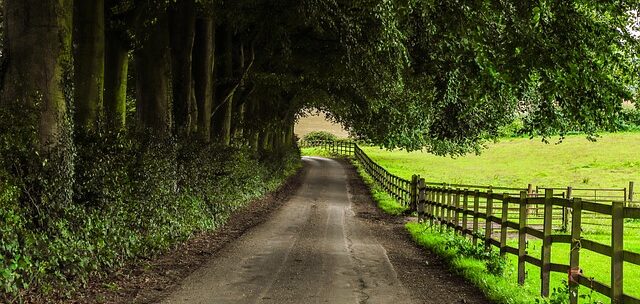
I drove west and London released its grip slowly — the suburbs thinning, the motorway giving way to dual carriageway, the dual carriageway giving way to lanes, the lanes giving way to something that felt like England had taken a breath and held it for six hundred years.
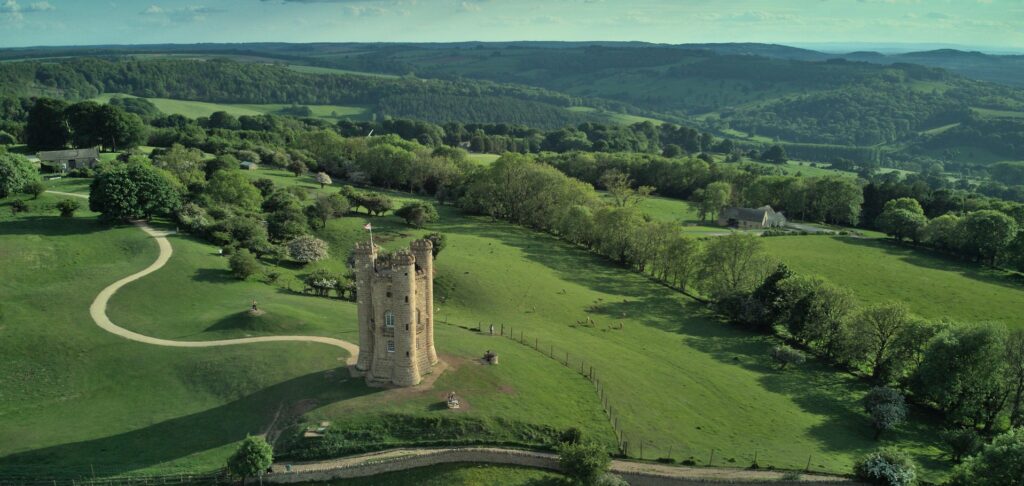
The Cotswolds are not dramatic. That’s the point. Rolling hills — wolds — covered in grass so green it looks adjusted. Dry stone walls dividing fields in patterns that haven’t changed since the medieval wool trade made this region one of the wealthiest in England. The stone is the colour of honey, warm oolitic limestone pulled from the ground beneath the hills and used for everything — houses, churches, walls, barns, gateposts. The Cotswolds are built from their own geology, and the result is a landscape where every structure looks like it grew from the field it sits in.
I stopped in Bibury — the village that William Morris called the most beautiful in England. Arlington Row is a terrace of weavers’ cottages from the 14th century, sitting beside a clear stream where trout hold in the current like they’re waiting for an appointment. The cottages are still lived in. The stream still runs. The scene looks like a painting but it’s someone’s Tuesday. That’s the Cotswolds — beauty so embedded in the everyday that pointing it out feels like pointing out the air.
I drove to Bourton-on-the-Water, where the River Windrush runs through the village centre, crossed by low stone bridges, bordered by greens where people sit with ice cream and do nothing with a commitment that borders on philosophy. Then to Stow-on-the-Wold, the highest town in the Cotswolds, where the market square has been the site of horse fairs since 1107 and the wind hits the square from every direction because the town sits exposed on a hilltop as if it chose the least sheltered spot on principle.
I walked through the churchyard at St Edward’s in Stow and found the north door — a wooden door flanked by two ancient yew trees whose trunks have grown into the stone walls on either side, creating a living doorway that looks like something from a story but is simply what happens when a tree and a church share the same ground for long enough. The Cotswolds don’t create spectacle. They create accumulation. Give anything enough centuries and it becomes extraordinary.
I ate in a pub in Lower Slaughter — a village whose name comes from the Old English “slohtre,” meaning muddy place, not violence, though the name does all the marketing the village will ever need. A ploughman’s lunch — cheddar, pickle, bread, an apple, a pint of local ale — in a garden overlooking the River Eye, which is narrow enough to step across and clear enough to read a newspaper through. The food in the Cotswolds is not ambitious. It is correct. The cheese is from the county. The bread is from the morning. The apple is from the tree you can see from your table. The beer is brewed with water that filtered through the same limestone that built the pub.
The Cotswolds taught me something I hadn’t learned on this entire journey — that beauty doesn’t require drama. No volcanoes. No earthquakes. No sieges. No empires. Just stone, grass, water, sheep, and the accumulated patience of a landscape that has been doing the same thing for so long that the doing itself has become the masterpiece.
Bath was the destination that connected everything.
I arrived and the city curved around me in a sweep of pale stone — the same oolitic limestone as the Cotswolds, because Bath sits at their southern edge, but here the stone was deployed with a theatricality that the Cotswolds would find unseemly. Bath doesn’t whisper. Bath projects.
The Roman Baths came first. The only naturally occurring hot spring in Britain — water that fell as rain ten thousand years ago, sank to a depth of nearly three kilometres, was heated by the earth’s core, and rises back to the surface at 46 degrees Celsius. The Romans found it, did what Romans do, and built one of the most sophisticated bathing complexes in the empire around it. The Great Bath is still filled with the same water, green now with algae, steam rising from the surface, surrounded by columns and statues that are partly Roman and partly Victorian reconstruction. I stood at the edge and watched the steam curl and thought about the fact that this water started falling from the sky when Britain was still attached to the ice age, spent ten millennia underground, and arrived here warm. The spring hasn’t stopped flowing in recorded history. The Romans left. The Saxons came. The Normans rebuilt. The Georgians reinvented. The water didn’t notice.
The city above the Baths is Georgian Bath — the reinvention that made the city a global architectural reference. John Wood the Elder and John Wood the Younger designed the Royal Crescent, the Circus, and the connecting streets in the 18th century using principles borrowed from Roman architecture — the Circus is a direct inversion of the Colosseum, a circular row of townhouses with the classical orders stacked on the exterior, Doric at the bottom, Ionic in the middle, Corinthian at the top. Rome’s arena turned inside out and converted into houses. Bath took the empire’s architecture and domesticated it.
The Royal Crescent is thirty townhouses arranged in a sweeping half-ellipse facing a sloping lawn, and standing at the centre of the crescent, the symmetry is so complete it feels like standing inside a mathematical proof. Every window, every column, every balustrade is identical. The uniformity is the design. Wood understood that repetition at this scale creates its own beauty — the same principle that makes a colonnade impressive and a single column merely structural. Bath doesn’t decorate. It repeats, and the repetition becomes the ornament.
I walked through the Assembly Rooms where Jane Austen set some of her social battlefields — the ballrooms and tea rooms where Georgian society performed its rituals of courtship, status, and gossip with a precision that Austen dissected so perfectly that the rooms still feel occupied by her characters. Bath was where English society came to see and be seen, to take the waters and take each other’s measure. Austen lived here and disliked it, which is possibly the most Austen response to a city that exists primarily for social performance.
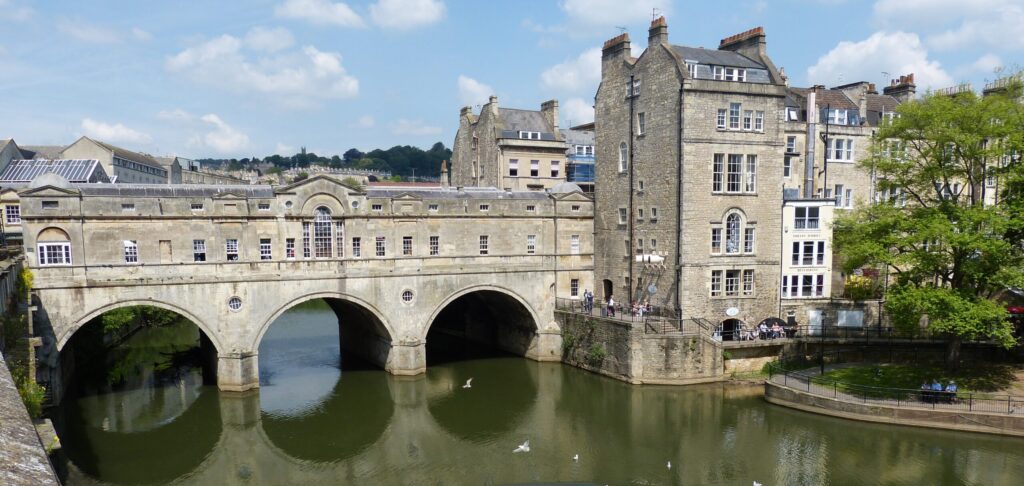
Pulteney Bridge crosses the Avon with shops built along both sides — one of only four bridges in the world designed this way, after the Ponte Vecchio in Florence, the Rialto in Venice, and the Krämerbrücke in Erfurt. I stood on it and looked upstream at the horseshoe weir, the water falling in a perfect curve, and downstream at the city climbing the surrounding hills in terraces of pale stone. Bath is a city that understands composition. Every view is arranged. Every street leads to a reveal. The Georgians didn’t just build a city — they directed it, the way a filmmaker directs the audience’s eye.
I ate a Bath bun — the original, not the London imitation — a soft, sweet, yeast roll topped with crushed sugar and caraway seeds, invented in the 18th century when Bath was the fashionable capital of England. I ate a Sally Lunn bun at the Sally Lunn house — the oldest house in Bath, where a French Huguenot refugee reportedly created the recipe in the 1680s. The bun is closer to brioche than bread, served split with butter, and the building is so old the floor is uneven and the ceiling is low enough that I ducked. Bath’s food is heritage food — not because it’s old-fashioned but because the recipes arrived with the people who came here and stayed because the water was warm and the stone was beautiful.
I returned to the Baths at night. The Great Bath was lit from below, the steam rising into floodlight, the columns casting shadows on the water, and the temperature outside cold enough that the steam was visible from the street. I stood above it and watched the water do what it has been doing for ten thousand years — arrive warm, sit still, and wait for whoever shows up next. The Romans came. The Georgians came. The tourists come. The water doesn’t distinguish.
Three stops. A capital that contains so much it can’t be summarised, only survived — two thousand years of power, migration, invention, and the relentless forward motion of a city that treats permanence as a dare. A landscape so quiet and so old that beauty has become its resting state, stone walls and green fields and honey-coloured villages doing nothing more than continuing, which turns out to be enough. A city built on the only warm water in Britain, where the Romans bathed, the Georgians posed, and the spring keeps flowing because the earth doesn’t care who’s standing above it.
England doesn’t announce what it is. It layers — bone under stone, wool under wealth, water under city — and lets you dig until you find the version that answers your question.
The journey through Britain does not end here. But the water at Bath is still rising, and it doesn’t know how to stop.

Beyondia
Trusted Travel CompanionReal digital nomad. I travel. I learn. I grow.
What about you? Where are you going?