Around the World with Beyondia 🧵 Nordic & Western Europe Region 🪡 Journal 24
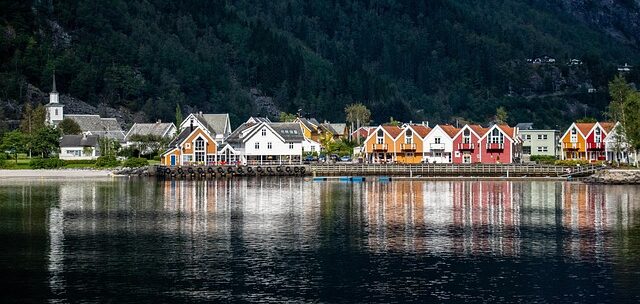
Oslo. Ålesund. Trondheim. A capital that found oil and decided to act like it didn’t, a town that lost everything in a fire and rebuilt itself as a work of art, and a medieval cathedral at the end of a pilgrim road that’s been pulling people north for a thousand years.
Oslo made me reconsider what wealth means.
I landed in Oslo expecting Scandinavian minimalism — clean lines, expensive coffee, quiet people. I got all three. What I didn’t expect was the philosophy underneath. Norway is one of the richest countries on earth. The Government Pension Fund — built on North Sea oil revenues — holds over $1.7 trillion in assets, the largest sovereign wealth fund in the world. That’s roughly $300,000 for every Norwegian citizen. And yet Oslo doesn’t look rich. It looks considered. The money isn’t on display. It’s in the infrastructure, the public transport, the free university education, the healthcare system. Norway found oil and made a decision that almost no other petrostate has made — save it, invest it, and don’t let it change who you are. The entire country is a case study in what happens when discipline meets abundance.
I started at the Vigeland Sculpture Park — the world’s largest sculpture park by a single artist, Gustav Vigeland, who spent twenty years creating over two hundred bronze, granite, and wrought iron sculptures depicting the human life cycle. The Monolith at the centre is a seventeen-metre tower of 121 intertwined human bodies carved from a single block of granite, rising from a cluster of figures reaching upward. It took three stonemasons fourteen years to carve. I stood at its base and the figures climbed above me — bodies tangled in struggle, embrace, exhaustion, and ecstasy — and the overall effect was not beautiful. It was honest. Vigeland didn’t idealise the human body. He showed it working, aging, failing, reaching, and continuing regardless. The park is free. No ticket. No barrier. Oslo put its most important art on open ground and let the city walk through it on the way to work.
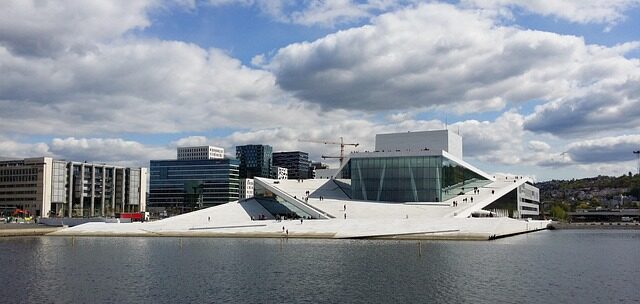
The Opera House sits on the harbour like an iceberg that chose to land. White marble and granite sloping from the waterline to the roof, designed so that anyone can walk up the exterior to the top. I climbed it and sat on the roof and Oslo spread around me — the fjord, the new Munch Museum across the water, the Barcode buildings lined up like books on a shelf. The Opera House cost $800 million. Norway built it as a public building, not a private monument. The roof is the point — a space where the city meets its harbour, free, open, democratic in the most literal sense. Every design decision in Oslo seems to answer the same question: who is this for? The answer is always everyone.
The Munch Museum — the new one, opened in 2021, a leaning tower of aluminium and glass on the Bjørvika waterfront — holds the largest collection of Edvard Munch’s work. The Scream is here, behind glass, smaller than I expected, more disturbing than any reproduction prepares you for. The colour isn’t just orange — it’s the orange of a sky that something is wrong with. Munch painted anxiety before the word had a clinical definition, and looking at the original, the feeling is not admiration. It’s recognition. He painted something everyone has felt and nobody could describe, and he did it in 1893 on a bridge in Oslo, staring at a sky that he later said was blood-red. The painting is a diagnosis. The museum built a tower to hold it.
I walked through Grünerløkka — the neighbourhood that was working class a generation ago and is now Oslo’s creative district, coffee roasters and vintage shops and street art covering the underpasses — and the transition felt honest. Oslo doesn’t gentrify the way London does, erasing what was there. The old apartment blocks remain. The immigrant-owned grocery shops remain. The new layers sit on top without replacing the foundations. The kebab shop and the specialty coffee bar share a wall and neither seems surprised.
I ate rakfisk in a bar in the city centre — fermented trout, a Norwegian tradition that is exactly as challenging as hákarl but presented with less theatre. The fish is salted, fermented for months, and served raw on flatbread with sour cream and onion. The flavour is sharp, funky, complex in the way that only time and bacteria can produce. I followed it with a bowl of fårikål — mutton and cabbage stew, the national dish, slow-cooked until the meat dissolves and the cabbage becomes something sweet and savoury simultaneously. Norwegian food is patience food. Everything takes longer than you think. The flavour is the reward for waiting.
I took the ferry across the Oslofjord to the Bygdøy Peninsula and visited the Fram Museum — home to the Fram, the strongest wooden ship ever built, used by Nansen and Amundsen to reach the farthest points north and south that anyone had reached. The ship sits inside the museum intact, and I climbed aboard and stood on the deck where Amundsen planned his expedition to the South Pole in 1911. The cabins are small. The equipment is crude by modern standards. The ambition is staggering. Norway produced explorers the way Florence produced painters — with a concentration and intensity that the country’s size doesn’t explain. Three hundred thousand people on the edge of the Arctic, and they sent ships to both poles and came back. Ejebiga, Norwegian style, except they’d call it something quieter and then actually do it.
Ålesund broke the pattern.
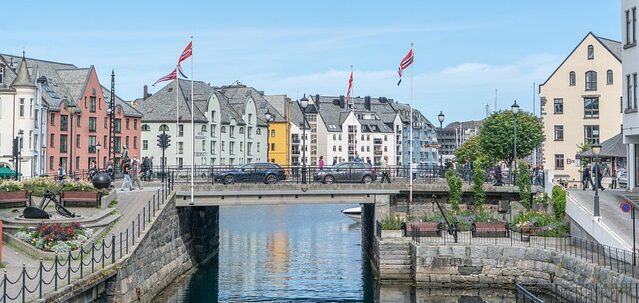
I flew north along the coast and the country changed from fjord to island, from inland forest to open Atlantic. Ålesund sits on a cluster of islands at the mouth of a fjord, and the first thing I noticed was that the town looked wrong for Norway. Not wooden. Not minimalist. Art Nouveau. Turrets, spires, ornamental façades, buildings decorated with flowers, dragons, faces, and maritime motifs carved into stone and plastered walls. Ålesund looks like it belongs in Prague or Vienna, and the reason it looks this way is fire.
On the night of January 23rd, 1904, a fire started in a factory and within sixteen hours, 850 buildings had burned. The entire town centre was destroyed. Ten thousand people were left homeless in the middle of a Norwegian winter. And then something extraordinary happened — Kaiser Wilhelm II of Germany, who loved the Norwegian fjords and had holidayed near Ålesund, sent ships loaded with building materials. The town was rebuilt in three years, entirely in the Art Nouveau style that was fashionable in Europe at the time. Every architect working on the reconstruction designed in the same movement, creating a town with a visual coherence that planned cities rarely achieve. Ålesund’s beauty is the product of total destruction followed by total coordination. The fire erased the town’s history. The rebuilding gave it an identity.
I climbed Aksla — the hill above the town — and from the viewpoint at the top, Ålesund revealed its geometry. Islands, bridges, channels, boats, and below me the Art Nouveau rooftops arranged along the waterfront like a catalogue of the style. The colours were muted — slate blue, sage green, cream, soft pink — and against the grey water and the green mountains beyond, the town looked like a watercolour that someone had set down and forgotten to pick up. Ålesund is the most visually unified town I’ve seen since Bath, and for the same reason — a single moment in time imposed a single style on an entire place. Bath had the Georgians. Ålesund had the fire.
I took a boat into the Geirangerfjord — a UNESCO World Heritage Site, one of the most visited fjords in Norway, and I understood why within the first ten minutes. The fjord narrows until the mountains rise vertically on both sides, waterfalls dropping hundreds of metres from ledges where abandoned farms still cling to slopes so steep that children were reportedly tied to rocks to prevent them falling while their parents worked the fields. The Seven Sisters waterfall — seven separate streams falling side by side — and across the fjord, the Suitor, a single fall that legend says is trying to impress them. The scale is biblical. The water is dark blue-green. The silence between the engine and the waterfall was the kind of silence that makes you aware of your own heartbeat.
I ate klippfisk — dried and salted cod — in Ålesund, which is appropriate because this town was historically the centre of Norway’s klippfisk trade, exporting preserved cod to Portugal, Spain, and the Caribbean for centuries. The cod trade connected Norway to the Mediterranean long before oil connected it to the global economy. The dish was served gratinado-style, with cream, onion, and potato, a preparation that came back from Portugal — the Norwegians exported the fish and imported the recipe. A dish that crossed the Atlantic twice before landing on my plate. Food as trade route. Flavour as foreign policy.
Trondheim was the end of a road I didn’t know I’d been walking.
Norway’s third city sits on a fjord in the middle of the country — the historical, cultural, and religious capital before Oslo took over. The city was founded by Viking King Olav Tryggvason in 997 AD, and for centuries it was the seat of Norwegian power and the destination of one of the great pilgrim routes in Europe. The road to Trondheim — the St. Olav’s Way — runs from Oslo to the Nidaros Cathedral, a walk of over 640 kilometres that pilgrims have been making since the 11th century when King Olav II was killed at the Battle of Stiklestad in 1030 and declared a saint. His burial site became a cathedral. The cathedral became a magnet. Trondheim became Norway’s Canterbury, its Santiago de Compostela, the point where the road ends and the meaning begins.
The Nidaros Cathedral is the northernmost medieval cathedral in the world, and it took my breath the way Durham, Chartres, and Sevilla had taken it — but differently. The west front is carved in a Gothic style that borrows from English cathedrals, covered in statues of saints, prophets, and biblical figures, but the stone is a dark green-grey soapstone that makes the building look like it grew from the Norwegian rock rather than being built on it. The cathedral has been under construction, reconstruction, and restoration almost continuously since the 12th century. Fire destroyed it. Reformation stripped it. Neglect decayed it. And every time, someone decided to rebuild. The cathedral I stood in front of is the same building that medieval pilgrims reached after weeks of walking — same location, same purpose, same stone — but it has been rebuilt so many times that the question of what is original and what is restoration has become irrelevant. The commitment is the original. Everything else is material.
I walked inside and the nave was tall, narrow, and dark in the way that only northern Gothic can be — light entering through stained glass in thin shafts that moved across the floor as the clouds shifted outside. The crypt is the oldest part, Romanesque, heavy, the arches round and the stone thick, and standing down there I was in the same space where Olav’s body was placed nearly a thousand years ago. The pilgrim road ends here. Thousands of people over a thousand years walked hundreds of kilometres to stand in this exact spot. The floor was worn smooth. Not by time. By feet.
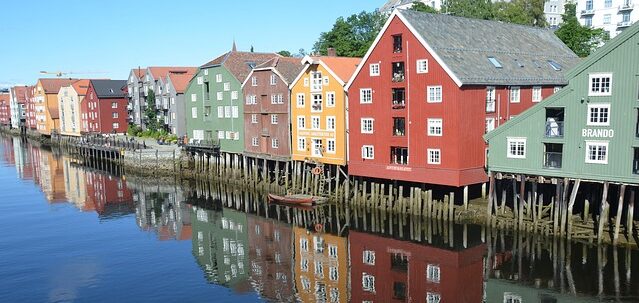
I walked the old town — Bakklandet — where colourful wooden houses line the Nidelva River, connected by the Gamle Bybro, the old town bridge, and reflected in the water in a way that makes every photograph look like it has a filter but doesn’t. Trondheim is smaller than Oslo, quieter, more intimate, and the wooden architecture gives it a warmth that Oslo’s steel and glass doesn’t attempt. The river bends through the city and the warehouses on stilts along the water — brygger, the same word as Bergen’s Bryggen — were built for the fish trade and are now restaurants, galleries, and apartments. Trondheim recycles its buildings the way it recycles its history — nothing is demolished if it can be repurposed.
I visited NTNU — the Norwegian University of Science and Technology — because Trondheim is also a university city, over thirty thousand students in a city of two hundred thousand, which means the place has a young, sharp energy underneath the medieval surface. The technology that drives Norway’s oil industry, its renewable energy sector, its maritime engineering — much of it is developed here. Trondheim is the place where Norway’s past and Norway’s future share a campus, the pilgrim road ending at a cathedral that sits three kilometres from the labs that design the country’s next century.
I ate svele — thick, sweet Norwegian pancakes — at a café by the river, with brown cheese and sour cream. Brown cheese — brunost — is the thing about Norwegian food that nobody outside Scandinavia is prepared for. Caramelised whey cheese, sweet, fudgy, dense, sliced thin and eaten on bread or waffles. It tastes like someone made dulce de leche from goat’s milk and forgot to stop cooking. It shouldn’t work on a pancake. It works on everything. Norway puts brown cheese on things the way the rest of the world puts butter — universally, without explanation, and with the quiet confidence of a nation that doesn’t need your approval.
I stood on the old town bridge at midnight and the Nidelva flowed beneath me and the sky was light. Not Akureyri light — Trondheim is further south, so the sun dipped below the horizon — but the sky never went dark. A pale blue holding pattern, the northern summer refusing to fully commit to night. The cathedral was visible upstream, its spire above the rooftops, still under scaffolding in places because the restoration never really ends. The pilgrims who walked here a thousand years ago arrived to a building that wasn’t finished. The visitors who come now arrive to a building that still isn’t finished. Nidaros Cathedral is the most honest monument I’ve encountered — it admits that the work is never done, and it keeps going anyway.
Three stops. A capital that found more money than most nations will ever see and decided the correct response was restraint — saving it, sharing it, and building public spaces so democratic that the opera house is a hill anyone can climb. A town that burned completely and rebuilt itself as an Art Nouveau jewel in three years because a German emperor loved the fjords and a community refused to accept that destruction was the end of the story. A medieval cathedral at the end of a thousand-year-old pilgrim road that has never been finished and never will be, because the building is the commitment, not the completion.
Norway doesn’t show off its wealth, its beauty, or its history. It maintains them. Quietly, consistently, without applause, the way a cathedral is maintained — not because it’s done, but because the maintaining is the point.
The Nordic chapter continues. But Nidaros is still standing at the end of the road, still under scaffolding, still waiting for the next pilgrim who walks far enough to reach it. I did. And I understand why they kept walking.

Beyondia
Trusted Travel CompanionReal digital nomad. I travel. I learn. I grow.
What about you? Where are you going?