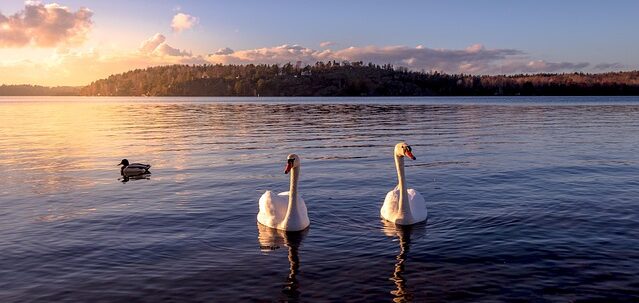
Around the World with Beyondia 🧵 Nordic & Western Europe Region 🪡 Journal 26
Abisko. Muddus. Luleå. A mountain station where the sky performs things that science can explain but the eyes refuse to believe, a national park where the forest has been growing without human interference since the last ice age, and an archipelago town where the sea freezes solid and 400 wooden cottages exist for a single gathering once a year.
Abisko. Sweden’s north didn’t arrive. It absorbed me.
I crossed from Norway into Swedish Lapland and the landscape shifted without announcing it. Norway’s north is vertical — mountains, fjords, cliffs. Sweden’s north is horizontal. The land flattened into birch forest, bog, lake, and sky. So much sky. The horizon stretched in every direction without obstruction, and the feeling wasn’t emptiness — it was exposure. There was nothing between me and the weather, between me and the light, between me and whatever the atmosphere decided to do next. Swedish Lapland doesn’t shelter you. It presents you to itself.
Abisko is a railway station, a research facility, a national park, and the most important piece of sky in Europe.
The village — if you can call a handful of buildings along a rail line a village — sits on the shore of Torneträsk, one of Sweden’s largest lakes, 70 kilometres long, surrounded by mountains that form the border with Norway. The national park covers 77 square kilometres of alpine terrain — birch forest below, bare rock above, the Kungsleden trail passing through on its 440-kilometre route from Abisko south to Hemavan, one of the great long-distance hiking trails in the world. I walked a section along the Abiskojåkka canyon, where the river has cut through rock to create a gorge so narrow I could hear the water echoing off both walls simultaneously. The birch trees were small, twisted by wind and cold into shapes that looked like calligraphy — each trunk a sentence written by decades of Arctic weather.
But the sky is why Abisko matters.
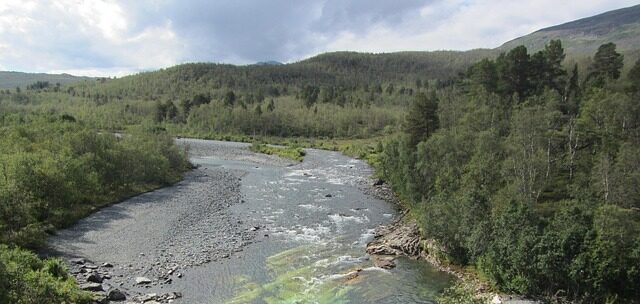
The Abisko Scientific Research Station has been studying the northern lights since 1903. The village sits in what meteorologists call the “blue hole of Abisko” — a microclimate created by the surrounding mountains and the lake that produces statistically clearer skies than anywhere else in the region. When clouds cover the rest of Lapland, Abisko often stays open. The Aurora Sky Station sits on a nearby peak, accessible by chairlift, and it exists for one purpose — watching the sky do things that belong in a different reality.
I didn’t see the northern lights. Wrong season. The midnight sun owned the sky. But standing at the Sky Station at eleven at night, looking north over Torneträsk, the light was doing something I hadn’t seen even in Lofoten or Nordkapp. The sun sat low on the mountains to the northwest, and the sky cycled through colours that don’t have names in any language I speak — a pale gold bleeding into rose bleeding into a blue so thin it was almost white, reflected perfectly in the lake below, doubling everything. The sky above and the sky below were the same image, and I stood between them feeling like I was inside the atmosphere rather than beneath it. Abisko’s sky isn’t scenery. It’s an event. It happens to you.
The Sámi presence here is not historical — it’s current. Reindeer grazed along the road as I drove. A Sámi family was moving a herd across the valley, the animals flowing over the landscape like water over stone. The Sámi relationship with Abisko is not tourism and not tradition in the way that word is usually used — it’s economic, ecological, ongoing. The reindeer follow routes that were established long before Sweden drew a border through this land, and the Sámi follow the reindeer. The national park exists because Sweden decided to protect the landscape. The Sámi were already protecting it. The difference between those two forms of conservation — institutional and indigenous — is a conversation Sweden is still having, and Abisko is one of the places where the conversation is most visible.
I ate suovas — smoked reindeer meat — sliced thin, served on flatbread with lingonberry jam. The smoke was birch wood. The meat was dense, dark, savoury in a way that filled the back of the mouth and stayed. Every meal in Lapland tasted like the landscape it came from — mineral, herbal, smoky, slow. The berries — lingonberry, cloudberry, blueberry — grew wild in quantities that made picking them feel less like foraging and more like the ground offering something it had too much of. Cloudberry — hjortron — is the one that caught me. Golden, tart, slightly resinous, growing in bogs across the Arctic, impossible to cultivate commercially, which means every cloudberry anyone eats was picked by hand from a swamp. The difficulty is the flavour.
Muddus was the silence I didn’t know I was missing.
I drove south and east from Abisko into the interior of Lapland, and the road narrowed and the forest thickened and the last signs of infrastructure disappeared. Muddus — or Muttos, its Lule Sámi name — is a national park covering 493 square kilometres of old-growth boreal forest, bog, and river gorge. It is one of the largest and least visited national parks in Sweden. I drove to the trailhead and there was one other car. I walked for five hours and saw no one.
The forest in Muddus has never been logged. The trees — Scots pine, Norway spruce, birch — are growing in the same patterns, at the same pace, in the same soil that they’ve occupied since the ice retreated roughly ten thousand years ago. Some of the pines are over seven hundred years old. They don’t look grand. They look patient. Short, gnarled, bark thick as armour, growing a few millimetres per year in a climate that gives them four months of warmth and eight months of cold. The oldest trees are not the tallest. They’re the most stubborn.
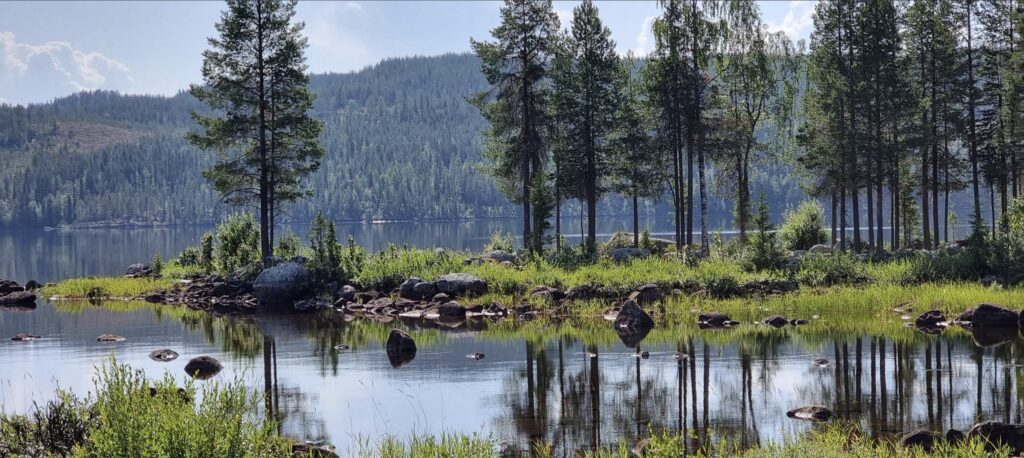
I walked through a section of forest where the floor was deep sphagnum moss — green, wet, springy underfoot, absorbing every sound. My footsteps made no noise. The wind made no noise. The only sound was a woodpecker somewhere in the canopy, drumming at intervals so regular it might have been mechanical. The boreal forest doesn’t welcome you. It doesn’t reject you. It is simply indifferent to your presence in a way that no human settlement can be. The trees were here before me. They will be here after. My walk through them registered on nothing except the moss, which would spring back by morning.
I reached the Muddus Falls — Muddusfallet — where the Muttosjåhkå river drops into a gorge, the water white and violent, surrounded by forest so dense the gorge felt like a secret the landscape was keeping from the rest of the country. The falls are not Dynjandi. They’re not Goðafoss. They’re not competing with anything. They exist because water follows gravity and rock follows time, and in Muddus nobody has tried to improve on that arrangement.
The bogs were the thing I expected to endure and ended up valuing most. Muddus is as much wetland as forest — vast open mires stretching between the tree stands, boardwalked in places, trackless in others. The bog is alive. Insectivorous plants — sundew, butterwort — dotted the sphagnum, catching flies in sticky leaves because the soil is too nutrient-poor to support them any other way. A plant that eats insects because the ground isn’t enough. That’s Arctic adaptation at its most precise — not strength, not speed, just an organism finding exactly the solution that the problem requires.
I camped at a shelter on the edge of a mire and cooked over a fire ring that had been used by every hiker who’d passed this spot for decades. The fire was small. The smoke was birch. The sky above the treeline was the same pale non-dark I’d seen across the Arctic, and the mire stretched flat in every direction, mist sitting on its surface like the landscape was breathing out. I ate dried reindeer and hardtack and drank coffee boiled in a pot over the fire — kokkaffe, the Scandinavian method, grounds thrown directly into boiling water, left to settle, poured through patience rather than a filter. The coffee was gritty. The silence was absolute. Muddus doesn’t give you an experience. It gives you the absence of every experience except the one you’re having.
Luleå brought me back to the coast and back to civilisation, but a very specific kind of civilisation.
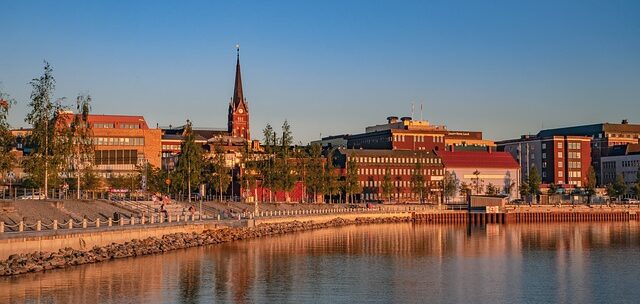
The city sits at the mouth of the Lule River on the Gulf of Bothnia — the northernmost bay of the Baltic Sea — and in winter the sea freezes. Not partially. Completely. The archipelago of over 1,300 islands becomes a single sheet of ice, and the locals drive cars across it, fish through holes in it, and treat the frozen sea as additional infrastructure. Luleå’s relationship with ice is not adversarial. It’s collaborative. The city gains territory every winter and gives it back every spring.
But the thing that stopped me — the thing that made me sit down and reconsider what a community means — is Gammelstad.
Gammelstad — the old town — is a UNESCO World Heritage Site, and it’s not what I expected. It’s a church town — kyrkstad — a settlement of 408 wooden cottages arranged around a 15th-century stone church, built not as permanent residences but as temporary housing for parishioners who lived too far away to travel to church and back in a single day. The parish was enormous — in northern Sweden, parishes were so large that attending Sunday service could mean a journey of a hundred kilometres. So the church built a town. Each family had a cottage. They arrived on Saturday, stayed overnight, attended services on Sunday, and went home. The town was occupied for one or two days a week and stood empty the rest.
I walked through the cottages — rows of small red wooden buildings, each one barely large enough for a family, arranged on narrow lanes that radiated from the church like spokes from a hub. The church at the centre is medieval stone, its interior painted with biblical scenes in the naïve, vivid style that characterises northern Swedish church art — bold colour, flat perspective, saints and sinners rendered with the same unflinching directness. The pulpit is ornate. The ceiling is vaulted. The effect is of a building that was designed to justify the entire town that exists solely to reach it.
Gammelstad is the largest and best-preserved church town in Sweden — 408 cottages, the most of any kyrkstad — and standing in the centre, surrounded by empty houses on a Wednesday afternoon, the silence had a different quality from Muddus. This wasn’t the silence of wilderness. It was the silence of a purpose that only activates on schedule. The town is a machine that runs one day a week. The rest of the time it waits, and the waiting is part of the design.
I visited the Norrbotten Museum in Luleå and spent an hour in the exhibition on Sámi culture and the history of colonisation in the north. Sweden’s relationship with its indigenous population is complicated in ways that the clean Scandinavian brand doesn’t advertise. The settlement of Lapland, the establishment of churches and mines and trade posts, the suppression of Sámi language and culture through boarding schools and forced assimilation — the history is there, documented, and Sweden is in the process of reckoning with it in a way that is genuine and incomplete, which is perhaps the only honest way a reckoning can be. Luleå sits at the intersection of that history — a coastal city built on trade and industry, serving a hinterland where the Sámi were the original inhabitants and remain the people most connected to the landscape. The tension isn’t resolved. It’s held.
I ate kalakukko — wait. Wrong country. I ate palt — the northern Swedish potato dumpling filled with pork, boiled until it’s dense enough to anchor a boat, served with butter and lingonberry. The dumpling is the size of a fist and the weight of a commitment. One is a meal. Two is an ambition. The pork inside melts during the cooking and the fat soaks into the potato dough and the whole thing is heavy, warm, and exactly what the body needs when the body has been standing in Arctic wind all day. Luleå’s food is engineering. Calories delivered in the most efficient format the climate requires.
I stood on the harbour in Luleå on a summer evening and the Gulf of Bothnia was open water, calm, islands scattered to the horizon, the light soft and long the way all Arctic light is soft and long in summer. In six months, everything I was looking at would be ice. The sea, the harbour, the channels between the islands — all of it frozen, solid, walkable, drivable. Luleå lives two lives every year. Summer Luleå is a coastal city. Winter Luleå is an ice city. The population doesn’t change. The geography does.
Three stops. A mountain station where the sky has a hole in the clouds that science can measure but standing beneath it feels like a privilege no instrument can quantify. A wilderness so old and so untouched that the trees grow a few millimetres per year and a plant eats insects because the soil isn’t enough and the silence is so total that your own heartbeat becomes the loudest thing in the forest. A coastal city where the sea freezes solid and 408 wooden cottages stand empty six days a week waiting for the one day that justifies their existence.
Swedish Lapland isn’t on the edge of Europe the way Nordkapp is. It’s behind Europe. North of the story most people tell about this continent, older than the borders, quieter than the cities, and running on a clock that measures time in ice ages, tree rings, and reindeer migrations rather than centuries and kings.
The Nordic chapter deepens. But Muddus taught me something none of the cities could — that the most powerful thing a landscape can do is not perform. Just stand there. Just grow. Just be what it was before anyone arrived to describe it.

Beyondia
Trusted Travel CompanionReal digital nomad. I travel. I learn. I grow.
What about you? Where are you going?