Around the World with Beyondia 🧵 Nordic & Western Europe Region 🪡 Journal 22
York. Edinburgh. Orkney. A city with two thousand years of dead underneath its streets, a capital that decided to invent the modern world, and islands where the stones were standing before the pyramids were planned.
York grabbed me by the ankles.
Not metaphorically — the city’s real story is underground.
I walked through the Shambles first because the street demands it. Medieval timber-framed buildings leaning toward each other overhead, so close at the top that the sky becomes a slit. The Shambles has been here since the 14th century — a butchers’ quarter originally, the name coming from the Old English word for the shelves where meat was displayed. The hooks are gone. The buildings remain. York’s old town is one of the most intact medieval streetscapes in England and Europe, and walking it feels less like visiting history and more like interrupting it.
But the Shambles is the surface. The real York is below.
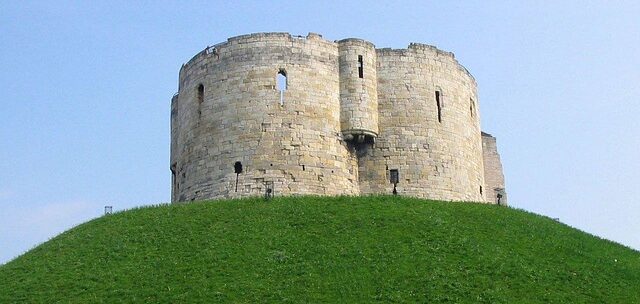
The Jorvik Viking Centre sits on the site where archaeologists in the 1970s uncovered the remains of a Viking-age street — preserved in the waterlogged soil for over a thousand years. The timbers, the tools, the leather shoes, the human waste — all of it intact enough to reconstruct what daily life looked like when York was Jórvík, one of the most important Viking cities in Britain. The Vikings didn’t just raid York. They moved in. They traded, built, married, raised children, and turned a Roman fortress town into a Norse capital. I stood over the excavation line and looked at a timber post that a Viking had driven into the ground eleven centuries ago, and the wood was still there, still holding, still doing its job.
York Minster took me upward. The largest Gothic cathedral in northern Europe, built over 250 years starting in 1220, its Great East Window containing the largest expanse of medieval stained glass in Britain — a single window the size of a tennis court, depicting the beginning and end of the world according to the Book of Genesis and Revelation. I stood in the nave and the glass turned the afternoon light into colour that landed on stone in ways that the 13th-century glaziers had calculated and I was only now receiving. The Minster sits on Roman foundations — the headquarters of the Roman legionary fortress of Eboracum, where Constantine was proclaimed emperor in 306 AD. York doesn’t just have layers. It has strata. Roman on the bottom, Viking in the middle, medieval on top, and the modern city wrapped around all of it like packaging around something too old to unwrap fully.
I walked the city walls — the most complete medieval walls in England, nearly five kilometres of continuous circuit — and from the top, York arranged itself in concentric rings of time. The Minster at the centre. The medieval streets spiralling outward. The river Ouse curving through it all, the same river the Romans used to supply the garrison, the Vikings used to trade, and the Georgians used to ship chocolate — York became the chocolate capital of England, home to Rowntree’s and Terry’s, because the Quaker families who founded the factories chose York for its river transport. Romans, Vikings, monks, and chocolate makers. All using the same river for different reasons across two millennia.
I ate at the Bettys Tea Rooms — not because it’s a tourist landmark but because a Swiss confectioner founded it in 1919 and the fat rascals — a Yorkshire scone with almonds, citrus peel, and cherries — are the kind of thing that shouldn’t work and does completely. York’s food identity isn’t dramatic. Yorkshire pudding. Parkin. Curd tart. Everything built on flour, fat, and the assumption that the weather will be cold and the portions should be honest.
Edinburgh didn’t introduce itself. It argued.
I arrived at Waverley Station and the city split in two immediately — the Old Town climbing the volcanic ridge to the castle on one side, the New Town descending in Georgian symmetry on the other. The divide isn’t just geographical. It’s philosophical. The Old Town is medieval, Gothic, dark, dense, the closes and wynds between the buildings so narrow that sunlight feels like a rumour. The New Town is 18th-century order — wide streets, uniform façades, planned gardens. Edinburgh built the Enlightenment next door to the Middle Ages and let them stare at each other across a drained loch.
The Castle sits on an extinct volcanic plug — Castle Rock, inhabited for at least three thousand years — and from the ramparts, Scotland announces itself without subtlety. The view north to the Firth of Forth, west to the Pentland Hills, east along the Royal Mile to the Palace of Holyroodhouse. Edinburgh is the only capital I’ve visited where the geology makes the political argument. The castle sits on a rock because the rock was there, and the kingdom was built around it because that’s what you do with a defensible position when everyone around you is trying to take it.
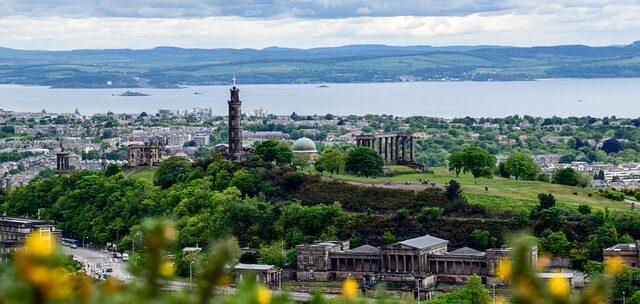
I walked the Royal Mile — the spine of the Old Town, dropping from the castle to Holyrood — and every close I ducked into revealed a different century. Riddle’s Court from the 1590s. The Writers’ Museum in Lady Stair’s Close, where manuscripts of Burns, Scott, and Stevenson sit in rooms smaller than most modern offices. The closes were vertical communities — ten storeys of families stacked above each other, rich at the bottom, poor at the top, everyone sharing the same staircase. Edinburgh’s Old Town was one of the first high-rise cities in the world, not by design but by geology — the ridge was narrow, the population was growing, and the only way to go was up.
But Edinburgh’s real claim — the one that changed the world — is what happened in the New Town in the 18th century.
The Scottish Enlightenment is the most concentrated intellectual explosion in modern history. David Hume rewrote philosophy. Adam Smith, Glasgow’s most famous professor who spent his final years here, rewrote economics. Joseph Black discovered carbon dioxide. James Hutton founded modern geology by looking at the rocks underneath Edinburgh and realising the earth was millions of years old, not thousands. Edinburgh in the 1700s was producing ideas at a rate that London, Paris, and the rest of Europe couldn’t match, and it was doing it from a city of fewer than 100,000 people on the edge of a continent. Voltaire said it was the hottest bed of genius in Europe. He was being accurate, not generous.
I walked through the New Town — Charlotte Square, the Georgian townhouses that Robert Adam designed with a precision that makes each street feel like a single continuous thought — and the order of it felt earned. This wasn’t decoration. It was the physical manifestation of a city that believed reason could organise everything, including itself.
I ate haggis in a pub on the Grassmarket — proper haggis, served with neeps and tatties, a dram of whisky on the side. The taste is nothing like its reputation. Peppery, earthy, savoury, the oats giving it a texture that’s closer to a rich stuffing than anything offal would suggest. The Scots don’t defend haggis. They serve it and wait for you to realise you’ve been wrong.
Arthur’s Seat — the other volcanic remnant, the 251-metre peak sitting inside the city like a mountain that forgot to leave — was the hike I did at dawn. I climbed in near-darkness and reached the summit as the sun came up over the North Sea. Edinburgh lit from the east, the castle a black silhouette against the brightening sky, the Forth Bridge a red line on the northern horizon. Standing on a volcano in the middle of a capital city, watching the Enlightenment’s streets fill with morning light, I understood why Edinburgh produces the people it produces. The city gives you a perspective — literally, physically, from a summit — and then dares you to think small. You can’t. The view won’t let you.
Orkney was where history lost its calendar.
I flew north from Edinburgh and the mainland fell away and the islands appeared — low, green, treeless, surrounded by water that can’t decide if it’s the North Sea or the Atlantic. Orkney sits off the northern tip of Scotland, closer to Norway than to London, and the first thing I noticed was the light. Orkney’s light in summer doesn’t quit. It dims. It softens. But it doesn’t leave. At midnight the sky was still holding colour, a pale grey-blue that made the concept of night feel like a suggestion rather than a fact.
I went to Skara Brae first. And Skara Brae rewrote my understanding of time.
A Neolithic settlement on the Bay of Skaill, uncovered by a storm in 1850. Eight houses, connected by covered passageways, built from stone because Orkney has no trees. Stone beds. Stone dressers. Stone shelves. Stone tanks set into the floor, possibly for keeping bait or shellfish. The houses were occupied from roughly 3180 to 2500 BC. That means people were living in these houses, sleeping in these beds, storing their belongings on these shelves, five thousand years ago. Before the pyramids of Giza. Before Stonehenge was completed. Before writing existed in Europe. Skara Brae is older than recorded history, and the furniture is still in the rooms.
I crouched inside one of the houses and the walls rose around me and the dresser faced the doorway exactly as it had been positioned five millennia ago. The person who placed it there wanted it to be the first thing a visitor saw when they entered. That’s not survival. That’s interior design. That’s someone thinking about how a room feels. Five thousand years ago, on a windswept island in the North Atlantic, someone cared about the arrangement of their home. That fact sat in me for the rest of the day.
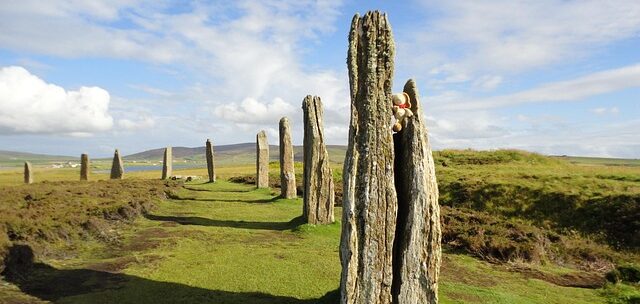
The Ring of Brodgar stands on an isthmus between two lochs — a stone circle originally of sixty stones, twenty-seven still standing, erected around 2500 BC. No one knows exactly why. Ceremonial. Astronomical. Spiritual. The explanations are guesses. The stones don’t explain themselves. They just stand, taller than me, placed with a precision that implies measurement and intention, in a landscape so open that the sky feels like a ceiling and the horizon is the only wall. I walked among them in the evening light and the silence was not empty — it was loaded. The kind of silence that exists when something was said a very long time ago and the air is still holding it.
Maeshowe — the chambered cairn across the road from Brodgar — is a Neolithic tomb built around 2800 BC, aligned so that the setting sun on the winter solstice shines directly down the entrance passage and illuminates the back wall of the chamber. Five thousand years ago, someone calculated that angle without instruments, without writing, without any technology beyond observation and stone. The alignment still works. Every December, the same light enters the same passage and hits the same wall. The builders are unknown. The engineering is exact.
Inside, Norse Vikings broke in during the 12th century and carved runic graffiti on the walls — the largest collection of runic inscriptions outside Scandinavia. Some are boasts. Some are names. One says a famous treasure was hidden here. Another, roughly translated, says something like “Ingigerth is the most beautiful of women.” A Viking broke into a five-thousand-year-old tomb and carved a love note on the wall. The human impulse to leave a mark — whether with a standing stone or a scratched name — hasn’t changed in five millennia. Maeshowe holds both acts in the same darkness.
I drove across the Mainland — Orkney’s largest island — and the landscape was farmland. Green fields, stone walls, cattle. Orkney is agricultural, productive, quiet. The dramatic history sits inside the ordinary landscape without announcement. A farmer’s field contains a tomb older than Egypt. A roadside ditch runs past a ceremonial circle. Orkney doesn’t separate the ancient from the everyday. It farms on top of it.
I ate Orkney beef — the islands are famous for it, the cattle raised on grass and salt air — and Orkney cheese, and Orkney oatcakes, and drank Highland Park whisky, distilled on the island since 1798 in the northernmost Scotch distillery in Scotland. The food was simple and serious. No performance. No garnish. Just ingredients that had been raised in a place where the wind never stops and the soil has been worked for five thousand years.
Standing Stones of Stenness — the oldest henge site in the British Isles, possibly erected around 3100 BC — were my last stop. Four stones remaining, the tallest nearly six metres, standing in a field next to a road where cars drove past without slowing. The stones were ancient when the Romans arrived. They were ancient when the Vikings arrived. They were ancient when Scotland became Scotland. And they’ll be standing when whatever comes next arrives and tries to understand them.
Three stops. A city built on two thousand years of its own dead, where every street is a cross-section and every river bend is a Roman supply line repurposed. A capital that decided reason was a building material and produced more genius per square metre in a single century than most nations manage in their entire history. A group of islands where the stones were placed before anyone on the European mainland had learned to write, and where a Viking in a dark tomb carved a woman’s name because even surrounded by death, the impulse to love out loud was stronger than the silence.
Britain doesn’t have one timeline. It has dozens, stacked and tangled, and the further north you go, the deeper they reach — until you’re standing in an Orkney field looking at a stone that was old before history learned to count.
The journey through Britain continues. But Orkney’s silence is the loudest thing I’ve heard on this trip, and I’m still listening.

Beyondia
Trusted Travel CompanionReal digital nomad. I travel. I learn. I grow.
What about you? Where are you going?