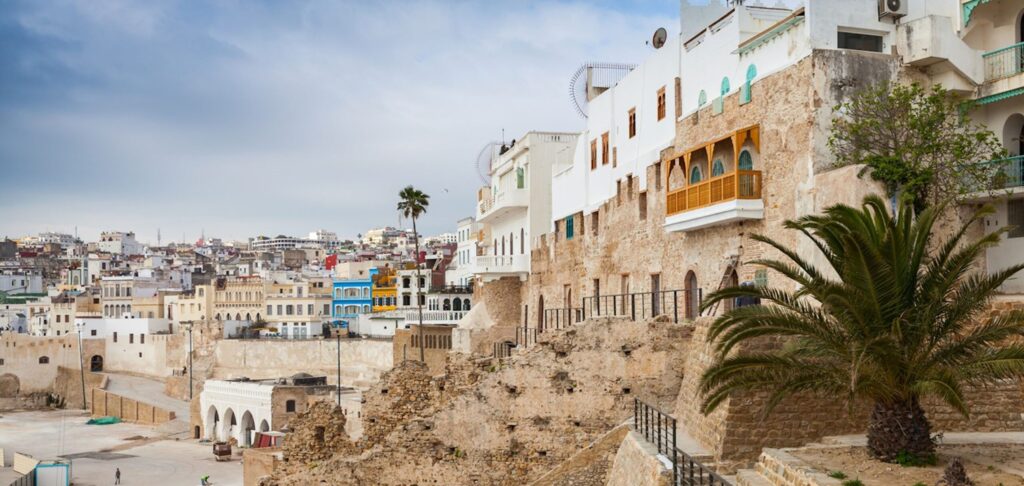
🌐 Around the World with Beyondia 🧵 Mediterranean Region 🪡 Episode 51: Chefchaouen
Chefchaouen — sometimes spelled Chaouen or Xauen — is a small town in the Rif Mountains of northern Morocco, population approximately 42,000, situated at 564 metres altitude in a small valley below two mountain peaks that give the town its name (the Berber word chaouen means “the horns,” in reference to the twin peaks of Jebel el-Kelaa and Jebel Meggou that flank the valley to the west and north). It sits approximately 100 kilometres south of Tangier, 60 kilometres south of the Spanish enclave of Ceuta, and 200 kilometres north of Fez, in a region of northern Morocco that has historically been culturally distinct from both the Atlantic coast and the imperial cities of the interior.
The town was founded on the 15th of Ramadan 876 in the Hijri calendar — which corresponds to the 25th of February 1471 in the Gregorian calendar — by Moulay Ali ben Rashid, a Sharifian nobleman of Idrissid descent (tracing his lineage to Idris I, the eighth-century founder of the first Moroccan Islamic state). The founding purpose was explicitly military and defensive. In 1415, Portuguese forces had captured Ceuta on the
coast opposite Gibraltar, beginning the long Portuguese-Moroccan coastal war that would occupy much of the fifteenth and sixteenth centuries. In August 1471, six months after Chefchaouen’s foundation, Portuguese forces captured Tangier as well. The Rif Mountains — the coastal mountain range running east from Tangier along the northern Moroccan coast — became the defensive frontier against further Portuguese incursion inland, and Moulay Ali ben Rashid’s new mountain foundation at Chefchaouen was positioned specifically to hold that frontier. The town was built with walls, a small kasbah at its centre (still standing today), and a defensive posture that would define its identity for the next four and a half centuries.
Chefchaouen was one of the settlements in Morocco where Europeans where prohibited
The defensive posture translated into an explicit policy of closure to non-Muslim outsiders. Chefchaouen was one of the very few settlements in Morocco where entry by Europeans was actively prohibited — first as a matter of local custom and military necessity, and later, as the town’s reputation for closure became institutionalised, as a matter of formal sanction. The prohibition was maintained continuously across the following four and a half centuries under six successive political regimes: the Wattasid sultanate (1471–1554), the Saadian dynasty (1554–1659), the early Alaouite sultans (from 1659), the various successor administrations, and the Spanish Protectorate (from 1912 in principle, from 1920 in practice at Chefchaouen). Only a small number of Europeans are documented to have entered Chefchaouen during this period. Charles de Foucauld — the French Catholic priest, geographer, and explorer, later canonised as a saint by Pope Francis in 2022 — entered Chefchaouen in 1883 disguised as a Jewish rabbi, spent a single night in the town, made careful geographical observations, and left the following morning without his disguise being detected. The American traveller Walter Harris of the Times of London entered in 1889 also in disguise. A third documented European visitor, an unnamed French explorer, is reported to have been caught and killed in the late nineteenth century, though the sourcing on this account is thin. The town’s closure was not absolute — Chefchaouen conducted trade with the surrounding Berber villages and with the Muslim populations of Tangier and Tetouan, and had its own small Jewish community continuously from the sixteenth century onward. But entry by non-Muslim outsiders from Europe or from the wider Mediterranean world was, in practice, prohibited. The prohibition ended on the 15th of October 1920, when Spanish colonial forces under General Dámaso Berenguer occupied Chefchaouen as part of the Spanish Protectorate of northern Morocco. The town had been closed to non-Muslims for four hundred and forty-nine years.
What the Spanish soldiers found when they entered the town is one of the more remarkable moments in early-twentieth-century linguistic and cultural discovery. The Sephardic Jewish community of Chefchaouen — which had been founded in the sixteenth century by refugees from the 1492 Spanish expulsion, expanded by seventeenth-century Morisco refugees after 1609, and maintained continuously in the intervening centuries — was still speaking, as its community language, a form of medieval Judeo-Spanish called Haketía. Haketía is one of the two main historical varieties of Judeo-Spanish (the other being Ladino, spoken by the Sephardic communities that settled in the Ottoman Empire and Balkans), and it descends from the Spanish spoken by Sephardic Jews in Andalusia before the 1492 expulsion. In Chefchaouen, because of the town’s closure to European contact, Haketía had been preserved in near-isolation from developments in mainland Spanish for over four centuries. The Spanish soldiers who marched into the town in 1920 could understand the Haketía-speaking Jews of the medina with some difficulty — the language sounded, to their ears, like a strange archaic Spanish, preserving vocabulary and grammatical features that had been lost from mainland Peninsular Spanish generations earlier, mixed with Hebrew, Arabic, and Judeo-Aramaic borrowings. The Sephardic scholar Manuel L. Ortega wrote in 1919 that Chefchaouen’s Haketía-speaking community was “a fragment of fifteenth-century Al-Andalus preserved in linguistic amber.” This was not entirely hyperbole. The community’s synagogues, prayer traditions, dietary customs, and religious calendar had been preserved in extreme isolation from the wider Sephardic diaspora, and the Chefchaouen Haketía register is one of the most conservative varieties of Judeo-Spanish documented anywhere. The community itself was, at the time of the Spanish occupation, approximately 800 people. Most of them emigrated to Spain, France, Latin America, and later Israel between the 1930s and the 1960s. By 2000, no fluent Haketía speakers remained in Chefchaouen itself. The linguistic fossil that Spanish soldiers had discovered in 1920 was, within eighty years, extinct in its home community.
The parallel that lands most cleanly for readers who have walked through the earlier Spanish arc is the Isleño Spanish of Louisiana, briefly touched in the Tenerife Ep 47 article — the eighteenth-century Canarian Spanish preserved in isolation in St Bernard Parish south of New Orleans by descendants of Canarian settlers recruited by Bernardo de Gálvez in the 1770s. Both cases follow the same pattern: a specific historical variety of Spanish, brought by a specific community, preserved in geographic isolation across generations, becomes an archaic linguistic fossil documented by early-twentieth-century observers, and then declines toward extinction as isolation ends and the community integrates into surrounding modern languages. The Isleños of St Bernard preserved eighteenth-century Canarian Spanish. The Sephardim of Chefchaouen preserved late medieval Judeo-Spanish. Both are, effectively, extinct today as living community languages. Both are documented in linguistic scholarship. Neither will be recovered.
The Andalusian architectural and cultural inheritance in Chefchaouen extends well beyond the Jewish community. The Andalusian refugees — Muslims expelled from Spain in successive waves between the 1492 fall of Granada and the 1609–1614 Morisco expulsion (treated at length in the Seville Ep 44 article and referenced again in Rabat Ep 50) — brought to Chefchaouen the same architectural, culinary, and musical traditions they brought to Rabat, Salé, Tetouan, and other refugee-receiving towns. The town’s older houses, particularly in the quartier andalou around the Plaza Uta el-Hammam, exhibit characteristic Andalusian courtyard-house architecture (the dar): rectangular ground plans arranged around a central courtyard with a fountain or pool, first-floor galleries, tile-and-plaster interior decoration, and small Andalusian-style gardens on the flat rooftops. The traditional cuisine incorporates Andalusian elements — chebakia honey pastries with sesame, specific tagine registers using dried fruits and preserved lemons in the Andalusian tradition, and a specific bread tradition (khobz) that uses Iberian techniques. The music includes the classical nuba tradition of Andalusian Arabic-Andalusian art music, still performed in Chefchaouen concerts today, particularly during the annual Chaouen Festival of Andalusian Music. The town is, in cultural terms, one of the most substantially Andalusian settlements in Morocco outside the Atlantic coastal cities. And unlike the Atlantic cities, which continued to receive European contact through Portuguese, English, and French trade after the seventeenth century, Chefchaouen’s isolation preserved the Andalusian inheritance in an unusually intact form. This is one of the deeper reasons for the town’s contemporary tourism appeal: it offers, in condensed physical form, a preserved fragment of what the Andalusian-Moroccan cultural continuum looked like before four centuries of European Mediterranean contact reshaped the coastal cities.
And then there is the blue. Chefchaouen’s medina is one of the most photographed small-town environments in Africa. Narrow alleys, whitewashed lime-plaster walls painted in shades ranging from pale sky blue through cobalt to deep Prussian blue, doorways and window frames edged in contrasting darker blue, occasional bright yellow or orange doors as accents against the blue field. The visual identity is so consistent that Chefchaouen has become effectively synonymous with the colour blue in international tourism marketing, comparable to Santorini’s white-and-blue or Positano’s warm pastels. Multiple explanations are given for the blue, and the article should handle the question honestly: none of the standard explanations is universally accepted, and the systematic blue as it appears today is substantially more recent than tourism materials suggest.
The three main hypotheses. The first is that the blue was introduced or expanded by Sephardic Jewish refugees, particularly by a wave of European Jewish refugees arriving in the 1930s from Nazi persecution, drawing on the Kabbalistic tradition that blue (specifically tekhelet, the ancient sacred blue-purple dye) represents the sky, heaven, and divine presence, and is spiritually protective. Blue as a colour on residential architecture appears in Jewish quarters in other Mediterranean towns, and the Chefchaouen Jewish community, though small, was active in the town’s built environment. The second hypothesis is that the blue was expanded or maintained for mosquito repellent — a widely-held folk belief across Mediterranean and Middle Eastern communities that blue paint deters biting insects. There is no strong entomological evidence for this claim, but the belief has been documented across multiple communities and could have influenced actual painting practices. The third hypothesis is that the blue emerged organically from local pigment availability and gradual aesthetic consolidation — the region’s mineral indigo dye traditions, the whitewash-plus-pigment finishing typical of Andalusian architecture, and a slow accumulation of blue elements that eventually became a coherent visual language. Recent oral-history research in Chefchaouen suggests that systematic wall-to-wall blue painting is substantially post-1930, with major expansion in the 1970s under municipal beautification initiatives, and further expansion driven by tourism-photography demand in the 1990s and 2000s. The town’s older seventeenth-century core almost certainly contained some blue elements from the Andalusian refugee period. But the completely-blue medina that appears in every modern photograph is largely a twentieth-century development that has continued to intensify in response to the town’s growing tourism profile.
This is not a criticism of the blue. The blue is beautiful, and its cultural meaning to the town’s contemporary residents is real regardless of its precise historical origin. The colour has been adopted by the Chefchaouen population as an authentic expression of local identity, is renewed and repainted continuously by residents (the paint requires regular refreshing, particularly after winter rains), and forms part of the town’s contemporary cultural life through annual repainting festivals and municipal maintenance programmes. But the blue is not four hundred years old. Some elements of it may date to the seventeenth-century Andalusian refugee period. Most of what visitors photograph today has been painted, expanded, and refreshed within living memory. The story of the blue is, in itself, an interesting example of how a place’s visual identity evolves in interaction with tourism, and how tradition is often more recent and more layered than tradition-marketing suggests. Chefchaouen looks the way it looks in part because visitors wanted it to look that way, and residents have adapted the town’s appearance in response.
The contemporary town functions as one of the primary tourism destinations of northern Morocco. Approximately 350,000 visitors per year arrive in Chefchaouen, most on short one-or-two-day trips from Tangier, Fez, or Rabat, with a growing number of longer-stay visitors drawn by the mountain hiking, the surrounding national park, and the town’s slower pace compared to the imperial cities. The Plaza Uta el-Hammam at the centre of the medina is dominated by the Grand Mosque (built by Moulay Ali ben Rashid’s son in 1560) and the Kasbah (the original fortress from the town’s founding, now containing a small historical museum with excellent displays on the town’s Andalusian, Jewish, and Berber inheritances). The Ras el-Maa waterfall at the northern edge of the medina — a small mountain spring where women have traditionally done laundry and where the town’s water supply originates — is one of the most photographed spots outside the medina itself. The Sunday souk brings Rif Berber farmers from surrounding villages to sell produce, textiles, and livestock in one of the most authentic weekly-market experiences in northern Morocco.
The surrounding Rif Mountains are the substantial background to Chefchaouen’s contemporary identity. The Rif is one of the most agriculturally productive parts of northern Morocco, with terraced farming, olive cultivation, and — significantly — the traditional heartland of Moroccan kif (cannabis) cultivation. The Rif accounts for approximately 60% of Moroccan cannabis production, and Morocco is one of the world’s largest cannabis producers by acreage. Cannabis has been cultivated in the Rif for at least 500 years, and is one of the region’s most important small-farm crops. It was formally illegal in Morocco until 2021, when the country legalised medicinal and industrial cannabis production for licensed farmers in specific Rif provinces including Chefchaouen — a legalisation that has begun to reshape the regional agricultural economy and is one of the more consequential contemporary policy developments in northern Morocco. Chefchaouen town itself is not a cannabis-tourism destination and does not present itself as one, but the surrounding valley economy has been substantially cannabis-inflected for generations, and the article names this honestly as a background fact about the region rather than as a tourism recommendation. The Talassemtane National Park immediately southeast of Chefchaouen contains one of the last significant stands of Moroccan Atlas cedar (Cedrus atlantica) and a small population of Barbary macaque (Macaca sylvanus), and offers day hikes from town into some of the most biodiverse mountain terrain in North Africa.
This is the deeper character of Chefchaouen, and the article proposes to close on it. The town was founded in 1471 as a defensive base against Portuguese expansion, and was closed to non-Muslim outsiders for four hundred and forty-nine years. During those four and a half centuries, it received successive waves of Iberian Muslim and Jewish refugees fleeing the Reconquista and the expulsions, and it preserved their cultural and linguistic inheritances in a form that the more contact-exposed Atlantic coast cities were unable to maintain. When Spanish soldiers marched into the town in October 1920, they discovered a Judeo-Spanish-speaking Sephardic Jewish community whose language had been preserved in linguistic isolation for four centuries. The town’s twentieth-century transformation from a closed Rif mountain settlement to one of the most photographed small towns in Africa took place in the space of a single hundred years — first through Spanish colonial administration, then through post-independence Moroccan municipal development, then through the gradual expansion of the blue-painted visual identity, and finally through the tourism-photography boom of the past three decades. The town today receives approximately 350,000 visitors a year, most of whom photograph the blue medina without knowing that Chefchaouen was ever closed to outsiders, that Haketía was ever spoken here, that the blue itself is a recent creation, or that the founding was a defensive response to Portuguese conquest of Tangier six months before Moulay Ali ben Rashid laid the first stone.
Some places closed their gates for centuries to preserve what they were. This one closed them for four hundred and forty-nine years, and when the gates finally opened in 1920, the world found a medieval Judeo-Spanish language still being spoken, an Andalusian refugee inheritance still intact, and a small mountain town painted mostly white — because the blue that would eventually cover it was not going to arrive for another few generations.

Beyondia
Trusted Travel CompanionReal digital nomad. I travel. I learn. I grow.
What about you? Where are you going?