Around the World with Beyondia 🧵 Mediterranean Region 🪡 Journal 17
Chefchaouen. Rabat. Casablanca. A town in Morocco that locked itself away for four and a half centuries, a capital that left its greatest ambition half-built, and a city famous for a film that was never shot there.
Chefchaouen wasn’t on my original plan. Sevilla put it there.
The Andalusian refugees — Muslims and Jews expelled from Spain after the fall of Granada in 1492 — crossed the Strait and settled in the Rif Mountains. Chefchaouen was already there, founded in 1471 as a fortress against the Portuguese, but the Andalusians remade it. They brought the architecture, the courtyards, the fountains, the tile. And then the town closed its doors. For four hundred and fifty years, Chefchaouen was forbidden to outsiders. Christians who entered were killed. The Spanish didn’t reach it until 1920, and when they arrived, they found a Jewish community still speaking medieval Castilian — a language preserved in amber for centuries because nobody from outside had come to change it.
I walked into the medina and everything was blue. Not one blue — dozens. Powder blue doorways. Cobalt staircases. Indigo walls bleeding into periwinkle. The blue tradition is debated — some say the Jewish community introduced it as a symbol of the sky and heaven, others say it repels mosquitoes, others say it simply keeps the buildings cool. Nobody agrees. Everyone paints. The result is a town that looks like it was dipped in the Mediterranean and then hung in the mountains to dry.
The medina is small enough to walk in an hour but dense enough to get lost in for a day. I turned corners into squares where cats owned every sunny surface and old men sat on steps that hadn’t changed since the Andalusians laid them. The Ras el-Maa waterfall at the eastern edge is where women still come to wash clothes in the same stream that has been running since the town was founded. The Rif Mountains rise directly behind — harsh, green, indifferent to the blue town at their feet.
I ate bissara — fava bean soup with cumin and olive oil — at a stall where the bowl cost less than the bread and the bread was free. Chefchaouen’s food is mountain food. Simple, warm, built for cold mornings at altitude. Goat tagine with prunes. Msemen dripping with honey. Mint tea poured from a height that I tried to replicate and failed.
The connection to Sevilla hit me standing in a riad courtyard that could have been lifted from the Alcázar. The same geometric tile. The same central fountain. The same proportions. The Andalusians didn’t flee to Morocco — they continued Andalusia in Morocco. The Seville I’d walked through weeks earlier and the Chefchaouen I was standing in were two chapters of the same story, separated by a strait and five centuries but built by the same hands, the same memory, the same refusal to let a culture die just because a king said it was over.
Rabat was the capital that didn’t act like one.
I arrived expecting formality. Government buildings. Embassies. The machinery of a modern state. What I found was a city with sand-coloured walls, a river mouth opening to the Atlantic, and an unfinished tower standing in the middle of it all like a question nobody answered.
The Hassan Tower was started in 1195 by Sultan Yaqub al-Mansur, who intended to build the largest mosque in the world. The minaret was designed to reach 86 metres. Construction stopped at 44 when the sultan died in 1199, and nobody continued the work. Eight hundred and twenty-seven years later, the tower still stands at exactly 44 metres, surrounded by the stumps of 348 columns that were meant to hold a roof that was never built. I walked among them in the morning light and the columns cast shadows like a forest of intentions. The mosque was never completed. The tower was never topped. Rabat kept it anyway — not as a ruin, but as the centrepiece of the city. There’s honesty in that. Most cities hide their unfinished ambitions. Rabat put its at the front door.
The Mausoleum of Mohammed V sits next to the tower — white marble, green tile, guarded by mounted soldiers, the burial place of the king who negotiated Moroccan independence from France in 1956. The contrast between the unfinished 12th-century minaret and the polished 20th-century mausoleum is Rabat in one glance — a city that holds its incomplete past and its careful present side by side without choosing between them.
The Kasbah of the Udayas — the old fortress at the river mouth — was where Rabat stopped being a capital and became a neighbourhood. Blue and white walls, narrow streets, cats, jasmine, and the Atlantic crashing against the rocks below. I sat in the Andalusian Gardens inside the kasbah — another echo of the Andalusian refugees, another courtyard designed by people who carried a culture across water because they refused to leave it behind — and drank mint tea looking out at the ocean. Rabat is quiet in a way that no other capital on this journey has been. Not sleepy. Deliberate. The city chose calm the way Madrid chose intensity and Paris chose indifference.
I walked through the medina — smaller and calmer than Marrakech or Fez, the kind of place where bargaining feels conversational rather than combative — and ate mechoui, slow-roasted lamb pulled from the bone, with khobz and harissa. The food in Rabat doesn’t shout. It arrives, it’s excellent, and nobody performs over it. That restraint might be the most capital-city thing about the place.
The first thing Casablanca taught me
Then Casablanca. And the first thing Casablanca taught me is that everything I associated with the name was a lie.
The 1942 film was shot entirely in Hollywood. Bogart never came here. Bergman never came here. The Rick’s Café that exists now in the medina was built in 2004 as a tribute — a real bar inspired by a fictional bar from a film set in a city neither of its stars ever visited. I walked in, sat at the piano bar, and appreciated the commitment. Casablanca built the fantasy because the world already believed it, and sometimes it’s easier to become the myth than to correct it.
But the real Casablanca doesn’t need the film.
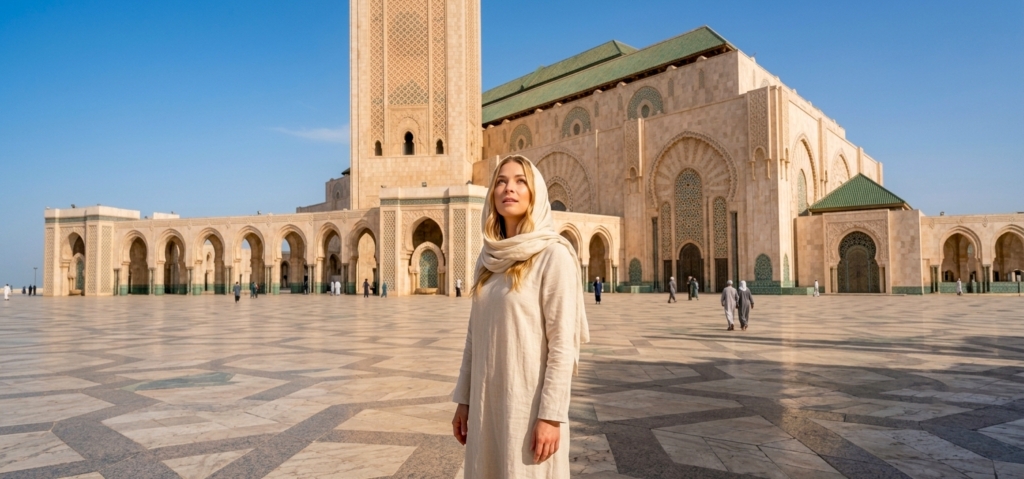
The Hassan II Mosque stands on a promontory jutting into the Atlantic, and it is the thing that silenced me. The third largest mosque in the world, completed in 1993, with a minaret reaching 210 metres — the tallest religious structure on earth. The building was designed so that worshippers inside can see the ocean through a glass floor, because the Quran says God’s throne was built on water. Twenty-five thousand worshippers pray inside. Another eighty thousand can fit in the courtyard. I stood on the esplanade with the Atlantic wind pulling at my clothes and the minaret disappearing into low cloud and felt the same thing I felt at the Parthenon, at the Sagrada Família, at Meteora — the moment when a building stops being architecture and starts being an argument about what humans are capable of when they commit without reservation.
I walked through the old medina — tighter and rougher than Rabat’s, louder, less polished — and then into the Art Deco centre of the Ville Nouvelle. Casablanca was rebuilt by the French during the protectorate era in the early 20th century, and the downtown is a catalogue of Art Deco, Moorish Revival, and Brutalist architecture layered on top of each other. Boulevard Mohammed V is lined with buildings that could be in Paris or Havana, white façades with geometric balconies, crumbling in places, elegant in others. Casablanca is Morocco’s economic capital — the financial centre, the largest city, the port that handles most of the country’s trade — and it carries that weight the way industrial cities do. Not gracefully. Functionally. The beauty is between the cracks, not on the surface.
I ate pastilla — the savoury-sweet pastry layered with pigeon, almonds, cinnamon, and icing sugar that sounds impossible and tastes inevitable. The combination of meat and sweetness should clash but doesn’t because Moroccan cuisine understood centuries ago that the boundary between savoury and sweet is a suggestion, not a wall. I ate it in a restaurant in the Habous Quarter — the “new medina,” built by the French in the 1930s as a planned version of traditional Moroccan urban design, which sounds like a contradiction but works because the proportions are right. The alleys are narrow. The courtyards breathe. The artisan shops sell leather and brass and spices without the pressure of the old medinas. Habous is a copy that became genuine through use, the way a cover song sometimes becomes more famous than the original.
Three cities. One locked itself in the Rif Mountains for four centuries and preserved an Andalusian world that Spain itself destroyed. One left its greatest building unfinished and made the incompleteness the point. One became famous for a film it had nothing to do with and then built a mosque on the ocean that made the fiction irrelevant.
Morocco doesn’t explain itself to visitors. It presents. You either stay long enough to understand or you leave with the surface, which is beautiful enough that most people don’t realise they missed the structure underneath.
The Mediterranean chapter closes here. Africa, Europe, Islam, Christianity, Phoenicians, Romans, Moors, Andalusians, French — every current that ever crossed this sea washed up on these shores and Morocco held them all without losing itself.
Season 1 ends. But the journey doesn’t. And the blue walls of Chefchaouen are the colour I see when I think about what it means to protect something by closing the door.
Beyondia
Trusted Travel CompanionReal digital nomad. I travel. I learn. I grow.
What about you? Where are you going?