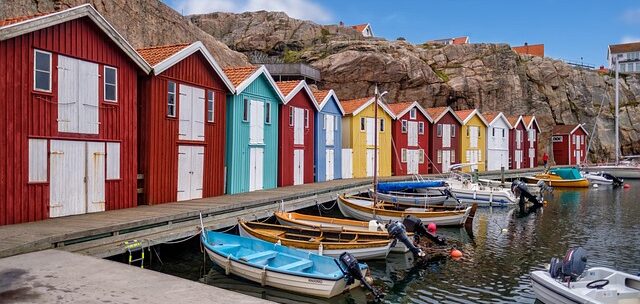
Route: Kiruna → Luleå → Haparanda Total distance: approximately 450 km Driving time: approximately 5.5–6.5 hours (spread over 3–5 days) Road: E10 southeast to Luleå, E4 northeast to Haparanda Currency: Swedish Krona (SEK). 1 EUR ≈ 11–12 SEK Driving side: Right Best months: Mid-June to August (midnight sun, warmth); December–March (northern lights, snow, Icehotel winter season)
The Shape of This Route
This route does not follow a coast. It crosses Swedish Lapland from the mountains to the sea, tracing the E10 from Kiruna — the city that is being physically moved — southeast through boreal forest to Luleå on the Gulf of Bothnia, then northeast along the coast to Haparanda, where Sweden ends and Finland begins without anyone bothering to build a wall between them.
The three stops form a sequence about impermanence and persistence. Kiruna is a city being dismantled and rebuilt three kilometres east because the mine underneath it will not stop expanding. Luleå’s Gammelstad is a church town that has stood unchanged for over five centuries because the people who built it left it exactly as it was. Haparanda is a border that functions as a seam — two countries, two languages, two time zones, one shared main street. Something moving, something staying, something merging.
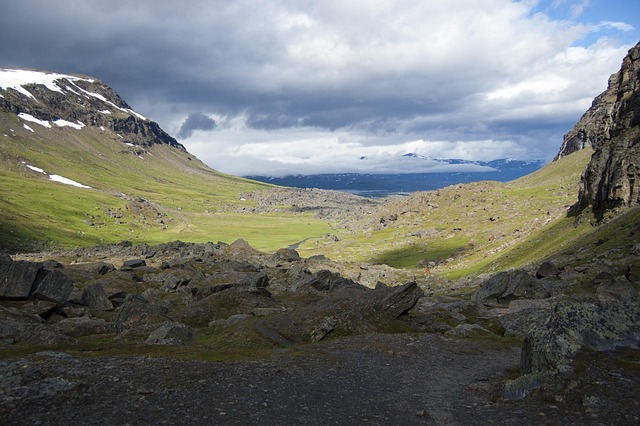
The landscape between them is birch forest, frozen rivers in winter, mosquito clouds in summer, and the kind of emptiness that is not empty at all but full of things that do not require buildings to exist: reindeer, aurora, the Torne River running 520 km from the mountains to the sea, and the silence that Swedish Lapland holds the way other places hold noise.
Kiruna — The City That Moves
Kiruna is the northernmost city in Sweden, 145 km above the Arctic Circle, and it is being moved.
The LKAB iron ore mine beneath Kiruna has been operating since the 1890s and produces approximately 80% of Europe’s iron ore. As the mine has expanded deeper — now approaching 1,365 metres — the ground above has begun to subside. Cracks appeared in roads and buildings. In 2004, LKAB and the municipality announced that the city centre would need to relocate approximately three kilometres east to avoid collapse. The project is expected to continue through 2035, at an estimated cost of 22.5 billion SEK (~€2 billion). Approximately 6,000 people and 3,000 homes are affected.
Buildings are being demolished and rebuilt. Some are being physically moved — placed on hydraulic platforms and driven along specially widened roads to new foundations. In August 2025, the Kiruna Church — a 113-year-old wooden structure weighing 672 tonnes, one of Sweden’s largest wooden buildings, designed with elements inspired by Sámi lavvu tents and Norwegian stave churches — was transported whole on 120 wheels across five kilometres to the new city centre. The move took two days. Thousands of visitors came to watch. The church is expected to reopen to the public in late 2026.
The new Kiruna is denser, more modern, and deliberately designed. The old Kiruna — the one that grew organically around the mine for a century — is being erased. There is no way to describe this without ambiguity: it is simultaneously a rescue and a loss, a pragmatic solution and an act of architectural grief. The residents support it because the mine is their economy. They mourn it because the streets they grew up on are being flattened. Both feelings are correct.
The Icehotel is in Jukkasjärvi, approximately 17 km from Kiruna. It was the world’s first hotel built from ice, founded in 1989 on the banks of the Torne River. Each winter, the seasonal Icehotel is rebuilt entirely from ice and compacted snow — rooms, bar, chapel, and art suites individually sculpted by international artists. It melts in spring and is reconstructed the following December. In 2016, Icehotel 365 opened — a permanent structure cooled by solar panels, allowing year-round visits to ice art suites. Overnight stays in the cold rooms include thermal sleeping bags on ice beds; temperatures hover around -5°C. It is extraordinary, uncomfortable, and exactly what it promises to be.
Eat souvas — reindeer meat lightly smoked over an open fire, a Sámi staple. Drink coffee. Swedish Lapland runs on coffee the way the Mediterranean runs on olive oil: it is infrastructure, not beverage.
Stage One — Kiruna to Luleå
Distance: approximately 330 km Driving time: 4–4.5 hours via E10
The E10 runs southeast from Kiruna through boreal forest — dense pine and birch, broken by rivers and the occasional small settlement. The road is well-maintained and quiet. In winter, it is dark, icy, and requires full winter equipment — studded tyres are mandatory from December through March. In summer, the midnight sun means 24-hour daylight and the landscape turns from white to an almost hallucinatory green.
The Torne River appears along parts of this route — one of the last major unregulated rivers in Europe, running from the Scandinavian mountains to the Gulf of Bothnia. It forms the border between Sweden and Finland for much of its length and connects every stop on this route: the ice for the Icehotel is harvested from it, the rock carvings in Kiruna’s hinterland were made by people who lived along it, and the border crossing at Haparanda sits at its mouth.
Fill the tank before leaving Kiruna. Services between Kiruna and Gällivare (approximately 100 km) are limited. After Gällivare — another mining town, smaller than Kiruna, with its own relocation challenges — the road continues southeast through Boden to Luleå on the coast.
Luleå — The City That Stays
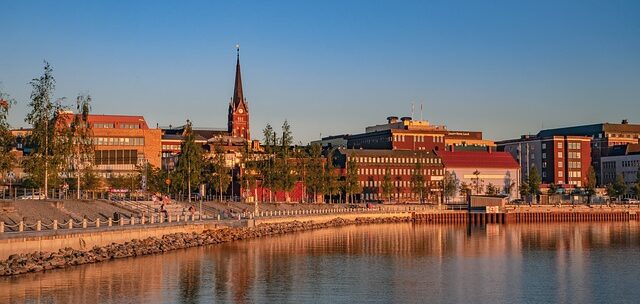
Luleå sits at the mouth of the Lule River on the Gulf of Bothnia, and it exists in its current location because its original location became unusable. In the seventeenth century, the land around the original settlement rose — post-glacial rebound, the earth still adjusting to the weight of ice that melted ten thousand years ago — and the harbour silted up. The commercial centre relocated to the coast and became modern Luleå. The original settlement stayed where it was.
That original settlement is Gammelstad — the Church Town — and it is the reason to come to Luleå.
Gammelstad Church Town is a UNESCO World Heritage site consisting of 404 red wooden cottages clustered around a fifteenth-century stone church. The cottages were not permanent residences. They were built by parishioners who lived too far away to travel to church and return home in a single day — in a parish the size of a small country, with distances measured in days rather than kilometres. They came for Sunday services, for festivals, for weddings and funerals, and they stayed in their cottage overnight, and then they went home.
The cottages are uniformly painted in Falu red — the same red as the rest stop where this route’s Evoke began. They are tiny, unheated, functional. Many still lack running water or electricity. The exteriors cannot be altered. The interiors are private — some are still owned by families, some are rented for cultural events, a few are open to visitors. The stone church at the centre dates to the early 1400s and remains in active use.
What makes Gammelstad remarkable is not any individual building but the collective discipline of preservation. 404 cottages, unchanged for centuries, maintained by a community that decided the correct amount of change was none. In a country where Kiruna is being physically moved to accommodate the future, Gammelstad is physically held in place to accommodate the past. Sweden contains both impulses simultaneously and does not consider them contradictory.
In winter, Luleå’s archipelago freezes. The city maintains an ice road (isbana) — Sweden’s longest — across the frozen sea, open to cars, pedestrians, and ice skaters when conditions permit, typically January through early April. The ice must be at least 30 cm thick. When it opens, locals drive across the frozen bay to reach islands that are accessible only by boat in summer. It is the most Swedish thing imaginable: practical, understated, and built on the assumption that nature cooperates if you respect it and prepare correctly.
Eat Kalix löjrom — vendace roe from the rivers around Kalix, near Luleå. It was the first Swedish food product to receive the EU’s Protected Designation of Origin. Small, pink, briny, served on toast with sour cream and red onion. It is caviar without the performance.
Stage Two — Luleå to Haparanda
Distance: approximately 120 km Driving time: 1.5 hours via E4
The E4 follows the coast northeast from Luleå along the Gulf of Bothnia toward the Finnish border. The landscape flattens. The birch trees thin. The river mouths widen. In winter, this stretch is subject to ice fog — a dense, ground-level fog that forms when extremely cold air meets open water or warmer road surfaces. Visibility can drop to near zero in minutes. Drive with headlights on, speed reduced, and full winter tyres. In summer, the road is flat, fast, and unremarkable until Haparanda appears at the mouth of the Torne River.
Haparanda — Where Sweden Becomes Finland
Haparanda is not a city that ends. It is a city that continues — across a bridge, over the Torne River, into Tornio, Finland. The two towns function as a single community divided by a river, a national border, and a one-hour time zone difference. Sweden is in CET; Finland is in EET. At the border square (Vittulajänkä on the Swedish side, Rajalla on the Finnish side), you can stand with one foot in each country and your watch confused.
There is no passport control. No barrier. No fence. The Schengen zone merges the two towns into a single pedestrian and commercial space. Residents shop on whichever side has the better prices — Finnish alcohol regulations differ from Swedish ones, Swedish groceries differ from Finnish ones, and the two populations have been performing this cross-border arbitrage for centuries. The IKEA Haparanda-Tornio — the world’s northernmost IKEA — serves both countries from a single building, with signage in both languages and meatballs that taste the same regardless of which time zone you’re eating them in.
Haparanda’s history is more layered than its current modesty suggests. During both World Wars, this border crossing was a critical passage for refugees, intelligence, and clandestine commerce — spies, war profiteers, and desperate families all passed through the same streets that now contain a shared supermarket and a bilingual tourist office.
The Torne River runs beside the town and empties into the Gulf of Bothnia. It is the same river that provides the ice for the Icehotel 450 km upstream. The river connects the entire route — mountains to sea, Kiruna to Haparanda, the moving city to the merged city — and it crosses the border without noticing.
From Haparanda, you cross the bridge into Tornio. Your clock moves forward one hour. The road signs switch from Swedish to Finnish. The Torne River is now on your left instead of your right. Finland begins.
Practical Notes
Driving: Sweden drives on the right. Roads in Swedish Lapland are well-maintained but often two-lane. Speed limits are typically 90–110 km/h on major routes, 50 km/h in towns. Winter tyres are mandatory December 1–March 31. Studded tyres are permitted and recommended. Reindeer on roads are a genuine hazard — they are semi-domesticated, owned by Sámi herders, and have absolute right of way. If you hit one, you are legally required to report it.
Winter driving advisory: Between Luleå and Haparanda, ice fog can form without warning. Temperatures can drop below -25°C. Carry extra fuel, warm clothing, a phone charger, and water. The car rental should include an engine block heater — in Swedish Lapland, cars are plugged in when parked to prevent the engine from freezing.
Season: Two profiles. Summer (June–August): midnight sun, warm (15–25°C), mosquitoes (bring repellent — this is not optional), 24-hour daylight, Icehotel 365 open. Winter (December–March): polar night or minimal daylight, northern lights, snow, cold (-10°C to -30°C), seasonal Icehotel open, ice road in Luleå, aurora photography.
Cost: Sweden is expensive but not as extreme as Norway. Accommodation in Kiruna and Luleå runs €100–200 per night. The Icehotel cold room experience costs significantly more — budget €300+ per night for the seasonal art suites. Restaurant meals €20–35. Coffee €4–5. Fuel approximately 18–20 SEK per litre.
Sámi culture: Kiruna and its surroundings are within Sápmi. The Sámi are the indigenous people of Northern Scandinavia. Reindeer herding, traditional foodways, and the Sámi language (Meänkieli is also spoken in the Torne Valley) are living practices, not museum exhibits. The Icehotel partners with local Sámi operators for cultural experiences. Respect herding routes, ask permission before photographing traditional activities, and engage with Sámi-run businesses directly.
The Finland turn: From Haparanda, cross the bridge to Tornio. No border control. Your phone may switch networks — check roaming. Finland is one hour ahead. The E8/E4 becomes Finnish Route 29 heading north into Finnish Lapland. The road to Rovaniemi (Santa Claus Village, Arctic Circle crossing) is approximately 130 km north of Tornio.
What This Route Is Really About
This route is about what moves and what stays.
Kiruna is being moved — physically, building by building, street by street — because the ground beneath it is hollow and the economy that hollowed it out is the same economy that pays for the relocation. The city accepts this with a pragmatism that looks, from the outside, like either courage or resignation, and from the inside looks like lagom: the correct response to an impossible situation is the response that is exactly enough. Not dramatic. Not passive. Sufficient.
Gammelstad stays. 404 cottages in Falu red, unchanged for five centuries, maintained by a community that understood that the correct amount of modification was zero. The church town was not preserved because someone declared it a heritage site. It was preserved because no one saw a reason to change it. The UNESCO designation came later — a recognition of something the locals had already decided.
Haparanda merges. Two countries, two languages, two currencies, two time zones, one main street. The border exists on paper and in clocks and nowhere else. The river flows through both and belongs to neither.
Move. Stay. Merge. Three verbs that describe three ways a place can respond to time, and Sweden contains all three within 450 km of Arctic highway. The coffee is the same at every stop.