🌐 Around the World with Beyondia 🧵 Nordic & Western Europe Region 🪡 Episode 76: Abisko
Abisko is a small village in Kiruna Municipality in Norrbotten County, in the Swedish Arctic region of Norrbotten (part of the broader traditional Sápmi region extending across northern Sweden, Norway, Finland, and Russia). The permanent population is approximately 85 residents, though the specific tourism infrastructure and seasonal workforce increase the effective population substantially during peak tourism periods. The village sits at approximately 68.35 degrees north latitude — approximately 200 kilometres north of the Arctic Circle (66°33′N) — on the northern shore of Torneträsk, Sweden’s sixth-largest lake and one of the specific glacial lakes shaped by Ice Age erosion of the Scandinavian Mountains. Abisko is approximately 90 kilometres west of Kiruna (the specific Arctic mining town, one of the major urban centres of Swedish Lapland) and approximately 100 kilometres east of Narvik in Norway (accessible via the specific Ofotbanen/Malmbanan railway, one of Europe’s northernmost regular passenger rail routes).
Abisko Geographical Position
The specific Arctic latitude produces the standard extreme daylight cycle. Midsummer brings continuous midnight sun from approximately 30 May to 13 July — 45 days when the sun does not set. Midwinter brings polar night from approximately 11 December to 1 January — 22 days when the sun does not rise above the horizon (though civil twilight provides ambient light for several hours around midday). The Northern Lights viewing season extends from approximately mid-September through late March, with peak activity typically between October and February.
The specific meteorological character of Abisko is what distinguishes it from most other Arctic locations. Abisko sits in a specific rain shadow created by the topography of the surrounding mountains. Weather systems approaching from the west across the Norwegian Sea encounter the specific Scandinavian Mountains (Skanderna in Swedish, Skanderna extending along the Norwegian-Swedish border with peaks reaching 2,000 metres), where they release most of their moisture as precipitation on the western Norwegian slopes. By the time weather systems reach Abisko on the eastern side of the mountain range, they have lost substantial moisture and generally produce clear or partly clear conditions. Weather systems approaching from the south encounter the mountains around Torneträsk lake, producing similar rain-shadow effects. The specific annual precipitation at Abisko is approximately 300 millimetres — one of the lowest annual precipitation totals anywhere in Europe, and dramatically lower than surrounding Arctic locations (Narvik on the Norwegian coast receives approximately 830 millimetres; Kiruna receives approximately 500 millimetres; most Arctic Norwegian coastal locations receive 700-1,500 millimetres annually).
The specific consequence for Northern Lights viewing is substantial. Abisko has approximately 200-220 clear or partly clear nights per year during the auroral viewing season, versus approximately 100-150 clear nights at most other Arctic Norwegian, Swedish, and Finnish locations at similar latitude. The specific auroral zone activity itself is broadly uniform across the region — the specific solar wind interactions that produce the aurora do not distinguish between Norwegian coastal and Swedish inland locations at similar geomagnetic latitude. But the specific probability of actually seeing the aurora, given that it is active, is dramatically different. Abisko’s specific combination of position within the auroral oval, high probability of clear skies, and specific dark-sky protection (minimal light pollution, no significant urban centres within 90 kilometres) has established the village as one of the most reliable Northern Lights viewing destinations on Earth.
Abisko Aurora Sky Station
The specific Aurora Sky Station (Aurora Sky Station) at Abisko is one of the primary purpose-built Northern Lights viewing facilities in Europe. The specific station was opened in 2003 on the summit of Mount Nuolja (Njulla in Sámi), at approximately 900 metres elevation, accessible via a specific chairlift that operates during evening viewing hours from October through March. The specific station includes viewing platforms, a warm indoor observation lounge, a small exhibition on auroral physics, a restaurant offering Nordic cuisine, and specific guided programmes for auroral photography and interpretation. The chairlift ride to the station itself takes approximately 20 minutes, providing views across Torneträsk lake and the surrounding mountains during ascent and descent. The specific facility has been extensively documented in international media coverage of Northern Lights tourism, and has become one of the primary Abisko tourism draws.
Beyond the specific Aurora Sky Station, Northern Lights viewing at Abisko is available from essentially any location in the village during clear nights, and from specific hiking routes around the village. The specific STF Abisko Turiststation (Swedish Tourist Association Abisko Tourist Station) — the primary hotel and hostel complex in Abisko, operated by the Swedish Tourist Association since 1902 — provides accommodation for approximately 300 guests and organizes specific guided Northern Lights excursions to specific viewing locations selected for optimal dark sky and horizon views. Multiple additional accommodation providers have developed across the past 20 years to meet the specific tourism demand.
Abisko National Park
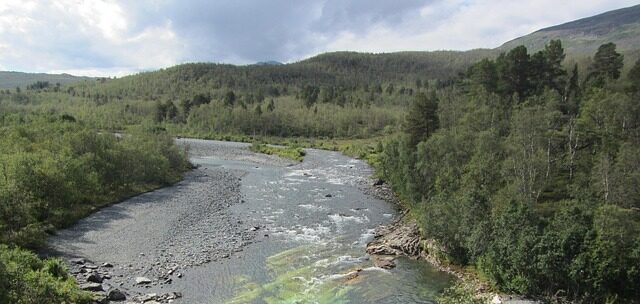
Abisko National Park (Abisko nationalpark) was established in 1909 as one of Sweden’s first national parks, in the same 1909 legislation that established nine Swedish national parks simultaneously — the earliest formal national park protection anywhere in Europe. The specific park covers approximately 77 square kilometres extending north from Torneträsk lake into the specific mountain landscape of the Scandinavian Mountains. The specific park includes the Abisko Canyon (Abiskojåkka canyon, a specific 20-metre-deep river canyon carved by the Abiskojåkka river through Precambrian bedrock), the specific hiking terrain of Mount Nuolja and surrounding peaks, the specific birch forest zone (with substantial mountain birch forests at the lower elevations transitioning to Arctic tundra above the treeline), and the specific Torneträsk lake shoreline. The specific park is home to approximately 400 documented plant species (including specific rare Arctic-alpine flora, one of the reasons for the 1909 protection), specific wildlife including reindeer, elk, brown bears, wolverines, Arctic foxes, and specific bird species including ptarmigan, snowy owls, and specific migratory species.
The specific Kungsleden (King’s Trail) is the primary long-distance hiking route in Sweden, extending approximately 440 kilometres from Abisko south through Swedish Lapland to Hemavan in Västerbotten County. The specific trail was established in stages beginning in 1900, with the specific Svenska Turistföreningen (Swedish Tourist Association) developing marked routes, mountain huts (fjällstuga), and specific hiking infrastructure across the 20th century. The specific complete Kungsleden route requires approximately 30 days of walking for a through-hike, with substantial elevation change, specific river crossings, and specific mountain passes. Most hikers complete specific sections of the trail rather than the whole route — the specific northern section from Abisko to Nikkaluokta (approximately 105 kilometres, typically 6-8 days) is the most-hiked section and passes through some of the specific most dramatic mountain scenery in Sweden, including approach to Kebnekaise (2,097 metres, Sweden’s highest mountain).
The specific Kungsleden hut system provides marked accommodation approximately every 15-20 kilometres along the route, operated by the Swedish Tourist Association and specific local partners. The specific huts range from basic shelter with wood-burning stoves and outdoor facilities to more substantial mountain lodges with kitchen facilities, showers, and meal service. The specific hut system enables hikers to complete the route with lightweight equipment, without needing to carry tents or extensive food supplies. The specific pattern has been substantially influential across European long-distance hiking infrastructure development.
The specific Malmbanan/Ofotbanen railway — the iron ore railway connecting Kiruna to Narvik on the Norwegian coast — passes through Abisko and provides the primary transport access to the village. The specific line was constructed 1898-1902 to transport iron ore from the Kiruna mines to the ice-free Norwegian Atlantic port of Narvik (Swedish Baltic ports were seasonally frozen and could not support year-round shipping). The specific completion in 1902 was one of the substantial European engineering achievements of the early 20th century — the specific line crosses the Scandinavian Mountains at the border, includes the specific tunnels and viaducts required to navigate the mountain terrain, and continues to operate as one of the world’s most important iron ore railways. Regular passenger service on the Malmbanan is provided by SJ (Swedish State Railways) and Vy Tåg (Norwegian passenger operator), with specific trains stopping at Abisko östra (eastern station, closer to the village centre) and Abisko turiststation (western station, closer to the STF hotel complex). The specific train journey from Stockholm to Abisko takes approximately 17-18 hours via overnight sleeper service — one of Europe’s specific classic long-distance rail journeys.
The specific Sámi cultural presence in the Abisko region reflects the broader Swedish Sápmi context. The specific Sámi are the Indigenous people of the traditional Sápmi region, and specific Sámi communities in the Abisko region traditionally practiced reindeer herding using the specific mountain grazing lands that now include the National Park. The specific Sámi name for Abisko is Ábeskovvu, and specific Sámi place names remain in use across the region. The specific Talma sameby (Sámi village/reindeer herding community) has traditional grazing rights across the Abisko region and continues to conduct reindeer herding in the area. The specific Swedish government’s approach to Sámi rights has developed similarly to but differently from the Norwegian approach documented at Alta Ep 74 — Sweden established the Swedish Sámi Parliament (Sametinget) in 1993 (four years after Norway’s 1989 establishment), and has ratified specific Indigenous rights instruments including the UN Declaration on the Rights of Indigenous Peoples (2007). Sweden has not ratified ILO Convention 169 (which Norway ratified in 1990), representing one of the specific ongoing differences between Swedish and Norwegian Indigenous rights frameworks.
The specific climate research infrastructure at Abisko is substantial and internationally significant. The Abisko Scientific Research Station (Abisko naturvetenskapliga station) was established in 1913 as one of the first permanent Arctic research stations in Europe, and continues to operate today as one of the primary European Arctic climate change research facilities. The specific station has produced one of the longest continuous meteorological, biological, and ecological data sets in the European Arctic — approximately 110 years of continuous observations documenting specific climate change impacts on Arctic ecosystems. The specific research has documented substantial changes: mean temperature at Abisko has increased approximately 2.5°C since 1913 (approximately double the global average temperature increase over the same period), specific vegetation zones have shifted upslope, permafrost has retreated substantially, and specific bird and mammal populations have shown documented range shifts. The Abisko research has been substantially referenced in IPCC climate assessments and in specific European climate policy documents. The specific research station is operated by the Royal Swedish Academy of Sciences and hosts approximately 300 visiting researchers annually from institutions across Europe and internationally.
Kiruna — the specific Swedish Arctic mining town approximately 90 kilometres east of Abisko — deserves brief mention because it is the primary urban centre of the Swedish Arctic and one of the more unusual contemporary urban projects in Europe. The specific town of approximately 17,000 residents is currently being physically relocated approximately 3 kilometres east of its original location, because the specific Kiruna iron ore mine (the world’s largest underground iron ore mine, operated by LKAB and producing approximately 27 million tonnes of iron ore annually) has undermined the specific ground beneath the original town centre through 130 years of extraction. The specific relocation began in 2004 and continues through the specific 2030s, involving specific movement of historical buildings (including the specific 1912 wooden Kiruna Church, moved 5 kilometres to its new location in August 2025 as one of the specific largest building relocation projects in European history), construction of a new town centre, and specific transition of the entire community across approximately 30 years. The specific project is one of the substantial contemporary European urban planning experiments.
Contemporary Abisko
Contemporary Abisko combines the specific Northern Lights tourism (approximately 100,000 annual visitors, with substantial concentration during the September-March viewing season), the specific hiking tourism (approximately 50,000 annual visitors during the June-September hiking season), the specific climate research activity (Abisko Scientific Research Station), the specific Swedish Tourist Association infrastructure (the STF Abisko Turiststation as one of the primary Swedish Arctic accommodation facilities), and the specific working village life of the approximately 85 permanent residents. The specific ongoing negotiations of contemporary Abisko life include the tensions common to specific Arctic tourism destinations — rapid growth producing infrastructure pressure, seasonal employment patterns creating specific economic instability outside peak periods, and the specific balancing of tourism development with community sustainability. The specific climate change impacts documented by the Abisko research station are producing specific tangible changes to the local environment — earlier spring melt, later autumn freeze, changes to snow conditions, shifting vegetation zones — that affect both tourism operations (snow-dependent activities are becoming more variable) and the specific traditional Sámi reindeer herding (which depends on specific snow and ice conditions for herd management).
Abisko is one of the demonstrations of how specific microclimatic anomalies can shape human activity patterns across an Arctic region. The specific rain-shadow effect that produces Abisko’s approximately 200-220 clear nights per year is a specific meteorological anomaly created by the surrounding mountain topography — the specific Scandinavian Mountains to the west blocking Atlantic weather systems, the mountains around Torneträsk lake blocking specific Baltic systems, producing one of the driest and clearest-sky locations in the European Arctic. The specific consequence for Northern Lights tourism has been transformative — Abisko has become one of the most-visited Northern Lights destinations in Europe over the past 20 years, drawing approximately 100,000 annual visitors to a village of 85 permanent residents. The specific Abisko National Park established in 1909 was one of the first formal national park protections anywhere in Europe. The specific Kungsleden hiking trail that begins at Abisko extends 440 kilometres through Swedish Lapland and represents one of the substantial European long-distance hiking routes. The specific Abisko Scientific Research Station has documented approximately 110 years of continuous Arctic climate change data, providing one of the primary European Arctic climate change research resources. The specific Malmbanan railway that provides transport access to Abisko was one of the substantial European engineering achievements of the early 20th century, and continues to operate as one of the world’s most important iron ore railways. And the specific Sámi cultural presence in the region reflects one of the ongoing Indigenous cultural continuities in Europe.
Some Northern Lights destinations market themselves on latitude. This one succeeds because of weather — the specific rain shadow that keeps clouds elsewhere while auroral activity proceeds as it does across the rest of the Arctic. Some remote Arctic villages have small permanent populations. This one has 85 residents supporting approximately 150,000 annual tourism visitors. Some national parks are marketed heritage. This one is one of Europe’s first formal national park protections, established in 1909 alongside eight other Swedish parks in the specific earliest national park legislation on the continent. Very few European Arctic locations carry this specific combination of meteorological anomaly, tourism infrastructure, long-distance hiking access, and 110-year continuous climate research documentation.
The journey continues east across the Swedish Arctic. The next stop is one of the primary Sámi cultural centres in Sweden — a specific inland town of approximately 3,000 residents at the Arctic Circle in Norrbotten County, home to the annual winter market that has operated continuously since 1605, the specific Sámi museum documenting Swedish Sápmi cultural heritage, and one of the specific centres of contemporary Sámi political and cultural production.
Nine regions. One hundred and twenty destinations.
Where are you going?

Beyondia
Trusted Travel CompanionReal digital nomad. I travel. I learn. I grow.
What about you? Where are you going?