Around the World with Beyondia 🧵 Nordic & Western Europe Region 🪡 Journal 25
Lofoten. Alta. Nordkapp. An archipelago that looks like a fantasy someone forgot to make fictional, a fjord where humans carved the sky into rock seven thousand years ago, and a cliff at the top of Europe where the continent surrenders to the Arctic Ocean.
Lofoten. The Arctic was not what I was told.
Everything I’d heard about the far north prepared me for severity. Cold. Dark. Sparse. Endurance. And those things are true — in winter. But I arrived in the Norwegian summer, when the Arctic breaks every expectation, and what I found was light that doesn’t end, mountains that rise from the sea like something geological that forgot its manners, and a silence so complete that my own footsteps sounded like an intrusion.
Lofoten hit me the way Venice did — a place that shouldn’t exist but does, and the impossibility is the whole point.
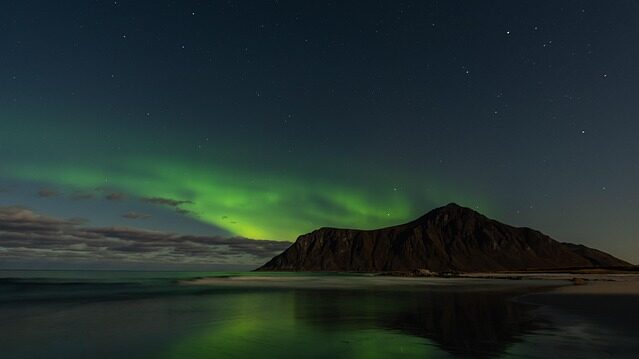
The archipelago stretches like a spine off the northwestern coast of Norway, above the Arctic Circle, a chain of islands connected by bridges and tunnels and the stubbornness of people who decided that living on vertical rock in the Norwegian Sea was not a problem but an address. The mountains don’t rise gradually. They erupt from the waterline — granite walls, a thousand metres tall in places, sheer, jagged, snow-capped even in summer, reflected in water so still and clear that the reflection is more detailed than the original.
I drove across the islands and every bridge crossing felt like entering a new painting that the previous one hadn’t prepared me for. The E10 — the road that connects the archipelago — winds between peaks, along fjords, through one-lane tunnels blasted through rock, past beaches that have no business being here. Haukland Beach. Uttakleiv Beach. White sand, turquoise water, Arctic mountains rising directly behind. If you showed someone a photograph without context, they’d guess the Caribbean. Then they’d see the snow on the peaks and the temperature on the thermometer and their brain would refuse to reconcile the two. Lofoten is a place where geography contradicts itself and doesn’t apologise.
I stopped in Reine — a fishing village on the southern tip of Moskenesøya that appears on every list of the most beautiful villages in the world, and for once every list is right. Red rorbuer — traditional fishermen’s cabins built on stilts over the water — clustered at the base of mountains so steep and so close that the village feels like it’s being held in two granite palms. The harbour was full of boats. Stockfish — cod dried on wooden racks in the open air, a preservation method that hasn’t changed since the Viking Age — hung in rows along the shore, headless and stiff, drying in the wind. Lofoten has been exporting dried cod since the 12th century. The fish trade built these villages, funded the merchants of Bergen, fed the Mediterranean, and connected a handful of Arctic fishing families to the global economy six hundred years before globalisation had a name.
I hiked Reinebringen — the ridge above Reine — and the trail was steep enough that my hands were on the ground for the final section. Stone steps have been laid in recent years to control erosion, but the climb is still a negotiation between your legs and the mountain’s opinion of your ambition. At the top, the view was the kind that makes you stop thinking in words. Reine below, miniaturised, the rorbuer like red drops on the waterline. The fjord stretching south, flanked by peaks. The Norwegian Sea opening to the west, flat and enormous, the horizon line so clean it looked drawn. I sat on the ridge and the wind was cold and the sun was warm simultaneously — the Arctic’s favourite contradiction — and I stayed until I ran out of reasons to come down, which took a while.
I slept in a rorbu in Nusfjord — one of the oldest and best-preserved fishing villages in Norway, a handful of red and yellow buildings around a harbour so small that the boats nearly touch the cabins. The rorbu was built in the 19th century, renovated without losing the proportions — low ceiling, thick walls, a view from the window of nothing but water, rock, and the wooden racks where cod once hung. At midnight, I walked outside and the sun was sitting on the mountains across the fjord, golden, low, casting shadows that stretched across the water like fingers reaching for the opposite shore. The silence was not silence — I could hear the water lapping against the stilts beneath my cabin, a seabird calling from somewhere I couldn’t see, and the creak of wood that has been standing in salt air for over a hundred years. Lofoten at midnight is the most beautiful version of Lofoten, and every version of Lofoten is already more than you’re ready for.
I ate bacalao in a restaurant built into a converted fish factory — salt cod in a tomato and olive sauce, a dish that exists in Lofoten because the dried fish went to Portugal and Spain and the recipe came back, the same circular trade I’d seen in Ålesund. The fisherman who caught the cod and the cook who prepared the bacalao were part of a transaction that has been looping between the Arctic and the Mediterranean for five centuries. I also ate fresh cod tongues — torsketunger — pan-fried in butter, a delicacy harvested by children in Lofoten as their first job, a tradition that still holds. The tongue is tender, almost sweet, and the fact that a child probably cut it from the fish makes the eating feel like participation in something generational rather than merely culinary.
Alta was where the timeline broke open.
I drove north and east from Lofoten, inland through Finnmark — Norway’s northernmost and largest county, a landscape so vast and so empty that the concept of a county feels absurd. Treeless plateau. Reindeer appearing at the roadside, belonging to Sámi herders whose families have followed these animals across this land for thousands of years. The Sámi are the indigenous people of northern Scandinavia, and Finnmark is the heartland of their culture — their language, their joik singing, their reindeer herding economy, and their relationship with a landscape that most people would consider uninhabitable. The Sámi looked at this plateau and saw home. Everyone else looked at it and kept driving.
Alta sits at the head of the Altafjord, and the town itself is unremarkable — functional, modern, spread out along the water. But at the edge of town, on a series of flat rock surfaces at Hjemmeluft, people carved images into the stone between 7,000 and 2,000 years ago, and those images are still there.
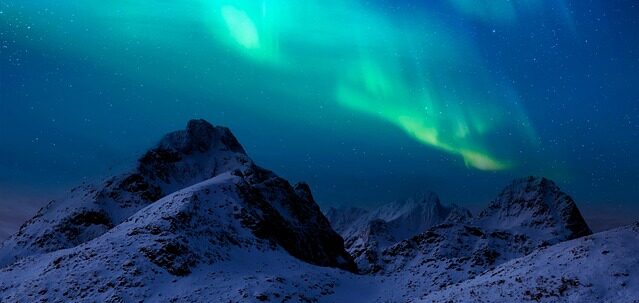
The Alta rock carvings — a UNESCO World Heritage Site — are the largest collection of prehistoric rock art in northern Europe. Over six thousand individual figures carved into smooth stone surfaces: reindeer, bears, boats, fish, human figures, fences, geometric patterns, and scenes of hunting, fishing, and ceremony. I walked the boardwalk path that winds between the carved panels and the images appeared beneath my feet and beside the trail, filled with red ochre paint to make them visible, each one a message from someone who stood on this exact rock thousands of years before any written language existed in Scandinavia.
One panel showed a man on skis following a reindeer — the oldest known depiction of skiing in the world. Another showed a boat filled with figures, crossing what might be the fjord I could see from where I stood. Another showed a bear surrounded by hunters in a formation that suggested coordination, strategy, communication. These weren’t decorations. They were records. Someone needed to say something about how they lived, what they hunted, what they saw in the sky, and the only material they had was stone and a harder stone to scratch it with.
I stood in front of a panel showing a figure with arms raised toward what appeared to be the sun or moon — impossible to know which — and the gesture was so human, so recognisably an act of worship or wonder or surrender, that the seven thousand years between us collapsed into nothing. The technology has changed. The tools have changed. The languages have changed. The impulse to look up at the sky and feel something hasn’t changed at all. Orkney’s stones had given me this feeling. Alta’s carvings made it specific. In Orkney, I felt the presence of ancient people. In Alta, I saw what they were looking at.
I ate bidos — a traditional Sámi reindeer stew, slow-cooked with root vegetables — at a restaurant that sourced its meat from a local Sámi herder. The reindeer had grazed on lichen and mountain herbs, and the flavour was unlike any other meat — lean, slightly gamey, mineral, tasting of the plateau itself. The Sámi have been eating this way for thousands of years. The dish isn’t traditional in the way that a recipe in a cookbook is traditional. It’s traditional in the way that breathing is traditional — it’s what you do because you’re here and this is what the land provides.
Then Nordkapp. And the road ended.
I drove north from Alta and the landscape stripped itself to essentials. Rock. Moss. Lichen. Sky. The trees had stopped long ago. The settlements thinned to nothing. The road — the E69 — ran through a tunnel under the sea to the island of Magerøya and then climbed to a plateau where the wind hit the car sideways and the land looked like it had been recently invented and not yet decorated.
Nordkapp — the North Cape — is a 307-metre cliff face that drops vertically into the Arctic Ocean. It is marketed as the northernmost point of Europe, which is technically incorrect — the nearby promontory of Knivskjellodden extends slightly further north — but the claim doesn’t matter. What matters is standing on that cliff.
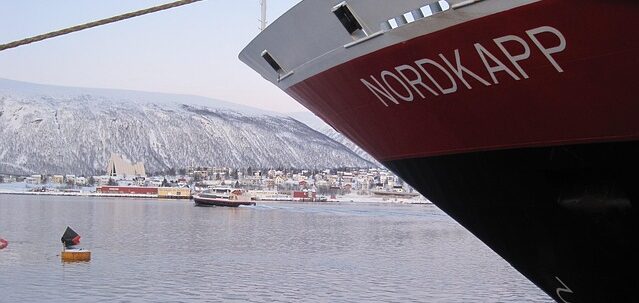
I arrived at midnight. The sun was above the horizon, golden, sitting on the Arctic Ocean like it was resting on a shelf. The cliff edge was marked by a globe sculpture — a metal wireframe of the earth, standing against the sky, the most minimal monument I’ve seen on this journey. Behind me, the continent. Ahead of me, nothing. The Arctic Ocean stretched north toward Svalbard, the North Pole, and a world that has no permanent human inhabitants. The water was dark. The sun was low. The wind was strong enough that I leaned into it and it held me.
I stood there and thought about the journey. Rome to this cliff. The Colosseum to this globe. Two thousand years of European civilisation behind me — cathedrals, mosques, castles, harbours, markets, vineyards, bridges, walls — and ahead of me, only water and ice and the knowledge that the continent had said everything it had to say. This is where Europe runs out of arguments.
A family from Germany stood nearby, taking photographs. A couple from Japan held each other against the wind. A Norwegian man sat on a bench alone, looking north, saying nothing. Nordkapp collects people who need to stand at the edge of something and confirm that the edge exists. It’s not beautiful in the way that Lofoten is beautiful or the way Santorini is beautiful. It’s beautiful in the way that finality is beautiful — the last sentence of a book you didn’t want to end.
The visitor centre — built into the cliff — has a cave chapel, a Thai museum donated by a Thai king who visited in 1907, and a bar where I drank the most expensive coffee of the trip while watching the midnight sun through a panoramic window. The absurdity of drinking coffee inside a cliff at the top of Europe while the sun refused to set was not lost on me. But absurdity is what happens when humans insist on going to places that weren’t designed for them and then building a café.
I drove south from Nordkapp in the small hours and the sun climbed as I descended. The plateau gave way to fjord. The fjord gave way to forest. The forest gave way to road signs and petrol stations and the reassuring mundanity of a country that has domesticated even its most extreme edges. Norway paved a road to the end of Europe and put a gift shop at the top. That’s either a triumph of infrastructure or a comment on human restlessness, and I think it’s both.
Three stops. An archipelago where fishing villages cling to vertical rock in the Arctic Ocean, drying cod on wooden racks the way they’ve done for eight centuries, surrounded by mountains and beaches that belong in a different hemisphere. A fjord where someone seven thousand years ago carved a skier into stone and gave humanity its oldest record of a sport now watched by billions. A cliff where Europe drops into the Arctic and the sun circles without setting and the wind holds you up if you lean into it hard enough.
Norway’s north isn’t the edge of civilisation. It’s the edge of land. Civilisation is already here — it arrived thousands of years ago, scratched its story into the rock, hung fish on wooden frames, and decided that the Arctic was liveable if you were willing to disagree with the climate.
The road doesn’t end at Nordkapp. Roads don’t end. They just stop being paved, and the journey continues on foot, on water, on faith, on the stubborn insistence that there’s always one more thing to see around the next headland.
The Norwegian chapter closes here. But that midnight sun sitting on the Arctic Ocean — patient, golden, refusing to leave — is the image I’ll carry longest. Not because it was the most beautiful thing I’ve seen. Because it was the most still.

Beyondia
Trusted Travel CompanionReal digital nomad. I travel. I learn. I grow.
What about you? Where are you going?