Route: Tangier → Rabat → Casablanca Total distance: approximately 340 km by road Driving time: 3.5–4 hours on the A1 motorway Alternative: Al Boraq high-speed train — Tangier to Casablanca in 2 hours 10 minutes Currency: Moroccan Dirham (MAD). 1 EUR ≈ 10–11 MAD Driving side: Right Best months: March–May, September–November
The Crossing
Everything changes at the water.
The ferry from Tarifa to Tangier Ville takes one hour. One hour between continents. The strait is 14 km at its narrowest point, and on the crossing you can see both coastlines simultaneously — Europe behind you, Africa ahead — for most of the journey. There is no other place on earth where two continents are this close and this different.
Ferries run daily year-round with Baleària and Africa Morocco Link (AML), departing Tarifa from approximately 07:00 to 21:00. Foot passengers pay approximately €40–50 one way. With a car, prices increase significantly — budget €250–350 each way depending on season and vehicle size. Book in advance during summer and around Eid holidays when Moroccan diaspora traffic fills every sailing.
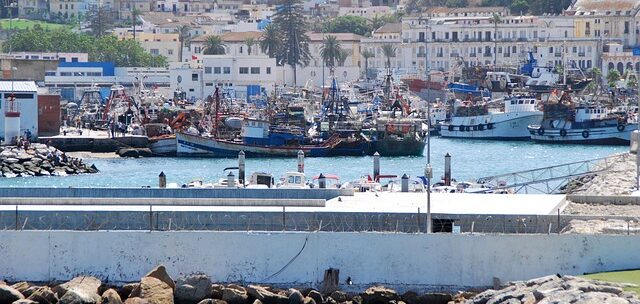
The ferries arrive at Tangier Ville port, which sits in the city centre — a 15-minute taxi ride from the medina. This is not Tanger Med, the industrial port 45 km east used by freight and some Algeciras sailings. You want Tangier Ville. Confirm when booking.
Passport control happens on the ferry. Have your passport ready before docking. EU citizens, Americans, Canadians, Australians, and most Western passport holders enter Morocco visa-free for up to 90 days. You will fill in a disembarkation form on board — they hand them out mid-crossing.
The air changes the moment you step off the gangway. The light has shifted. The sound has shifted. The language on the signs has shifted. You are in Africa.
Tangier — The International Anchor
Tangier spent most of the twentieth century as an International Zone — a city governed by no single country, attracting writers, spies, artists, and exiles who needed a place where the rules were different. That atmosphere has not entirely evaporated. The city still feels like it belongs to the strait rather than to any single nation — a port city where French, Spanish, Arabic, Berber, and English overlap in the same conversation.
The Kasbah sits at the highest point of the old medina, overlooking the strait. The Kasbah Museum (housed in the former Sultan’s palace) offers views across the water toward Spain — on clear days, you can see Tarifa and the wind turbines on the Spanish coast. The medina below is tight, steep, and saturated with the smell of mint, leather, and cedar. Tangier’s medina is smaller and more navigable than Fes or Marrakech — a good first medina if you have never walked one.
Cape Spartel is a 14 km drive west of the city centre — the exact geographical point where the Mediterranean meets the Atlantic. The lighthouse marks the corner. Below it, the Caves of Hercules offer a sea-facing opening that is famously shaped like the outline of the African continent (mirror image, but unmistakable). Entry to the caves is approximately 60 MAD (~€6). Go in the late afternoon when the light pours through the opening and the outline glows against the dark rock.
Drink mint tea — Morocco’s national drink, called “Moroccan whiskey” with affection. It is green tea, fresh spearmint, and an amount of sugar that will surprise you. It is served in small glasses poured from height, and refusing it is refusing hospitality. Eat b’stilla — a layered pastry of pigeon or seafood, almonds, egg, and cinnamon dusted with powdered sugar. Sweet, savoury, and architectural — the dish requires the same precision as zellij tilework.
The Road South — or the Train
You have two options from Tangier to Casablanca, and both are excellent.
Option 1 — Drive the A1. Morocco’s Atlantic motorway runs 340 km from Tangier through Rabat to Casablanca. It is modern, well-maintained, and often runs parallel to the railway line. Tolls are paid at booths — have cash in dirhams ready, cards are not always accepted at every station. Budget approximately 150–200 MAD (~€15–20) for the full Tangier-to-Casablanca toll. Speed limit is 120 km/h. The road passes through flat agricultural land, cork oak forests, and stretches where the Atlantic is visible to the west. Moroccan driving is faster and more assertive than European driving — expect overtaking on both sides, motorcycles without lights, and the occasional donkey cart on the hard shoulder near towns.
Option 2 — Take the Al Boraq. Africa’s first high-speed train, opened in November 2018, connects Tangier Ville to Casa Voyageurs via Rabat Agdal in 2 hours and 10 minutes. The trains are French-built Alstom double-deckers — the same rolling stock as France’s TGV — and they reach 320 km/h on the dedicated high-speed track between Tangier and Kenitra. Hourly departures from 06:00 to 21:00. Second class: 149–224 MAD (~€15–23). First class: 243–300 MAD (~€25–31). Book on the ONCF website (oncf-voyages.ma) or buy at the station — arrive 20 minutes early to claim luggage space. The ride is smooth, air-conditioned, and the fastest way to cover this coast.
If you are driving the full Mediterranean Season route from Spain, you will have the car. If you are flying into Tangier or crossing as a foot passenger, the Al Boraq makes the car unnecessary for this corridor.
Rabat — The Imperial Soul
Rabat is the quieter capital. Morocco’s administrative seat is greener, calmer, and more orderly than Casablanca, Marrakech, or Fes — a city of wide boulevards, whitewashed walls, and gardens that still carry the scent of orange blossom from the Andalusian plantings that arrived with the Moors expelled from Spain.
The Kasbah of the Udayas is the visual centrepiece — a fortress of blue and white alleys overlooking the mouth of the Bou Regreg river and the Atlantic beyond. The colour palette is unmistakable: blue doors, white walls, terracotta pots of geraniums. If you have been to Sidi Bou Said in Tunisia or the villages of the Greek islands, the visual language will be familiar — but the geometry here is Berber, the light is Atlantic, and the gardens inside the kasbah were planted by Andalusian refugees who brought their horticultural knowledge from southern Spain.
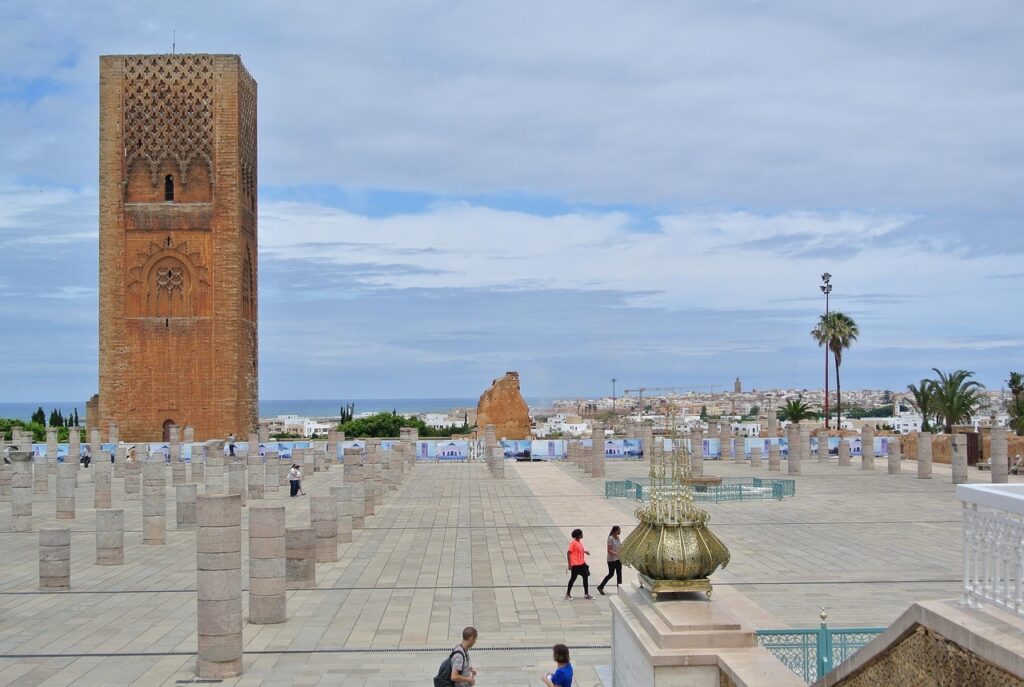
The Hassan Tower stands at the edge of an enormous stone platform — the unfinished minaret of a mosque that was intended to be the largest in the world when construction began in 1195. The sultan died, the project stopped, and what remains is a 44-metre tower surrounded by 348 stone columns marking where the prayer hall’s roof would have been. Opposite it, the Mausoleum of Mohammed V is the aesthetic counterpoint: completed in 1971, covered in zellij tilework and carved plaster, guarded by mounted royal guards in red and white. Entry to the mausoleum is free. The contrast between the unfinished medieval tower and the immaculate modern mausoleum is Rabat in a single frame.
Eat harira — the slow-cooked tomato and lentil soup that is Morocco’s comfort food, traditionally served to break the Ramadan fast but available year-round. Follow it with chebakia — flower-shaped pastry fried, soaked in honey, and sprinkled with sesame seeds. The combination of savoury broth and honey-drenched pastry is the Moroccan equivalent of soup and bread, except nothing about it is simple.
Stage Two — Rabat to Casablanca
Distance: approximately 90 km Driving time: 1–1.5 hours on the A3/A1 Al Boraq: approximately 45 minutes
The final leg runs south along the Atlantic coast. The landscape becomes more industrial as you approach Casablanca — Morocco’s economic engine, its largest city, and the place where the country’s commercial energy concentrates into a single urban mass. Casablanca is not beautiful in the way Rabat is beautiful. It is alive in a way that no other Moroccan city is alive — Art Deco buildings from the French Protectorate era standing next to glass office towers, a port that handles most of Morocco’s international trade, and a waterfront where the Atlantic crashes against a city that turned its face toward the open ocean and never looked back.
Casablanca — The Cinematic End
Casablanca is a working city. Its beauty is architectural rather than picturesque — French Protectorate-era Art Deco in the city centre, wide Hassan II Boulevard running from the port to the commercial district, and in the background, the constant sound and smell of the Atlantic.
The Hassan II Mosque is the building that justifies Casablanca. Completed in 1993, it is one of the largest mosques in the world — capacity for 105,000 worshippers, a 210-metre minaret topped with a laser beam pointing toward Mecca, and a position on a platform extending over the Atlantic Ocean so that worshippers pray above the water. Sections of the floor are glass, revealing the ocean beneath. The retractable roof opens to the sky.
It is one of the very few mosques in Morocco open to non-Muslim visitors. Entry is by guided tour only, outside of prayer times. Tours run at 9:00, 10:00, 11:00 AM and in the afternoon (typically 2:00–4:00 PM, varying by season — check the official schedule). Tickets: 130 MAD (~€13) for adults, purchased on site. Arrive 30 minutes before the tour. Modest dress required — cover shoulders and knees. Shoes are removed at the entrance.
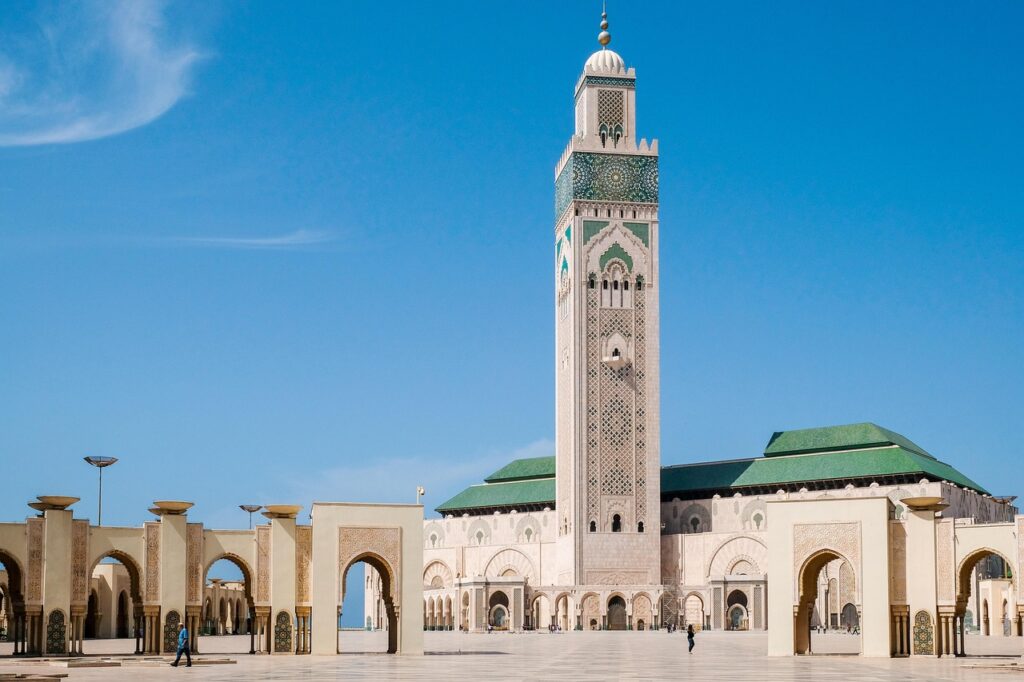
The tour lasts approximately 45 minutes and covers the prayer hall, minaret hall, and ablution rooms. The craftsmanship — carved cedar, zellij tilework, marble, painted plaster — represents 6,000 artisans working for seven years. Regardless of your faith or architecture literacy, this building commands attention. Visit in the morning when the Atlantic light enters through the eastern windows and the glass floor glows.
Rick’s Café exists. The 1942 film Casablanca was shot entirely on a Hollywood studio lot — Humphrey Bogart never set foot in the city. But in 2004, an American diplomat opened a recreation of the fictional café in the medina, complete with the piano, the arches, and the atmosphere. It is a tourist destination built on a myth built on a film built on a play, and it is completely self-aware about this. The cocktails are good. The piano player takes requests. The irony is part of the experience. For the GoBeyondia narrative, Rick’s Café is where the season ends — at the crossroads of myth and reality, in a city named after a white house that became the name the world uses for a place most people have never visited.
Eat couscous — the Friday tradition. In Morocco, couscous is a communal dish served from a shared platter, hand-rolled, steamed three times, and topped with slow-cooked vegetables and meat. Friday couscous is a family institution — restaurants serve it as a weekly special, and the quality on Fridays is higher than any other day. Eat Atlantic sea bass baked in salt at one of the port-side restaurants where the fish arrived that morning. Casablanca’s relationship with the ocean is not decorative — the port feeds the city, and the city feeds from the port.
Practical Notes
Visa: Most EU citizens, Americans, Canadians, Australians, and British passport holders enter Morocco visa-free for up to 90 days. Passport must be valid for at least six months.
Currency: Moroccan Dirham (MAD). ATMs are widely available. Credit cards accepted at hotels, larger restaurants, and the Hassan II Mosque. Cash is essential in medinas, for taxis, small restaurants, toll booths, and most daily transactions. The dirham is a closed currency — it cannot be purchased outside Morocco and leftover dirhams should be exchanged before departure.
Ferries: Book via Baleària (balearia.com), AML, Ferryhopper, or Direct Ferries. The Tarifa–Tangier Ville route is the shortest crossing between Europe and Africa. Alternatively, Algeciras–Tangier Med takes approximately 25–30 minutes but arrives at the industrial port 45 km from Tangier city.
Driving: Morocco drives on the right. Motorway speed limit is 120 km/h. Fuel is affordable (approximately 12–14 MAD per litre for diesel). An International Driving Permit is recommended alongside your national licence. Rental cars are available in Tangier, but if driving from Spain, ensure your rental agreement covers Morocco — many EU rental companies do not permit cross-strait travel. If driving your own vehicle, confirm insurance coverage extends to Morocco.
Al Boraq: Tangier Ville → Rabat Agdal: ~1h 20min. Tangier Ville → Casa Voyageurs: ~2h 10min. Hourly departures. Book at oncf-voyages.ma or at the station. The ONCF website can be unreliable with non-Moroccan credit cards — buying at the station a day ahead is a reliable fallback.
Language: Arabic and Amazigh (Berber) are official languages. French is widely spoken in cities and used in business. Spanish is common in Tangier and the north. English is understood in tourist areas but not universal.
Safety: Morocco is one of the safest countries in Africa for tourists. Standard urban precautions apply in Casablanca. The medinas of Tangier are generally safe but can be disorienting — a guide for your first visit is practical, not just tourist theatre. Agree on the price before accepting any guide’s services.
Tipping: Tipping (pourboire) is expected and appreciated. 10–15% at restaurants. 10–20 MAD for small services. Guides and drivers expect tips.
What This Route Is Really About
This is the exit node. The Mediterranean Season began at a kitchen window in Italy and ends at a mosque built over the Atlantic Ocean in Casablanca. Between those two points, the journey circled an enclosed sea — touching its northern coast, its eastern islands, its southern shore, its centre, and its western edge — before crossing the strait and stepping onto a different continent.
The A1 motorway from Tangier to Casablanca runs parallel to the Atlantic — the first open ocean of the entire season. Every previous body of water was the Mediterranean: enclosed, crossable, historically charted. The Atlantic is not enclosed. It does not end at a visible opposite shore. It opens.
The air changes along this route in a way that marks the transition. Tangier’s air is humid and bustling — Mediterranean and Atlantic winds mixing above a port that has been the gateway between continents since the Phoenicians. Rabat smells of salt spray and orange blossom from the Andalusian gardens — the scent of exile becoming home. Casablanca’s air is industrial, salty, kinetic — the energy of a mega-port city that faces the open ocean and does not look back.

Beyondia
Trusted Travel CompanionReal digital nomad. I travel. I learn. I grow.
What about you? Where are you going?