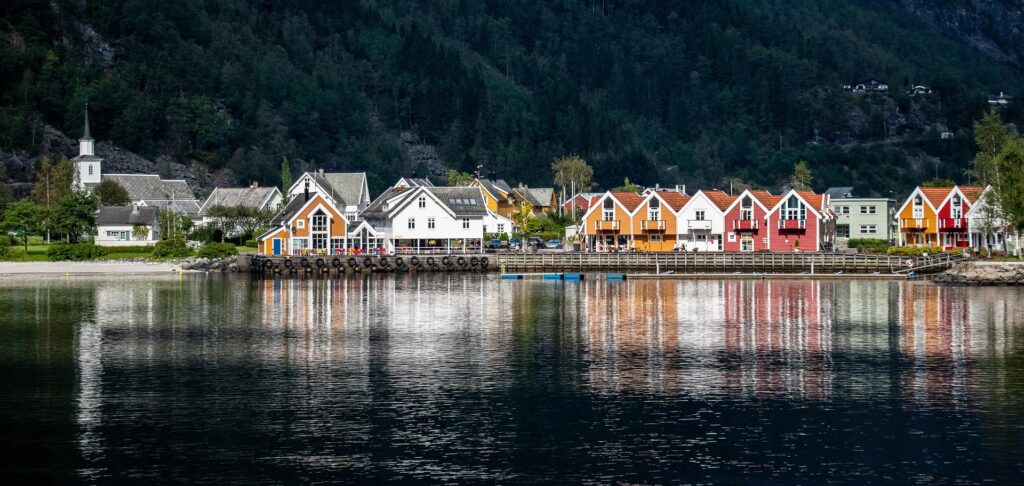
Nordic and Western Europe is not a comfort zone. It is the intellectual engine room of the modern world — the territory that produced the Enlightenment, the Industrial Revolution, the welfare state, and the design principle that the best object is the one you cannot improve by subtraction. Eleven countries share this geography, divided by language and latitude but connected by a shared conviction that ideas matter, that systems can be made to work, and that the journey itself — whether across a Norwegian fjord, an Irish bog, or a Swiss alpine pass — is an argument worth having. The light in the north is extraordinary. The coffee is serious. The silence, when you find it, is absolute.
The Nordic Arc
Iceland stands at the outer edge of everything — the volcanic island where the Atlantic splits along a tectonic fault, where geysers perform on schedule and the aurora borealis treats the sky as its personal canvas. It is the smallest country in Europe with the largest claim on the imagination, a place where geology is still actively writing itself and the entire population fits inside a mid-sized football stadium. [Read the full Iceland Travel Guide →]
Norway is the argument that geography makes best — the fjords of the western coast cutting inland with the precision of something that took ten thousand years to build, the Lofoten Islands defying every reasonable expectation of where mountains and fishing villages are permitted to coexist, the Svalbard archipelago placing polar wilderness within reach of a regular commercial flight. [Read the full Norway Travel Guide →]
Sweden runs the full Nordic proposition from Malmö in the south to Kiruna in the north, from the medieval lanes of Gamla Stan in Stockholm to the summer archipelago of 30,000 islands that begins where the capital ends. It invented flat-pack furniture and the safety match, produced ABBA and Ingmar Bergman, and designed its cities around the principle that public space belongs to everyone. [Read the full Sweden Travel Guide →]
Finland contains more lakes than any country has a reasonable need for — 188,000 of them — and a silence in its forests that functions less as absence than as presence. Helsinki is the capital of considered design; the sauna is the national institution that the Finns have been exporting, imperfectly, to the rest of the world for centuries; and the northern wilderness above the Arctic Circle operates on its own seasonal logic entirely. [Read the full Finland Travel Guide →]
Denmark is where Nordic philosophy became liveable — the country that gave the world hygge, the concept that warmth and intentional comfort are not luxuries but civic responsibilities. Copenhagen is the most complete argument for urban design as quality of life, the cycling city that urban planners study the way architecture students study Florence, with Legoland, the fairy tales of Hans Christian Andersen, and the New Nordic cuisine movement completing the brief. [Read the full Denmark Travel Guide →]
The Atlantic Edge
Ireland operates on a different frequency from the rest of Europe — the western coast where the Cliffs of Moher take the full force of the Atlantic without apology, the ancient passage tombs of the Boyne Valley older than the pyramids, the literary tradition that produced Yeats, Joyce, Beckett, and Heaney from a country of five million people. The pub is not a bar. The conversation is the point. [Read the full Ireland Travel Guide →]
The United Kingdom is four countries with one passport and the accumulated institutional weight of an empire that shaped the modern world’s legal systems, language, and urban form. London remains one of the three or four cities that can legitimately claim to contain multitudes. The Scottish Highlands, the Yorkshire Dales, the Pembrokeshire coast, and the Giant’s Causeway represent a geographic range that the island’s modest dimensions do nothing to suggest. [Read the full United Kingdom Travel Guide →]
Portugal is the Atlantic country that reached the rest of the world before the rest of the world knew the rest of the world existed — the nation of navigators whose 15th-century maritime empire produced the first global trade routes, and whose capital Lisbon remains one of Europe’s most emotionally resonant cities, built on seven hills above the Tagus, scored by fado, and currently experiencing a renaissance that the Portuguese are handling with characteristic understatement. The Alentejo, the Douro Valley, and the Algarve complete the argument. [Read the full Portugal Travel Guide →]
The Continental Heart
Germany is the country that processed its own 20th century more seriously than any other nation in history and emerged with the most rigorous civic culture in Europe. Berlin contains more cultural institutions, more radical architecture, more historical weight per square kilometre than any capital on the continent. Bavaria makes the counter-argument for tradition; the Rhine Valley makes the argument for rivers; and the engineering culture that produced Goethe, Beethoven, and the autobahn continues to run on the principle that excellence is a standard, not an aspiration. [Read the full Germany Travel Guide →]
The Netherlands turned a geographic disadvantage — a country built largely below sea level — into one of the great feats of human engineering, and then went on to produce Rembrandt, Vermeer, Van Gogh, and the world’s most sophisticated cycling infrastructure within the same modest delta. Amsterdam’s canal ring was designed in the 17th century and remains the most liveable urban grid in northern Europe. The tulip fields, the windmills, and the cheese markets are not tourist inventions — they are the country being exactly what it has always been. [Read the full Netherlands Travel Guide →]
Switzerland is precision made into landscape — the country that decided in the 13th century to organise four language groups around a shared commitment to functional democracy, and that has been quietly outperforming everyone else ever since. The Alps here are the Alps at their most organised: the trains run through them on schedule, the mountain villages maintain their medieval geometry, and Lake Geneva sits below them with the specific composure of a place that has resolved its existential questions. [Read the full Switzerland Travel Guide →]
When to Visit
Nordic and Western Europe rewards the traveller who understands that latitude determines the calendar. In the far north — Iceland, Norway above the Arctic Circle, Lapland — the summer solstice delivers the Midnight Sun, a phenomenon with no adequate preparation and no parallel anywhere else; the winter delivers darkness and the aurora, an equally valid proposition for a different kind of traveller. June through August is the operational peak across Scandinavia and the British Isles, with long evenings that extend every experience by two hours.
The Atlantic edge — Ireland, Portugal, the UK — runs a milder, wetter calculus. Portugal’s Alentejo and Algarve belong to spring and autumn; Lisbon and Porto are excellent year-round. Ireland is finest in May and September, when the light is lateral and the crowds are not yet a conversation. For Germany, the Netherlands, and Switzerland, the May-to-October window covers everything, with the Alpine passes accessible from June and the Christmas markets of December making a separate, entirely legitimate case for winter.
For the full seasonal breakdown, explore the monthly travel guides by destination.

Beyondia
Trusted Travel CompanionReal digital nomad. I travel. I learn. I grow.
What about you? Where are you going?