🌐 Around the World with Beyondia 🧵 Nordic & Western Europe Region 🪡 Episode 52: Madeira
Every serious wine on Earth is protected from heat. Winemakers build cellars underground to keep temperatures stable at twelve degrees. Heat destroys aromatics, oxidises colour, degrades acidity. Everyone knows this. Except on one Portuguese island in the mid-Atlantic, where for two hundred and fifty years, wine has been deliberately cooked. Aged in oak casks in hot attics reaching forty degrees Celsius through the summer, or heated in industrial vats to fifty degrees for months at a time, until the wine tastes of caramelised nuts and dried figs and burnt toffee and becomes essentially indestructible. Open a bottle. Leave it on the counter for six months. Come back. It will still be perfect. This is Madeira. There is no other wine like it, because there is no other place like it.
Madeira is a small Portuguese archipelago in the North Atlantic
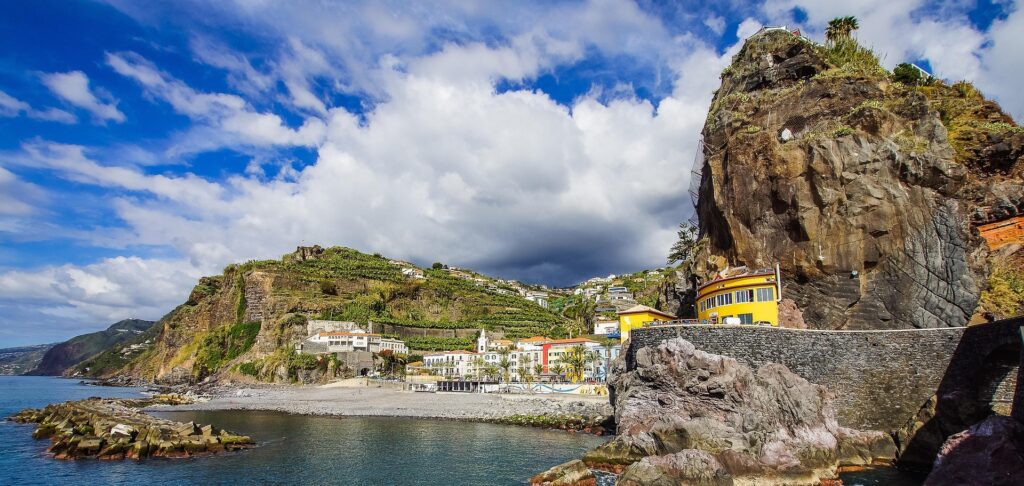
Sitting approximately 900 kilometres southwest of Lisbon and approximately 500 kilometres west of the Moroccan coast. The main island (also called Madeira) is 741 square kilometres — roughly the size of Singapore — with a population of approximately 250,000, most of whom live in the capital Funchal on the southern coast. The archipelago also includes the smaller inhabited island of Porto Santo (42 square kilometres, population approximately 5,500) and the uninhabited Desertas and Selvagens island groups. The main island is dramatically volcanic — a single mountain rising from the Atlantic seabed roughly 5 million years ago, with peaks reaching 1,862 metres at Pico Ruivo (the highest point on the island and the third-highest point in Portugal after Serra da Estrela on the mainland and Pico on the Azores). The interior of the island is mountainous, forested with a distinct temperate laurel forest (Laurisilva) that has been a UNESCO World Heritage Site since 1999, and cut through by dramatic valleys and waterfalls. The southern coast is subtropical and warm year-round; the northern coast is cooler and wetter, with Atlantic storms bringing significant rainfall to the interior mountains. The climate is remarkably stable — Funchal has the smallest average annual temperature range of any European city, with mean January temperatures of 16°C and mean August temperatures of 22°C, a variation of only 6°C between winter and summer. This is why the Victorians called Madeira “the island of eternal spring.” They were not exaggerating. There genuinely is no other Portuguese place, and few other places anywhere in Europe, with this specific combination of subtropical climate stability, volcanic-mountain terrain, Atlantic maritime setting, and continuous 600-year Portuguese cultural inheritance.
Portuguese navigators João Gonçalves Zarco and Tristão Vaz Teixeira sighted the smaller island of Porto Santo in 1418 and the main island of Madeira the following year, in 1419. Portugal formally claimed both islands for the crown in 1420. This is a set of dates worth pausing on. Madeira was claimed 73 years before Columbus’s first voyage to the Americas in 1493, 78 years before Vasco da Gama’s voyage to India in 1497, and at least 60 years before any other significant European Atlantic colonisation. The Madeira colonisation, coordinated by Prince Henry the Navigator (Infante Dom Henrique) from the Portuguese court at Sagres and Lagos in the southern Algarve, was in operational terms the first sustained European overseas colonial project of the modern period. Portuguese settlers arrived in the 1420s on an uninhabited subtropical island covered in dense laurel forest. Their first act was to burn much of the forest to clear agricultural land — the fire is documented to have burned continuously for seven years, according to some historical sources, and the island’s name (Ilha da Madeira, “island of wood”) reflects the forest that the settlers found and largely destroyed within a generation. The cleared land was terraced into small agricultural plots, watered by the extensive levada irrigation system that would grow over the following four centuries into one of the most extraordinary hydraulic-engineering projects in Europe, and planted with sugarcane, wheat, and eventually wine grapes.
The Madeira sugarcane plantations of the 15th century have a specific and uncomfortable historical significance that the article should name honestly. They were the first significant European deployment of enslaved sub-Saharan African labour in a colonial-plantation context — Berber captives from Morocco, sub-Saharan Africans captured through the emerging Atlantic trade, and enslaved Guanches from the Canary Islands (comparable to the situation covered in the Tenerife Ep 47 article) were forcibly transported to Madeira to work the sugarcane fields. By 1500, Madeira was the largest single sugar producer in the Atlantic, exporting approximately 3,000 tonnes of sugar per year to European markets. The plantation-slavery system developed at Madeira in the 15th century provided the direct operational template that Portugal — and subsequently Spain, England, the Netherlands, and France — would apply to Brazil (from the 1530s), to the Caribbean (from the 1620s), and eventually to the American South (from the 17th century onwards). Madeira sugar production collapsed in the 16th century as Brazilian sugar came online at vastly greater scale, and the island’s economy shifted toward wine production, which had been growing steadily since the earliest vine plantings in the 1440s. But the plantation-slavery precedent that Madeira established during its sugar century is one of the more consequential and least-discussed footnotes in the history of the Atlantic world. Madeira is, in operational terms, the birthplace of European colonial plantation slavery. The article names this in the same tonal register the series has established for comparable material (Bordeaux’s Ep 37 treatment of the slave-trade centuries, Seville’s Ep 44 treatment of the Morisco expulsion, Casablanca’s Ep 49 treatment of colonial planning): state the honest fact, name the mechanism, refuse to moralise or omit, let the reader draw their own conclusions.
Madeira wine
The wine that replaced sugar as Madeira’s economic centre would eventually produce the island’s most distinctive contribution to global culture. Vine plantings had begun in the 1440s, using Malvasia, Sercial, Verdelho, Boal, and Tinta Negra grape varieties imported primarily from Crete, Cyprus, Sicily, and mainland Portugal. Wine production grew steadily through the 16th and 17th centuries, primarily for local consumption and small-scale export to Portuguese Atlantic possessions. The transformation into Madeira wine as it is known today began in the 1750s-1770s, when Madeira producers began shipping their wines as ballast on East India Company vessels bound for the American colonies, the Caribbean, and India. The barrels crossed the equator twice on round-trip voyages of six to twelve months, spending sustained periods in tropical heat as the ships crossed and re-crossed the Atlantic and Indian oceans. When some barrels returned unsold to Madeira, the producers discovered something startling: the heat-exposed wine tasted dramatically better than the fresh wine. It had developed a rich, nutty, caramelised character — notes of dried fig, roasted almond, burnt toffee, and dried orange peel — with vibrant acidity preserved despite the oxidation, and an unusual quality of near-indestructibility (the heat exposure had stabilised the wine chemically, making it resistant to further deterioration).
The producers began deliberately sending wine on long tropical voyages specifically to produce this effect, calling the process vinho da roda — “wine of the round trip.” A wine that had made the full India voyage and back was labelled vinho da roda, and commanded premium prices. This is a genuinely unusual moment in the history of wine — the deliberate replication of an accidental commercial process to produce a superior product. It is comparable in its structural logic to the American development of bourbon whiskey through the accidental discovery that char-treated oak barrels produced a distinctive spirit character. Both traditions treated a commercial accident as a discovery worth institutionalising. Both became defining features of their respective drink categories. Both are now protected by regulation.
When steamships made long voyages economically impractical in the mid-19th century — a return voyage that had taken twelve months by sail could be completed in three months by steam, and no producer could afford to keep wine in transit for the full sail-era duration — Madeira producers developed two on-island methods to replicate the tropical heat exposure. The estufagem method (from estufa, “heating chamber”) involves heating the wine in stainless-steel or concrete vats to 45–50°C for a minimum of three months — a legally regulated period under the Madeira DOP (protected designation of origin) rules. The canteiro method — used for the finest wines — involves aging the wine in oak casks in the warm attics of Funchal, where summer temperatures reach 40°C and the wine is left exposed to the natural annual heat cycles for a minimum of 20 years, with premium canteiro wines aged for 50, 80, or over 100 years before bottling. The oldest continuously operating Madeira producer, Blandy’s Wine Lodge (founded 1811), currently holds wines from every decade back to the 1810s, and older vintages back to the 1790s. Some of these wines are still commercially available. A bottle of Blandy’s 1795 Terrantez was auctioned in 2014 for approximately €8,000. Wine chemists who have analysed 200-year-old Madeira wines have documented that they retain their acidity, aromatic complexity, and drinkability essentially unchanged — a stability that no other wine tradition can match.
The consequence for wine history is that Madeira wine became one of the most-shipped and most-consumed premium wines of the 18th and 19th centuries, particularly in the American colonies where climate stability and durability made Madeira the practical choice for transatlantic commerce. This is where the article’s most quotable single fact enters. Madeira wine was the ceremonial wine of the American Revolution. Thomas Jefferson kept the largest personal Madeira cellar in colonial America — approximately 300 bottles at Monticello at the time of his death, ordered by the barrel from Madeira producers throughout his political career. George Washington drank Madeira daily, and the ceremonial toast at his first Presidential inauguration on 30 April 1789 in New York was Madeira. The Declaration of Independence, signed at Independence Hall in Philadelphia on 4 July 1776, was toasted with Madeira at the City Tavern that evening. John Adams and Benjamin Franklin drank Madeira throughout their political careers. Approximately 95% of all wine imported into the American colonies in the 18th century was Madeira. When historians describe the drinking habits of the American Founding Fathers, they are describing a specific island in the mid-Atlantic and its heat-cycled wine. Most Americans do not know this. Most Portuguese barely emphasise it. The article installs it as one of the most consequential and least-recognised links between a small European island and American political history.
The physical infrastructure that made all of this possible is still visible today. Funchal — the capital, population approximately 105,000, founded 1424 as one of the first Portuguese colonial capitals in the Atlantic — is dominated by the wine trade, with historic wine lodges (Blandy’s, Henriques & Henriques, D’Oliveiras, Cossart Gordon, Barbeito, and others) still operating in 18th- and 19th-century buildings in the old town. The Sé Cathedral of Funchal, completed in 1517, is one of the oldest colonial-era cathedrals in the Atlantic. The Fortaleza de São Tiago (built 1614 to defend the harbour) and the Fortaleza do Pico (built in the 17th century on the hill above the city) still stand. The Mercado dos Lavradores (Farmers’ Market) — a distinctive Art Deco building from 1940, painted in the traditional Funchal blue-and-white with dramatic ceramic panels — is one of the most photographed markets in Portugal.
The interior of the island contains the levada system — approximately 2,500 kilometres of small stone irrigation channels built between the 16th and 19th centuries, with continuing 20th-century extensions, to carry water from the wet northern mountains to the drier southern and coastal agricultural terraces. The levadas are still functional agricultural infrastructure, and they double as one of the most extensive walking-trail networks in Europe. Hikers can follow levadas for hundreds of kilometres across the interior mountains, along cliff faces, through UNESCO-inscribed laurel forest, and past dozens of waterfalls. The Levada do Caldeirão Verde is one of the most-walked routes; the Levada das 25 Fontes passes 25 documented mountain springs; the Vereda do Pico Ruivo connects the two highest peaks of the island in a demanding day-hike above the clouds. The Laurisilva forest — 15,000 hectares of temperate laurel woodland covering approximately 20% of the island’s surface — is one of the last significant stands of the ancient Tertiary-era laurel forest that once covered much of southern Europe before the Ice Ages, and is home to endemic species including the trocaz pigeon (Columba trocaz) and the Madeira long-toed pigeon (Columba palumbus maderensis).
The contemporary Madeira
The contemporary island is one of the most-visited tourist destinations in Portugal, receiving approximately 1.8 million tourists per year — roughly seven times its permanent population. Tourism is dominated by mid-range European visitors (particularly British, German, and Scandinavian long-stay winter tourists, following the same climate-migration pattern established at Madeira in the 1880s and continuing to Puerto de la Cruz on Tenerife, Las Palmas on Gran Canaria, and other subtropical Atlantic destinations covered in the Canaries articles). Madeira’s cruise-ship traffic is substantial — approximately 400,000 cruise passengers per year through Funchal harbour, with the port ranking as one of the busiest Atlantic cruise destinations. The island’s contemporary tourism identity emphasises the levada walking, the wine tourism, the Portas Pintadas street-door art project in the Zona Velha (approximately 200 doors painted since 2011 by local artists as public art), the natural volcanic swimming pools at Porto Moniz and Seixal, and — increasingly — the association with Cristiano Ronaldo.
Cristiano Ronaldo was born in Funchal on 5 February 1985, in the Santo António neighbourhood of the city, and left the island at 12 to join Sporting Lisbon’s youth academy in 1997. His subsequent career — Manchester United, Real Madrid, Juventus, Al-Nassr, five Ballon d’Or awards, over 900 senior career goals, 200+ Portugal national team caps, and status as one of the two most globally recognisable footballers of the 21st century — has been a substantial economic and cultural presence for the island. The CR7 Museum in Funchal (opened 2013 by Ronaldo himself) displays trophies, jerseys, and career artefacts. The Pestana CR7 Funchal hotel (opened 2016, co-owned by Ronaldo with the Portuguese Pestana hotel group) sits on the Funchal harbour. Cristiano Ronaldo International Airport (renamed by the Portuguese government in 2017) is the island’s international gateway. Local shops sell CR7-branded merchandise. Ronaldo returns to Madeira periodically to visit family and the neighbourhood where he grew up. It is a specific and unusual case of a small island whose most globally recognisable contemporary export is a single individual, and the article acknowledges this honestly — Ronaldo is not incidental to modern Madeira’s identity. He is one of its principal contemporary economic assets.
The poncha — Madeira’s traditional drink — is made from aguardente de cana (sugarcane brandy distilled from Madeira’s remaining sugarcane production), honey, lemon juice, and hand-whipped in a small wooden crusher called a caralhinho. The version served in the fishing villages of Câmara de Lobos (where Winston Churchill famously painted during his 1950 Madeira holiday, and where the poncha is served in traditional buckets rather than glasses) is the most authentic. The traditional foods include espetada (skewered beef grilled over laurel wood), bolo do caco (a flat wheat-and-sweet-potato bread cooked on a stone), milho frito (fried polenta cubes), and lapas (Atlantic limpets grilled with garlic and butter). The island’s contemporary cuisine reflects its Atlantic-island position — significant fresh Atlantic seafood, subtropical fruit (Madeira produces distinctive bananas, passion fruit, custard apples, and the endemic deliciosa fruit hybrid), and a wine culture that pairs with almost everything.
This is the deeper character of Madeira, and the article proposes to close on it. The island was the first sustained European overseas colonial project of the modern era, discovered by Portuguese navigators in 1419, colonised in the 1420s, and used as the operational template for the plantation-slavery economy that would subsequently reshape Brazil, the Caribbean, and the American South. Its wine tradition emerged from an 18th-century commercial accident — the tropical heat exposure of transatlantic shipping — and became the only wine on Earth that improves through deliberate cooking, aged for decades in oak casks in the warm attics of Funchal or heated in industrial vats to replicate the original voyages. The wine was ceremonial to the American Revolution, drunk at the signing of the Declaration of Independence and at Washington’s inauguration, and still commands premium prices at auction for vintages back to the 1790s. The island’s interior contains 2,500 kilometres of levada irrigation channels, 15,000 hectares of ancient laurel forest, and volcanic mountain terrain crossed by some of the most extensive hiking-trail networks in Europe. Its contemporary economy is dominated by tourism, wine, and — genuinely — a single footballer born in Funchal in 1985 whose face is on the airport. The island sits 900 kilometres closer to Africa than to Lisbon, at the latitude of Casablanca, in a subtropical climate that has made it “the island of eternal spring” continuously for 250 years of European tourism. It opens Season 2 of the journey because the geographic drift from the Mediterranean into the Atlantic runs directly through it — from the Moroccan coast the reader has just left, to the mainland Portuguese arc still ahead — and because the wine that improves when cooked is the single most surprising piece of enological history in this part of the world.
Some islands were shaped by continental proximity. This one was shaped by ocean distance, subtropical stability, Portuguese ambition, colonial plantation logic, and one wine that improves when heated to fifty degrees — and along the way it produced a footballer whose face is on the airport and a drink that toasted the birth of the United States.
Nine regions. One hundred and twenty destinations. Three hundred and nine weeks remaining.
Season 2 opens here. The journey continues north. The next stop is on the mainland, in a medieval university town that was Portugal’s first capital and where students still wear black capes to lectures.

Beyondia
Trusted Travel CompanionReal digital nomad. I travel. I learn. I grow.
What about you? Where are you going?