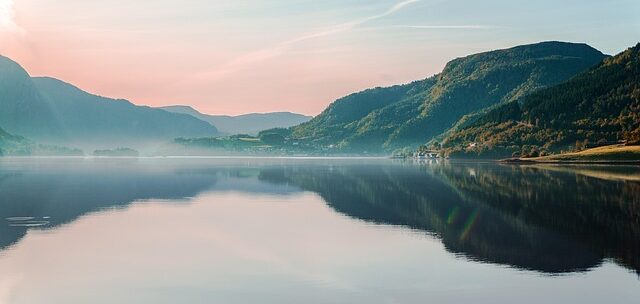
Route: Tromsø → Alta → Nordkapp (North Cape) Total distance: approximately 540 km Driving time: approximately 8–9 hours (spread over 3–5 days) Road: E6 northeast to Alta, then E6/E69 north to Nordkapp Currency: Norwegian Krone (NOK). 1 EUR ≈ 11–12 NOK Driving side: Right Best months: Mid-May to late July (midnight sun); September–March (northern lights and polar night)
The Shape of This Route
This is the furthest north a road goes in Europe.
The E6, Norway‘s main arterial highway, runs 2,500 km from the south of the country to the Arctic. This route picks it up at Tromsø, already 350 km above the Arctic Circle, and follows it northeast through Finnmark — Norway’s largest, emptiest, and most extreme county — to Nordkapp, the North Cape, where the road ends at a 307-metre cliff above the point where the Atlantic meets the Arctic Ocean.
The landscape empties as you drive north. Tromsø is a city — small, but a city, with university buildings and restaurants and a cable car. Alta is a town — the last real urban anchor, with a supermarket and a museum and a hotel built of ice. After Alta, the settlements thin to villages, then to scattered houses, then to nothing. The E69, the final highway to the cape, crosses the island of Magerøya through a subsea tunnel and arrives at a plateau that looks like what the earth looked like before it decided to grow anything.
Three stops. The Arctic capital, the ancient frontier, the end of the continent. One road, getting narrower, getting emptier, getting closer to the point where the land simply stops.
Tromsø — The Paris of the North
Tromsø sits on an island between the Norwegian Sea and the mainland mountains, at 69°N — the same latitude as northern Alaska. It has been called the Paris of the North since the nineteenth century, not because it resembles Paris but because it had, improbably, the cultural ambitions of a much larger city: a university, a brewery, a cathedral, a botanical garden, all packed onto a small island in the Arctic and functioning year-round in conditions that would close most European cities for the winter.
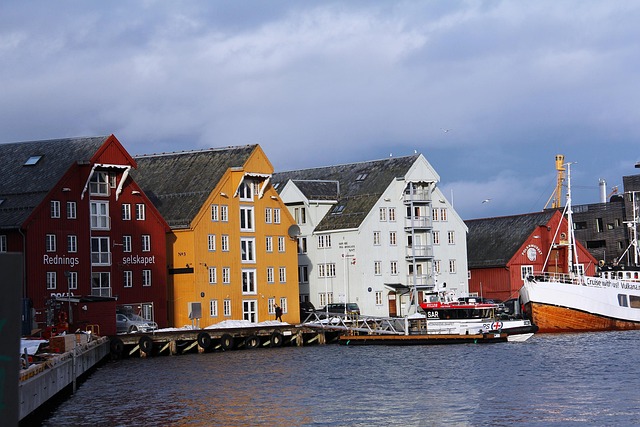
The Arctic Cathedral (Ishavskatedralen) is Tromsø’s defining silhouette — a triangular concrete and glass structure built in 1965, its eleven aluminium-clad frames rising to a point that mirrors the mountains and the ice. The eastern wall is a single massive stained-glass mosaic by artist Victor Sparre. Entry approximately 70–80 NOK (~€7–8). Summer hours are longer (typically 10:00–18:00 June–August); winter hours shorter. Midnight sun concerts in summer are a signature experience — check the schedule and book in advance.
Fjellheisen — the cable car — takes you 421 metres above sea level to the top of Storsteinen mountain. The viewing platform offers a panorama of the city island, the surrounding fjords, and the mountain ranges that continue in every direction without interruption. In summer, this is where you watch the midnight sun. In winter, this is where you watch the aurora. The cable car operates year-round, weather permitting. Approximately 250–350 NOK return. Go on a clear evening regardless of season.
Northern lights: Tromsø is one of the best locations on earth for aurora viewing. The season runs roughly September through March. The lights are not guaranteed — they require solar activity, clear skies, and darkness. Guided northern lights tours depart nightly in season (approximately 1,000–1,800 NOK per person) and take you by bus or boat to locations away from city light. The aurora, when it appears, is not what photographs suggest. It is slower, greener, more fluid, and more silent than any image can convey. It moves like something thinking.
Stage One — Tromsø to Alta
Distance: approximately 330 km Driving time: 5–6 hours via E8/E6
Leave Tromsø heading southeast on the E8 to the junction with the E6, then northeast along the coast into Finnmark. This is not a motorway drive. The E6 in Northern Norway is a two-lane road that follows the contour of every fjord, crosses mountain passes, and passes through landscapes so empty that the GPS shows nothing but the road and the terrain on either side. There are no services for long stretches. Fill the tank before leaving Tromsø and again at every opportunity.
The road passes through the Lyngen Alps — a mountain range visible across the Lyngen Fjord that produces some of the most dramatic scenery in Scandinavia. In winter, sections of the E6 can be closed by weather — check road conditions at vegvesen.no before departing. In summer, the midnight sun means you can drive at 2 AM in full daylight, which is disorienting and beautiful and the reason why coffee is Norway’s most important infrastructure.
Norway is expensive. Budget accordingly. Fuel prices are among the highest in Europe (approximately 20–22 NOK per litre for diesel). Roadside cafés charge 50–70 NOK for a coffee. A hotel room in Alta costs €150–250 per night. This is not a budget destination. It is a destination that costs what it costs because the logistics of existing this far north require it.
Alta — The Ancient Frontier
Alta sits at the head of the Altafjord at 70°N — the last substantial town before the landscape empties into Finnmark’s interior. It is the gateway to the North Cape and the cultural centre of Northern Norway’s Sámi heritage.
The Alta Museum is a UNESCO World Heritage site containing rock carvings (helleristninger) dating from approximately 2,000 to 7,000 years ago. The carvings — etched into flat rocks along the shoreline — depict reindeer, boats, fishing scenes, bears, and human figures. They were made by the ancestors of the Sámi people and represent one of the largest concentrations of prehistoric rock art in Northern Europe. The site is outdoors, along a boardwalk trail of approximately 3 km. Allow 2–3 hours. Open year-round but access may be limited in deep winter. Check the museum website for current hours and prices.
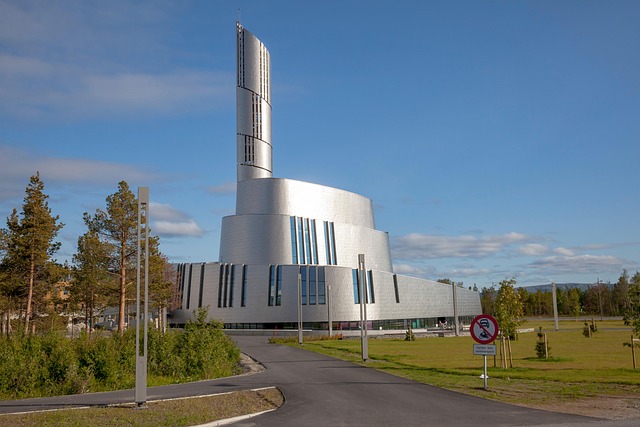
The Northern Lights Cathedral (Nordlyskatedralen) opened in 2013 — a spiralling titanium-clad structure that looks like a coiled aurora frozen in metal. The architecture is as much a sculpture as a building, and the interior is minimal and modern. This is the counterpoint to the Arctic Cathedral in Tromsø — where Tromsø’s church looks like ice, Alta’s looks like light.
Sorrisniva Igloo Hotel — approximately 20 km from Alta — is rebuilt entirely from ice and snow each winter (typically December through April). The structure melts in spring and is reconstructed the following winter. Rooms, bar, chapel, and sculptures — all carved from ice. Overnight stays include thermal sleeping bags on ice beds. Temperatures inside hover around -4°C to -7°C. It is an experience rather than a comfortable night’s sleep, and it is honest about being both. Book in advance.
Eat reindeer. This is Sámi country, and reindeer is not an exotic novelty — it is the local protein, prepared as stew (bidos), dried, smoked, or served as steak. It is lean, rich, and tastes like the landscape it came from. Pair it with lingonberries and root vegetables. Drink coffee. More coffee.
Stage Two — Alta to Nordkapp
Distance: approximately 210 km Driving time: 3–3.5 hours via E6/E69
The final leg. Leave Alta on the E6 heading northeast to Olderfjord, then turn north onto the E69 — the last highway in Europe.
The E69 crosses to the island of Magerøya through the North Cape Tunnel (Nordkapptunnelen), a 6.8 km subsea tunnel that descends to 212 metres below sea level before climbing back to the surface. The tunnel is toll-free. On the far side, the island of Magerøya is treeless, wind-scoured, and populated primarily by reindeer. The road crosses an open plateau where fog and wind are constant companions, and the visibility can drop to near zero without warning.
Honningsvåg — approximately 30 km before the cape — is the last town. Refuel here. Check weather conditions here. Buy whatever you need here, because after Honningsvåg, there is nothing between you and the end of the continent except 30 km of road, tundra, and the occasional reindeer standing in the middle of the lane with no intention of moving.
Nordkapp — The End of the Continent
The road ends.
It does not curve or lead to another road. It arrives at a car park on a plateau 307 metres above the Arctic Ocean, and that is it. There is nowhere else to drive. Europe is behind you. Ahead is the Barents Sea, and then the ice, and then the North Pole, and then the other side of the planet.
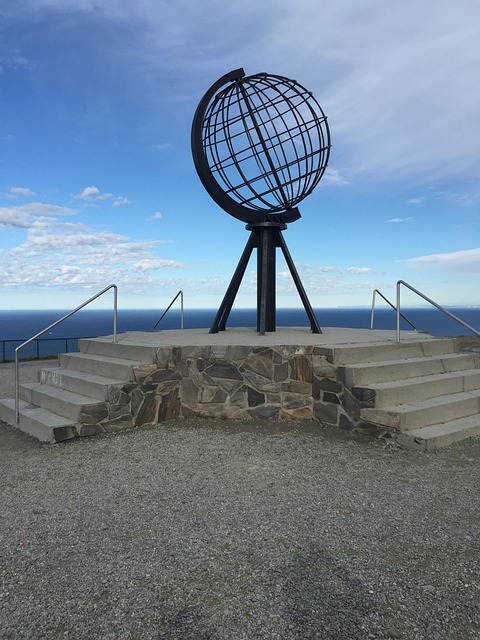
The Globe Monument stands at the cliff edge — a steel wireframe sphere at 71°10’21″N, the symbol of Nordkapp and the most northernmost point in Europe reachable by car. (Technically, nearby Knivskjellodden is slightly further north, but it requires a 9 km hike and has no monument. Nordkapp has the globe and the cliff and the weight of centuries of people travelling to the edge to look at what is beyond it.)
The North Cape Hall (Nordkapphallen) is a visitor centre carved into the rock, containing a panoramic cinema, historical exhibitions, the Cave of Lights (a chapel-like installation), a café, and a post office from which you can send postcards stamped at the top of Europe. The visitor centre charges approximately 320 NOK for adults, 90 NOK for children. Tickets are valid for 6 hours and allow re-entry. Note: access to the outdoor plateau, the globe monument, and the cliff edge is technically free — the fee covers the indoor facilities. This distinction is not always made clear at the entrance.
The midnight sun is visible at Nordkapp from 14 May to 31 July. The sun reaches its lowest point between 00:14 and 00:24 and does not dip below the horizon. It simply hovers, turns gold, and rises again. The 24-hour golden hour that results is not a lighting condition — it is a temporal dislocation. You stand at the globe at midnight and the sun is above you and the shadows are long and the Arctic Ocean is lit from a direction that your body does not believe, and you understand that time, up here, is not what it is everywhere else.
Practical Notes
Driving: Norway drives on the right. The E6 in Northern Norway is a well-maintained two-lane road, not a motorway. Speed limits are typically 80 km/h outside towns, 50–60 km/h in towns, strictly enforced by cameras. Overtaking opportunities are limited. Patience is required. In winter (October–April), winter tyres are mandatory. Roads can be closed by weather — check vegvesen.no. In summer, 24-hour daylight eliminates night driving concerns but creates fatigue risk — take breaks.
Season: Two distinct visiting profiles. Summer (mid-May to late July): midnight sun, 24-hour daylight, wildflowers, accessible roads, tourist peak. Winter (November–February): polar night, northern lights, snow, extreme cold (temperatures to -15°C and below), limited daylight (zero above the Arctic Circle during polar night). Both are extraordinary. Summer is easier. Winter is more profound.
Northern Lights: Best September–March. Solar activity forecasts available at the Norwegian Centre for Space Weather (tromsø.spaceweather.no). The aurora is unpredictable — plan multiple nights in Tromsø to maximise chances.
Sámi Culture: The Sámi are the indigenous people of Northern Scandinavia. Alta and Finnmark are within Sápmi — the Sámi homeland. Respect cultural sites and reindeer herding routes. The Alta Museum’s rock carvings are a UNESCO site — stay on the boardwalk. Sámi-guided experiences (reindeer sledding, lavvu visits, cultural presentations) are available in Alta and surrounding areas.
Cost: Norway is among the most expensive countries in the world. Budget €150–300 per night for accommodation in Tromsø and Alta. A restaurant meal runs €30–50 per person. Coffee is €5–7. Fuel is approximately €2 per litre. The Nordkapp entrance fee is 320 NOK (~€30). Plan accordingly and do not expect budget-travel pricing.
Getting There: Fly to Tromsø (TOS) — direct flights from Oslo, Stockholm, and seasonal connections from London and other European cities. Rent a car in Tromsø for the drive north. Alternatively, fly to Alta (ALF) to shorten the road journey.
What This Route Is Really About
This is the route where the road runs out.
Every other Explore in this series has connected cities — Rome to Venice, Barcelona to Málaga, Lisbon to Porto, Dublin to Dingle. The road continued. There was always another destination after the one you had just reached. Nordkapp is the first destination in the series where there is no next destination. The road arrives at a cliff and stops. Beyond the cliff is water. Beyond the water is ice. Beyond the ice is silence.
The route from Tromsø to Nordkapp is a gradient of subtraction. Tromsø has restaurants, culture, a cable car. Alta has a museum, a cathedral, a hotel made of ice. Nordkapp has a globe and a cliff and the sound of the Arctic Ocean hitting the base of Europe. Each stop removes something. By the time you reach the plateau, what remains is the planet itself — rock, water, sky, wind — and you, standing on it.
The GoBeyondia journey started in a kitchen in Italy where a bird tapped a window. It ends at a cliff in the Arctic where the continent taps the ocean. Between those two points: twelve countries, thirty-six pieces of content, one character who began as a question and became a practice. The road ran out. The practice continues.

Beyondia
Trusted Travel CompanionReal digital nomad. I travel. I learn. I grow.
What about you? Where are you going?