South and South East Asia is not a region. It is a reckoning — the part of the world that holds more than half of humanity, more ancient continuous civilisations than any comparable territory on earth, and a density of spiritual, culinary, architectural, and natural experience that defeats every attempt at summary. Eleven countries share this geography, separated by language, religion, and the geological accident of archipelago versus continent, but united by a hospitality so embedded it precedes the idea of tourism by several thousand years. The food here is not fusion. The temples were not built for photographs. The silence inside a Thai forest monastery or a Nepalese mountain valley is the kind that changes the question you arrived with.
The Subcontinent
India is not a country in the conventional sense — it is a civilisational argument conducted simultaneously in 22 official languages across a territory the size of Western Europe, producing more internal variation in culture, cuisine, landscape, and spiritual tradition than most people encounter in a lifetime of travel. The Himalayas define the north; the Thar Desert the west; the backwaters of Kerala the south; the Bay of Bengal the east. Between them: the Mughal architecture of Agra, the ghats of Varanasi, the medieval temple cities of Tamil Nadu, the Rajasthani forts that the desert light was made to illuminate. India does not meet the traveller halfway. It requires arrival on its own terms, and rewards it accordingly. [Read the full India Travel Guide →]
Nepal is where the Himalayas become personal — the country that contains eight of the world’s ten highest peaks, including Everest, and that has made those peaks accessible not just to climbers but to trekkers, to pilgrims, and to anyone willing to walk at altitude through a landscape that operates at a scale the human brain was not evolved to process without recalibration. Kathmandu’s medieval Durbar Squares, the temples of the Kathmandu Valley, and the lakeside calm of Pokhara complete a country that does more with its geographic hand than almost anywhere on earth. [Read the full Nepal Travel Guide →]
Sri Lanka is the island that manages to contain a tropical rainforest, a high-altitude tea country, ancient Buddhist kingdoms, a surf coast, and one of the great wildlife spectacles in Asia — the elephant gathering at Minneriya — within a landmass smaller than Ireland. Sigiriya’s rock fortress rising from the jungle plain, Galle’s Dutch colonial fort on the southern coast, and the temple of the Sacred Tooth Relic in Kandy represent a civilisational depth that the island’s resort reputation consistently undersells. [Read the full Sri Lanka Travel Guide →]
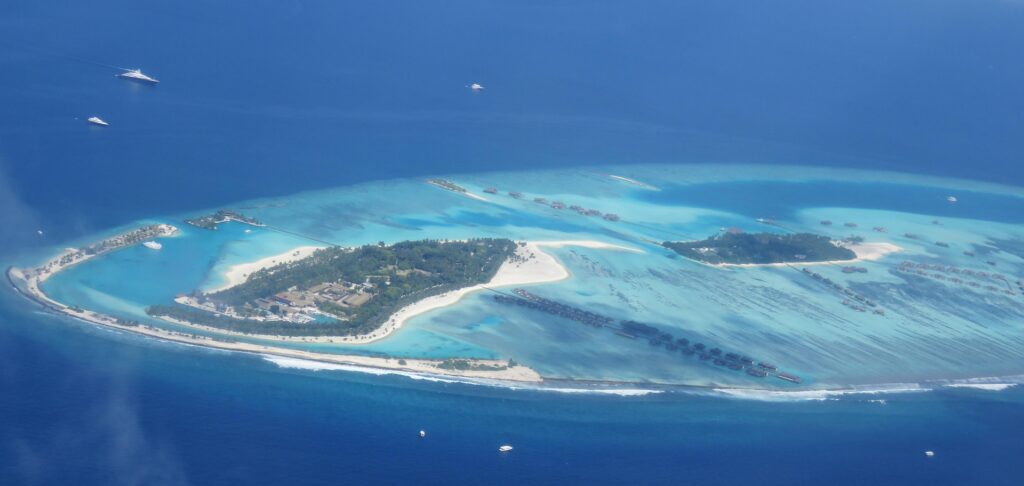
Maldives occupies the category of destination that photographs cannot exaggerate — 1,200 coral islands arranged across the Indian Ocean in a configuration that exists nowhere else on the planet, the water achieving a transparency that makes the reef visible from 30 metres up on a seaplane approach. It is the most vulnerable inhabited country on earth to sea level rise, which gives every visit a dimension of urgency that no amount of resort luxury entirely removes. [Read the full Maldives Travel Guide →]
The Mainland
Thailand has absorbed more international visitors than any country in the region and somehow retained, in its northern hills, its island interiors, its Buddhist temple culture, and its street food markets, the specific quality that drew people here before the tourism infrastructure existed. Bangkok is the most kinetic city in South East Asia — the floating markets, the Grand Palace, the rooftop bars above the Chao Phraya, the night food stalls operating at a standard that would earn recognition in any food capital in the world. Chiang Mai, the Pai Valley, and the national parks of the north make the case for the country’s other register entirely. [Read the full Thailand Travel Guide →]
Vietnam runs 1,650 kilometres from north to south and changes almost completely along the way — from the mountain markets of Sapa near the Chinese border to the lantern-lit Old Town of Hội An on the central coast to the Mekong Delta’s labyrinthine waterways in the south. Hanoi’s Old Quarter preserves a street-by-street commercial geography unchanged in its fundamentals for centuries; Ha Long Bay’s limestone karsts rising from the Gulf of Tonkin constitute one of the genuinely non-negotiable natural spectacles of the continent. The food changes every 200 kilometres and improves at every stop. [Read the full Vietnam Travel Guide →]
Laos is the country that the 21st century has not yet fully found — the landlocked nation along the Mekong whose former royal capital of Luang Prabang remains one of the most compositionally perfect small cities in Asia, its French colonial architecture and Theravada monastery culture existing in an arrangement that UNESCO designated a World Heritage Site and that the morning alms-giving ceremony renders, daily, into something that feels less like tourism and more like witnessing. The Plain of Jars, the waterfalls of Kuang Si, and the cave temples of the Mekong gorge complete a country that rewards the traveller who is not in a hurry. [Read the full Laos Travel Guide →]
Cambodia earns its place in every serious travel conversation through a single argument: Angkor. The 12th-century temple complex covering 400 square kilometres of the Cambodian jungle is the largest religious monument ever constructed, the high point of the Khmer Empire’s architectural ambition, and the one site in South East Asia that exceeds every expectation formed by every photograph seen before arrival. Phnom Penh, the river town of Kampot, and the Gulf of Thailand coast at Kep and Koh Rong represent a country with more to offer than the temple complex that defines it. [Read the full Cambodia Travel Guide →]
The Archipelago
Indonesia is the world’s largest archipelago — 17,000 islands, 270 million people, the fourth most populous nation on earth — and a geographic proposition so vast that most visitors choose a single island and return for more. Bali has achieved the status of a cultural destination that transcends its resort infrastructure, the Hindu temple culture and rice terrace landscape of the interior operating on a different frequency from the southern coast’s tourism economy. Java contains Borobudur, the 9th-century Buddhist mandala that is the largest single Buddhist monument in the world. Lombok, Flores, Sulawesi, and the Komodo archipelago make the case for the Indonesia that most visitors have not yet reached. [Read the full Indonesia Travel Guide →]
Malaysia divides its considerable argument between peninsula and Borneo — between the colonial shophouses and hawker culture of Penang, the gleaming financial ambition of Kuala Lumpur, the jungle-interior of the Cameron Highlands, and the primary rainforest of Sabah and Sarawak on Borneo’s northern coast where the orangutan shares its territory with proboscis monkeys and pygmy elephants in a biodiversity density that has no equal. The food culture of Peninsular Malaysia — Malay, Chinese, Indian, and Peranakan traditions operating in productive proximity — is among the finest and most underrecognised in Asia. [Read the full Malaysia Travel Guide →]
Philippines is 7,641 islands arranged across a stretch of the western Pacific with the specific generosity of a country that has absorbed Spanish, American, and Asian cultural influences without losing the particular warmth of a people who consider hospitality a point of national pride rather than a service industry. Palawan’s El Nido and Coron produce the kind of lagoon and limestone cliff photography that drives search algorithms; the Chocolate Hills of Bohol, the active volcano of Mayon, and the rice terraces of Ifugao carved two thousand years ago into the Cordillera mountains represent a geographic and cultural range that the island count alone cannot convey. [Read the full Philippines Travel Guide →]
Singapore is the city-state that decided in 1965 that the only viable response to the absence of natural resources was the systematic cultivation of human ones, and proceeded to execute that decision with a consistency and rigour that has produced, in sixty years, one of the most logistically perfect cities on earth. Changi Airport is not just an airport — it is the country’s founding philosophy made operational. The hawker centres deliver some of the finest street food in Asia at prices that make the city’s luxury hotel rates seem like a different economic reality. For the traveller, Singapore functions best as either a destination in itself or the most comfortable entry point into the region. [Read the full Singapore Travel Guide →]
When to Visit
South and South East Asia spans the equator and runs north to the Himalayas, which means the seasonal logic varies more dramatically here than in almost any other region on earth. The governing calendar across most of South East Asia is the monsoon — the south-west monsoon arriving in May and retreating in October, the north-east monsoon reversing the equation for the eastern coasts of Vietnam, the Philippines, and Sri Lanka between November and March.
The dry season window of November through April is the operative peak for Thailand, Cambodia, Laos, and the western coasts of the peninsula — the period when humidity is manageable, rainfall is minimal, and the cultural and natural sites are at their most accessible. Vietnam requires reading by region: the south is best November to April, while Hội An and Hanoi are finest in February and March. The Philippines divides between coasts in ways that reward planning.
India runs a separate calculus. The Himalayan north — including Nepal — is accessible for trekking from October to May, with October and November delivering the clearest Himalayan views. Rajasthan and the Deccan plateau are finest October to March. The south, with its double monsoon, rewards year-round visitation with appropriate coastal selection. The Maldives and Sri Lanka operate on the north-east monsoon’s calendar, making the west coast of Sri Lanka finest December to March and the east coast April to September.
For the full seasonal breakdown, explore the monthly travel guides by destination.

Beyondia
Trusted Travel CompanionReal digital nomad. I travel. I learn. I grow.
What about you? Where are you going?