The Middle East and the Silk Road are not a region — they are a mechanism. For three thousand years, the territory stretching from the Bosphorus to the Tian Shan mountains was not the edge of anything but the centre of everything: the corridor through which silk, spices, ideas, religions, and armies moved between the civilisations of China, India, Persia, and Europe, generating in the process the great trading cities, the monumental architecture, the mathematical and astronomical breakthroughs, and the three monotheistic faiths that the modern world still organises itself around. Thirteen countries share this geography today, divided by contemporary borders that the caravans would not have recognised and that the underlying cultural logic still largely ignores. The hospitality is not a feature of the tourism industry. It precedes it by several millennia. The food is the accumulated intelligence of every civilisation that passed through. The architecture is the ambition of empires made in stone, tile, and gold — and, in the Gulf, in glass and steel. Come with patience, curiosity, and the understanding that you are not visiting the past. You are walking through the room where the present was assembled.
The Arabian Peninsula
Saudi Arabia is the largest country in the Middle East and the one undergoing the most consequential transformation — a society that spent decades defined by what visitors could not do, now actively constructing the infrastructure of a tourism economy at a scale and speed that has no modern parallel. The ancient Nabataean city of AlUla, with its rock-carved tombs and rose-red sandstone formations rivalling Petra, waited in near-total isolation for generations before opening to international visitors in 2019. Diriyah — the 15th-century mud-brick capital of the first Saudi state on the outskirts of Riyadh — is being restored as a cultural district. The Red Sea coast, the asir highlands in the southwest, and the Empty Quarter’s dune landscape on the scale of a small country complete a geographic brief that the world is only beginning to understand. [Read the full Saudi Arabia Travel Guide →]
United Arab Emirates is the argument that the 21st century makes most completely — the federation of seven emirates that turned a pearl-diving economy into a global hub in fifty years with the specific combination of vision, capital, and strategic positioning that historians will be analysing long after the buildings stop being the tallest. Dubai’s Burj Khalifa, the Palm Jumeirah, and the Dubai Mall represent one register entirely; the wind-tower architecture of Bastakiya, the dhow wharves of the Creek, and the Al Fahidi Historical Neighbourhood represent the city that existed before the superlatives. Abu Dhabi’s Louvre, the Jubail Mangrove Park, and the desert dunes of Liwa make the case for the emirate that runs the federation. Sharjah holds the cultural argument. [Read the full UAE Travel Guide →]
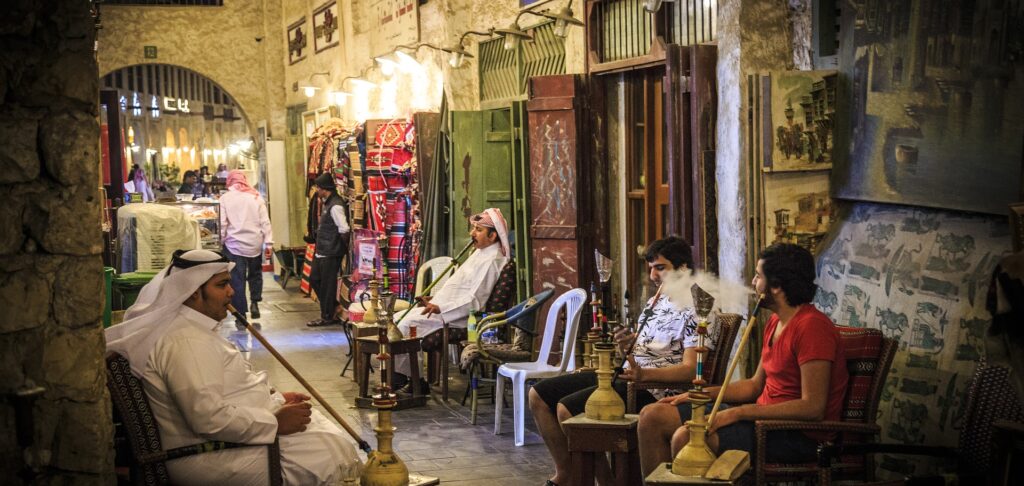
Qatar is the country that hosted the world — the 2022 FIFA World Cup giving a nation of 300,000 citizens a global platform that it used with considerable architectural and cultural ambition. Doha’s Museum of Islamic Art, designed by I.M. Pei and housing one of the world’s most significant collections of Islamic art and artefacts, sits on the corniche above a skyline that moved from modest to skyline-defining in the space of a decade. The Souq Waqif’s restored traditional market, the Al Zubarah archaeological fort on the northwest coast, and the desert of the inland sea at Khor Al Adaid — where sand dunes meet the Persian Gulf in a configuration that exists nowhere else on the peninsula — complete a small country that punches well above its geographic weight. [Read the full Qatar Travel Guide →]
Bahrain is the island kingdom that the Dilmun civilisation built its mythology around five thousand years ago and that the modern Gulf built its financial architecture around four decades ago — the first Gulf state to discover oil, the first to see it running out, and consequently the most culturally and economically diversified of the peninsula’s smaller nations. The Bahrain Fort overlooking the sea where the Dilmun traded with Mesopotamia and the Indus Valley, the traditional pearl diving route that UNESCO recognised as a world heritage landscape, and the tree-lined streets of Muharraq’s old merchant quarter represent a Bahrain that the Formula 1 circuit and the banking towers have not displaced. [Read the full Bahrain Travel Guide →]
Oman is the Gulf country that the 21st century has treated most gently — the Sultanate that chose the path of gradual, considered development over spectacular transformation, and that has preserved in the process the frankincense trade routes of Dhofar, the aflaj irrigation systems that have watered its date plantations since the Iron Age, and a desert and mountain landscape of extraordinary variety. Muscat’s Royal Opera House sits beside dhow harbours that the Portuguese fortified in the 16th century. The Wahiba Sands, the Hajar Mountains, the fjord-like inlets of the Musandam Peninsula — rented from the UAE geography and separated from the mainland — and the Wadi Shab with its turquoise pools cut through limestone cliffs complete a country whose understatement is its most accurate advertisement. [Read the full Oman Travel Guide →]
The Levant & Anatolia
Turkey is where the Silk Road met the Mediterranean and where Europe and Asia have been conducting a conversation — sometimes cooperative, often violent, always consequential — for the entirety of recorded history. Istanbul is the only city in the world to span two continents, and it contains within its geography the full weight of that position: the Hagia Sophia converting between identities for fifteen centuries, the Grand Bazaar operating on a commercial logic established in 1455, the Bosphorus strait carrying container ships between the Black Sea and the Mediterranean beneath the windows of yalı mansions built for Ottoman pashas. Cappadocia’s volcanic landscape of fairy chimneys and cave churches, the Aegean coast’s Ephesus and Pamukkale, the Kurdish southeast’s Göbekli Tepe — the world’s oldest known temple complex, rewriting the timeline of human civilisation — and the eastern Anatolian plateau above Lake Van complete a country that is not one thing but a full civilisational argument. [Read the full Turkey Travel Guide →]
Jordan is the country that holds the Silk Road’s most emotionally resonant single site — Petra, the Nabataean city carved directly into the rose-red sandstone cliffs of the Wadi Musa, which the 19th-century Swiss explorer Johann Ludwig Burckhardt rediscovered in 1812 and which two centuries of subsequent visitors have found impossible to approach with managed expectations. The Treasury reveals itself around a bend in the Siq gorge with the specific drama of something that was designed to be approached exactly this way. Beyond Petra: the Roman city of Jerash preserved with a completeness that surpasses most of Italy’s Roman sites; Wadi Rum’s desert landscape that T.E. Lawrence described as vast, echoing, and god-like; the Dead Sea at the lowest point on earth; and the ancient Crusader fortresses of Kerak and Shobak standing on ridgelines above the King’s Highway that caravans have been travelling since the Bronze Age. [Read the full Jordan Travel Guide →]
The Caucasus & Silk Road
Georgia is the country that the Silk Road traveller reached after crossing the Caucasus and that offered a wine, a cuisine, a polyphonic choral tradition, and a script so distinctive that UNESCO placed it on the Intangible Cultural Heritage list — the only alphabet in the world created specifically to translate Christian scripture, in the 5th century, and still in use today. Tbilisi’s old town of sulphurous bathhouses, wooden balconied houses, and the Narikala fortress above the Mtkvari River operates at the specific frequency of a city that has been destroyed and rebuilt seventeen times and carries that history as character rather than damage. The cave city of Vardzia, the winemaking valleys of Kakheti, the Svaneti towers standing in their mountain isolation in the Greater Caucasus, and the Black Sea coast at Batumi complete a country that the cognoscenti discovered a decade before the crowds. [Read the full Georgia Travel Guide →]
Armenia holds the distinction of being the world’s first Christian nation — adopting the faith in 301 AD, a decade before the Roman Empire — and has built its identity around a civilisational continuity and a historical grief that gives the country a particular emotional gravity. The Geghard monastery carved partly into a cliff face above the Azat River gorge, the Noravank canyon with its 13th-century churches rising from red-rock walls, the Tatev Monastery accessible via the world’s longest non-stop double track cable car, and the Garni Hellenistic temple — the only standing Greco-Roman colonnade structure in the former Soviet Union — represent a country whose stone churches are simultaneously its cathedrals, its museums, its monuments, and its argument for survival. Yerevan’s cognac distilleries and the view of Ararat across the Turkish border complete the brief. [Read the full Armenia Travel Guide →]
Azerbaijan occupies the edge of Europe and Asia simultaneously, the Caspian Sea defining its eastern boundary and the Caucasus its western, and has been producing oil from the Absheron Peninsula since the 10th century — a fact that made Baku one of the world’s first oil boom cities in the late 19th century and that funded the extraordinary architecture of the Old City, the İçərişəhər, whose 12th-century walls and caravanserais earned it UNESCO status as the Silk Road’s most complete Azerbaijani trading post. The Flame Towers above Baku make the contemporary argument with equal conviction. The mud volcanoes of the Absheron Peninsula, the ancient Zoroastrian fire temple of Ateshgah still burning on a natural gas vent, and the rock carvings of Gobustan — some dating back 40,000 years — complete a country of layered civilisational depth that its oil wealth biography has consistently undersold. [Read the full Azerbaijan Travel Guide →]
Uzbekistan is the Silk Road’s most concentrated single argument — the country that contains Samarkand, Bukhara, and Khiva in a triangle of medieval Islamic architecture so complete and so well-preserved that moving between them feels less like tourism and more like inhabiting a chapter of world history that most people know only as a paragraph in a textbook. Samarkand’s Registan — three madrasahs arranged around a central square covered in the turquoise and cobalt tilework of Timur’s 15th-century empire — is the kind of place that stops movement entirely upon first sight. Bukhara’s trading domes and the Ark Citadel have been functioning continuously since the Silk Road was an operational trade network. Khiva’s walled inner city, the Itchan Kala, is the most intact medieval Central Asian urban environment on earth. Tashkent completes the country’s contemporary dimension. [Read the full Uzbekistan Travel Guide →]
Kazakhstan is the Silk Road’s vast interior — the ninth largest country in the world, a steppe the size of Western Europe across which the caravans moved between China and Persia for fifteen centuries and which the 20th century used for nuclear testing, space launches, and the Soviet Union’s most ambitious agricultural experiment. The Baikonur Cosmodrome, from which Yuri Gagarin launched in 1961, remains the world’s first and largest space launch facility and is visitable. The petroglyphs of Tamgaly, the Charyn Canyon whose rock formations rival Arizona’s, the Tian Shan mountains above Almaty offering trekking terrain of genuine Alpine quality, and the futurist capital of Astana — built from scratch on the steppe in 1997 with an architectural ambition that only petrostate budgets permit — represent a country that the 21st century is beginning to understand on terms other than geography and resources. [Read the full Kazakhstan Travel Guide →]
Kyrgyzstan is the Silk Road in its most elemental form — the mountain country of the Tian Shan and Pamir Alay ranges where the nomadic pastoral culture that predates the trading routes themselves survives not as a cultural performance for tourists but as an operational way of life. The yurt is not a boutique hotel concept here — it is the architecture of a people who have been moving their homes with their herds across the high-altitude jailoos since before the first caravans passed through. Lake Issyk-Kul, the second largest alpine lake in the world, sits at 1,600 metres in a depression so deep that it never freezes. The Tash Rabat caravanserai — a 15th-century stone waystation preserved in a mountain valley at 3,200 metres — is the Silk Road made solid and still entirely findable without a tour group. [Read the full Kyrgyzstan Travel Guide →]
When to Visit
The Middle East and Silk Road spans desert, mountain, steppe, and coast — and the seasonal logic shifts so dramatically between the Arabian Peninsula and the Central Asian highlands that the two ends of this region require almost opposite planning calendars.
The Arabian Peninsula — Saudi Arabia, UAE, Qatar, Bahrain, Oman — is finest October through April, when the temperatures descend to the range where the desert and the cities become genuinely pleasurable rather than merely survivable. The summer months of June through August deliver heat that the indoor infrastructure of the Gulf handles with considerable air-conditioned proficiency, but that limits meaningful outdoor engagement. Oman’s Dhofar region is the exception: the Khareef monsoon of July through September transforms the southern coast into a green, mist-covered landscape that is one of the Arabian Peninsula’s most unexpected seasonal experiences.
Turkey operates on a Mediterranean and continental calendar simultaneously. Istanbul is excellent April through June and September through November — the shoulder seasons when the crowds are manageable and the light is lateral. Cappadocia rewards the winter visit with snow on the fairy chimneys and hot air balloon flights above a white landscape. The Aegean and Mediterranean coasts are a June-to-September proposition, with the shoulder months preferable for archaeological site visits.
Jordan runs at its finest March through May and September through November — the spring wildflowers on the plateau above Petra and the autumn clarity of Wadi Rum making the shoulder seasons the operative recommendation. Petra is visitable year-round; the summer heat demands early morning starts and significant water consumption.
The Caucasus — Georgia, Armenia, Azerbaijan — has its best sustained period from May through October, with the mountain regions accessible June through September and the capital cities rewarding year-round. The wine harvest in Georgia’s Kakheti in September and October adds a seasonal motivation that the spring visit cannot match.
Central Asia — Uzbekistan, Kazakhstan, Kyrgyzstan — runs on a strict summer logic. May through September is the operational window for the Silk Road cities and the mountain terrain alike; the winters are severe enough across the steppe and the high passes to close significant portions of the landscape entirely. The Uzbek spring of April and May, when the apricot orchards above Samarkand are in blossom, is the finest single moment the region offers the traveller who chooses correctly.
For the full seasonal breakdown, explore the monthly travel guides by destination.

Beyondia
Trusted Travel CompanionReal digital nomad. I travel. I learn. I grow.
What about you? Where are you going?