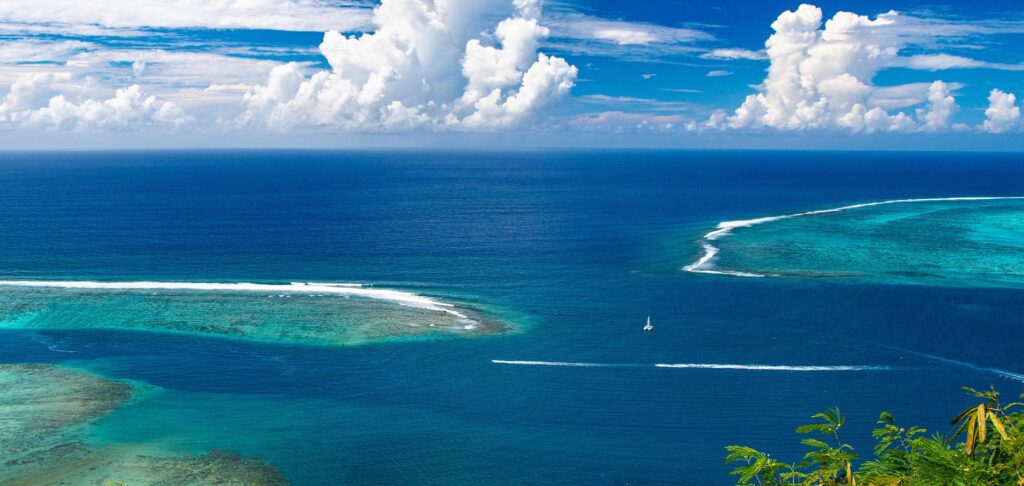
The Pacific Ocean covers more of the earth’s surface than all the landmasses combined — a fact that the map, which flattens and compresses, consistently fails to convey and that the traveller crossing it by air, watching hours of uninterrupted blue pass beneath the window, finally understands viscerally. Thirteen countries and territories share this guide, arranged around the world’s largest ocean in a configuration that connects the oldest continuous civilisations on earth — China’s four thousand years of unbroken recorded history, Japan’s imperial lineage, Australia’s Aboriginal cultures stretching back sixty thousand years — with some of the youngest nations in the world, Pacific island states that achieved independence within living memory and that carry in their navigation traditions, their oral histories, and their relationship with the ocean a knowledge system that the satellite era is only beginning to appreciate as the sophisticated science it always was. The food across this region spans the full range of human culinary achievement. Asian cities include the most technologically advanced on earth. The wilderness includes some of the last places where the human presence has not yet settled the terms. And in the middle of all of it, the Pacific — vast, indifferent, and the reason that everything here is exactly as it is.
East Asia: The Pacific Shore
China is the proposition that scale makes inevitable — the world’s most populous nation, the second largest economy, a civilisational continuity of four thousand years that produced gunpowder, paper, printing, the compass, and the bureaucratic examination system that most of the world’s civil services are still running variants of, compressed into a territory of such geographic and cultural diversity that the distance between subtropical Yunnan and the Inner Mongolian steppe is greater in every meaningful sense than the distance between Portugal and Finland. The Great Wall running across the northern ridgelines, the Forbidden City at Beijing’s centre, the terracotta warriors of Xi’an standing in their burial formation since 210 BC, the karst landscape of Guilin that Chinese landscape painting has been rendering for a thousand years, the Yangtze gorges, the Tibetan plateau at 4,500 metres, and the hyper-modern skylines of Shanghai and Shenzhen make arguments that no single visit can reconcile and that no serious traveller exhausts in a lifetime of return. [Read the full China Travel Guide →]
Japan is the country that the world keeps returning to because it keeps revealing another layer — the nation that absorbed Chinese civilisation, Buddhist philosophy, Confucian ethics, and Western industrial modernity in successive waves without dissolving its own identity in any of them, producing instead a culture of such internal coherence and aesthetic precision that the gap between a 12th-century temple garden and a contemporary convenience store — both operating on principles of considered arrangement, cleanliness, and attention to the experience of the person encountering them — is smaller than it appears. Tokyo is the largest city on earth and the most logistically functional, the city where the trains run on the second rather than the minute and where the apology for a ten-second delay is sincere. Kyoto’s 1,600 Buddhist temples and 400 Shinto shrines, the snow country of Hokkaido, the deer-populated ancient capital of Nara, the feudal castle town of Kanazawa, and the sacred island of Miyajima complete a country that surprises the prepared visitor and overwhelms the unprepared one. [Read the full Japan Travel Guide →]
South Korea compressed fifty years of economic development into twenty and emerged as one of the world’s most culturally dynamic mid-sized nations — the country that gave the world Samsung, Hyundai, BTS, and Parasite, that built Seoul into a city of 25 million operating at a standard of urban infrastructure, culinary sophistication, and creative energy that its international profile consistently undersells. The palaces of Gyeongbokgung and Changdeokgung in Seoul’s historic centre, the ceramic heritage of the Goryeo dynasty, the temple complex of Bulguksa near Gyeongju in the country’s ancient capital region, and the volcanic island of Jeju — South Korea’s Canary Islands, with its own dialect, its own lava tube caves, and its haenyeo diving women who have been harvesting the seafloor without equipment since the 7th century — complete a country at the productive intersection of Confucian tradition and radical contemporary reinvention. [Read the full South Korea Travel Guide →]
Taiwan is the island that proved a proposition — that Chinese democratic governance, Taiwanese indigenous culture, Japanese colonial influence, and Hokkien mercantile tradition could coexist in a single polity and produce, in the process, one of Asia’s most open, creative, and culinarily exceptional societies. Taipei’s night markets, operating at a standard of street food sophistication that the city’s Michelin stars do not surpass and its residents do not abandon for, the National Palace Museum’s collection of Chinese imperial artefacts so comprehensive that Beijing spent decades diplomatically seeking their return, the Taroko Gorge’s marble canyon walls dropping to the Pacific coast, the high-speed rail corridor connecting north and south through a landscape of rice paddies and volcanic peaks, and the lantern festival of Pingxi where thousands of sky lanterns ascend simultaneously in February complete a Taiwan that the geopolitical conversation consistently obscures and that the traveller who goes discovers with the specific surprise of a place that was better than the brief suggested. [Read the full Taiwan Travel Guide →]
Hong Kong is the city that the 20th century built as an argument and the 21st century is conducting as an experiment — the harbour between Kowloon and Hong Kong Island producing the most photogenic urban skyline in Asia, the dim sum culture operating at a standard that the Cantonese diaspora has been exporting to the world’s Chinatowns for a century without the export fully replicating the original, and the hiking trails of the Dragon’s Back and the Lantau Island peaks delivering a wilderness of surprising quality within forty minutes of the most densely built urban environment on earth. The temples of Wong Tai Sin and Man Mo, the night market of Temple Street, the cable car to the Po Lin Monastery and Tian Tan Buddha on Lantau, and the outlying islands of Cheung Chau and Lamma operating at a village pace that the harbour skyline renders entirely improbable complete a city navigating its contemporary identity with the specific resilience of a place that has always understood itself as a point of exchange. [Read the full Hong Kong Travel Guide →]
Mongolia is the country that the Silk Road passed through and that the 13th century used as the launch pad for the largest contiguous land empire in human history — Genghis Khan’s Mongol Empire at its 1270 peak controlling 24 million square kilometres from the Pacific to the Danube, built entirely on horse culture, steppe navigation, and a military organisation that the Harvard Business School has since studied as a case in decentralised command structure. The contemporary Mongolia that the traveller enters is the inverse of empire in the most liberating sense — a country of three million people in a territory the size of Western Europe, the most sparsely populated nation on earth, where the nomadic herding culture that produced the Khan is still operational across a grassland steppe that the 21st century has not yet fundamentally altered. The Gobi Desert’s dinosaur fossil beds, the ancient capital of Karakorum, the Naadam Festival of horse racing, archery, and wrestling in July, and the taiga forests of the north where the Tsaatan reindeer herders maintain a way of life that has no parallel anywhere on earth complete a country that rewards the traveller willing to accept distance, silence, and the productive discomfort of a landscape that has not been arranged for their convenience. [Read the full Mongolia Travel Guide →]
The Great Southern Landmasses Surrounded by Pacific
Australia is the continent that solved a paradox — how to be simultaneously one of the world’s most ancient landscapes and one of its most recently constructed modern nations, the rock country of the Kimberley and the Pilbara bearing geological formations three and a half billion years old, and the Aboriginal cultures that have been reading that landscape continuously for sixty thousand years, existing in productive tension with a settler nation of 26 million that has been here, by that geological measure, for approximately the last thirty seconds. Uluru rising from the red centre with the specific authority of a landform that has been a sacred site since before the concept of tourism existed, the Great Barrier Reef’s 2,300-kilometre coral system visible from space, the Sydney Harbour’s Opera House and bridge in their famous arrangement, the Daintree Rainforest’s 180-million-year-old ecosystem in Queensland, the wine country of the Barossa and McLaren Vale, and the wildlife — the kangaroo, the platypus, the cassowary, the quokka — that evolution produced in isolation and that exists nowhere else on earth complete a country whose scale defeats the single visit and whose character rewards the return. [Read the full Australia Travel Guide →]
New Zealand compressed the full range of planetary landscape — volcanic plateau, alpine spine, glacial fiord, subtropical rainforest, temperate coast — into two islands the size of the United Kingdom and staffed them with a culture that the Māori settled in the 13th century and that European arrivals joined five hundred years later, producing in the collision a bicultural identity that remains unresolved, honestly contested, and more genuinely engaged with its own complexity than most settler nations have managed to achieve. The Fiordland’s Milford Sound — where Mitre Peak rises 1,692 metres directly from the water and the waterfalls in the wet season outnumber the boats — is the South Island’s defining argument. The volcanic heartland of Rotorua, the Tongariro Alpine Crossing’s active volcanic plateau, the Marlborough Sounds’ drowned river valleys, and the Northland’s Bay of Islands where the Treaty of Waitangi was signed in 1840 complete a country that the Lord of the Rings films introduced to a generation of travellers as a film set and that revealed itself, on arrival, as something considerably more complex and considerably more interesting. [Read the full New Zealand Travel Guide →]
The Pacific
Fiji is the Pacific in its most immediately hospitable form — the archipelago of 333 islands where the Fijian greeting of Bula is delivered with a genuine warmth that the tourism industry has been packaging as a differentiator for fifty years without managing to manufacture it or exhaust it. Viti Levu, the main island, contains Suva’s colonial capital and the Sigatoka Sand Dunes; Vanua Levu to the north offers dive sites of exceptional quality in the Somosomo Strait; and the Mamanuca and Yasawa island chains to the west deliver the lagoon, the reef, and the white sand configuration that the Pacific poster image was built around — except that the water is warmer, the reef is healthier, and the village culture on the inhabited islands adds a human dimension that the resort brochure systematically underemphasized. [Read the full Fiji Travel Guide →]
French Polynesia is the Pacific at the outer limit of its own mythology — the 118 islands and atolls spread across an ocean territory the size of Western Europe, producing in Bora Bora’s lagoon, Moorea’s jagged volcanic peaks, and the black pearl atolls of the Tuamotus the images that the overwater bungalow concept was invented to place the traveller inside of. Paul Gauguin arrived in Tahiti in 1891 seeking a world that modernity had not yet reached and found it sufficiently intact to produce the paintings that made French Polynesia the Pacific’s most recognisable visual identity. The Marquesas Islands in the northeast — the most remote inhabited island group on earth, where Melville jumped ship in 1842 and wrote Typee — and the Austral Islands’ whale-watching season of July through October complete an overseas collectivity that France governs and that the Pacific ocean defines on its own terms. [Read the full French Polynesia Travel Guide →]
Samoa is Polynesia before the resort industry arrived and the culture adapted to accommodate it — the independent island nation that maintained its fa’a Samoa, the Samoan way, with a commitment that the 20th century’s colonial pressures and 21st century’s tourism economics have both failed to fundamentally alter. The fale, the open-sided thatched house that is simultaneously sleeping quarters, community hall, and architectural expression of a society that operates publicly rather than privately, still lines the village roads of Upolu and Savai’i. Robert Louis Stevenson lived his final years here, dying in 1894 and buried on Mount Vaea above Apia, having described Samoa as the most beautiful place he had encountered in a life of considerable geographic range. The To Sua Ocean Trench on Upolu’s south coast, a natural swimming hole of extraordinary depth and clarity connected to the sea through an underground tunnel, and Savai’i’s lava fields — the result of eruptions as recent as 1911 — complete a Samoa that rewards the traveller who is not in a hurry. [Read the full Samoa Travel Guide →]
Tonga is the only Pacific island nation never colonised by a European power — a Polynesian kingdom that signed treaties with European powers from a position of sufficient political coherence that full annexation never occurred, and that remains a constitutional monarchy under the Tupou dynasty that has been the governing house since 1845. The Ha’apai island group’s deserted white beaches and the Vava’u archipelago’s protected deep-water harbour, where humpback whales arrive from Antarctica every July through October to mate and calve in waters warm enough for the snorkeller to descend beside them, are the two experiences that Tonga offers the world with a quiet confidence that the Pacific’s more marketed destinations cannot replicate. The ancient coral limestone trilithon of Ha’amonga ‘a Maui, built in the 13th century and still the subject of unresolved debate about its astronomical purpose, completes the brief. [Read the full Tonga Travel Guide →]
Palau is the marine biologist’s superlative and the diver’s pilgrimage — the Micronesian archipelago of 340 islands in the western Pacific that contains the Jellyfish Lake, a marine lake where two million golden jellyfish migrate daily following the sun and where the stinging cells have atrophied from disuse in a predator-free environment, allowing the snorkeller to move through them in a biological impossibility that requires witnessing to believe. The Blue Corner dive site, consistently ranked among the world’s top ten, delivers shark, manta ray, and pelagic fish density at a current-driven reef wall that the advanced diver enters with a reef hook and holds against the flow while the ocean’s full attendance passes in review. Palau enacted the world’s first shark sanctuary in 2009 and the Palau Pledge — a commitment stamped in every visitor’s passport requiring environmentally responsible behaviour as a condition of entry — represents the most serious attempt by any nation to make conservation a non-negotiable condition of tourism access. [Read the full Palau Travel Guide →]
When to Visit
East Asia and the Pacific spans forty degrees of latitude and crosses the international date line, which means the seasonal logic operates in almost every direction simultaneously and the honest answer to when to visit depends entirely on which part of this region’s vast geography the traveller is prioritising.
Japan runs two peak seasons of extraordinary beauty and consequently extraordinary crowds: the cherry blossom of late March to early May, which moves north from Kyushu to Hokkaido over the course of six weeks and that the Japan National Tourism Organization tracks with blossom forecast maps of genuine meteorological precision; and the autumn foliage of October to November, which moves south from Hokkaido and delivers a colour palette that the Japanese aesthetic has been celebrating in poetry, painting, and ceramic glaze for a thousand years. Both are worth the crowds. June through August brings the rainy season and summer heat to Honshu; Hokkaido in summer is an exception, operating in pleasant cool while the south swelters. Winter in the Japan Alps — Hakuba, Niseko in Hokkaido — is among the world’s finest powder skiing propositions.
China’s seasonal logic fractures by region. Beijing and the north are finest in September and October, when the summer humidity has broken and the autumn light falls on the Great Wall with the angular quality that the summer haze removes. Yunnan and the southwest are a year-round proposition, the altitude moderating the subtropical latitude. Tibet is accessible May through October, with June through August offering the highest temperatures and the monsoon’s peak; the shoulder months of May and September deliver better mountain clarity. Shanghai and the Yangtze basin are best in spring and autumn.
South Korea’s seasons mirror Japan’s: spring blossom and autumn foliage are the peak cultural moments; July and August bring the monsoon rains and summer heat; winter in Seoul is cold but dry and the ski resorts of Pyeongchang — host of the 2018 Winter Olympics — are operating at full capacity January and February.
Australia inverts the Northern Hemisphere calendar. The southern cities — Sydney, Melbourne, Adelaide, the Great Ocean Road — are finest October through April, with December and January delivering long days and beach weather at the cost of peak prices and school holiday crowds. The tropical north — the Kimberley, the Top End around Darwin — is the reverse: the dry season of May through September is the only viable window for road travel, with the wet season of October through April closing tracks and concentrating the crocodile, the bird, and the storm-watching population around the remaining accessible areas. Uluru is accessible year-round; the summer heat of December through February demands early morning and late afternoon engagement and midday retreat.
New Zealand operates October through April as its primary season — the Southern Hemisphere summer delivering the hiking conditions, the Milford Sound boat access, and the Tongariro crossing weather window. June through August is the ski season in the Southern Alps, with Queenstown and Wanaka functioning as dual ski resort towns of considerable international quality.
The Pacific Islands — Fiji, French Polynesia, Samoa, Tonga, Palau — run on a broadly consistent tropical calendar. The dry season of May through October represents the operational peak across most of the region: lower humidity, reduced rainfall, and the trade winds moderating the equatorial heat. The wet season of November through April brings the cyclone risk to Fiji, Samoa, Tonga, and French Polynesia, with February and March representing the peak cyclone window. Palau, sitting closer to the equator, receives less cyclone exposure but more consistent rainfall through the wet season; its diving conditions are year-round excellent, with the manta ray aggregation peaking October through April. Tonga’s humpback whale season of July through October is a non-negotiable calendar anchor that overrides all other seasonal considerations for the traveller making that specific journey.
For the full seasonal breakdown, explore the monthly travel guides by destination.

Beyondia
Trusted Travel CompanionReal digital nomad. I travel. I learn. I grow.
What about you? Where are you going?